
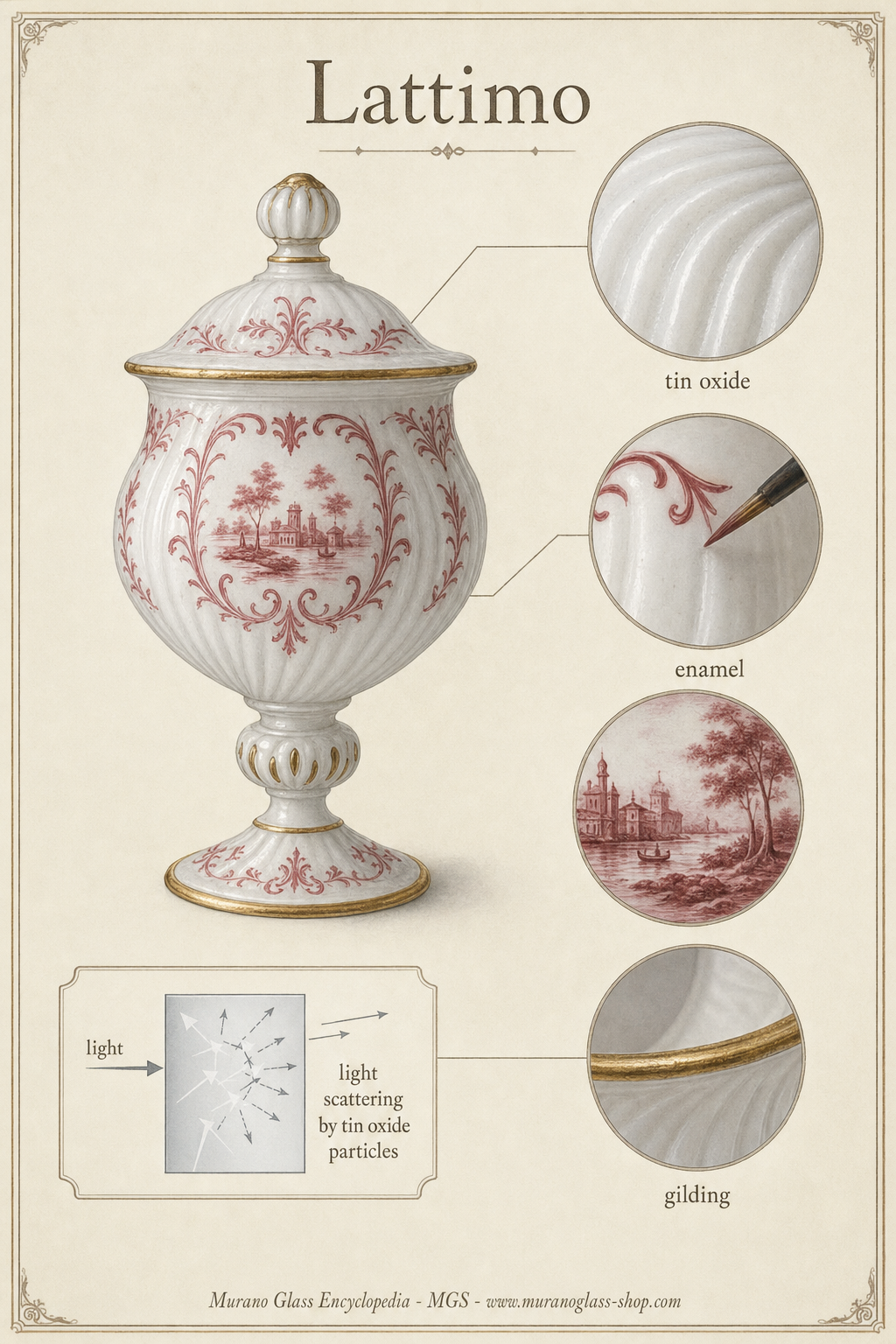
Lattimo is an opaque white glass whose milky appearance made it one of the most distinctive materials of Venetian and European decorative glass. Closely linked to Murano, it became especially valued between the late seventeenth and eighteenth centuries, when glassmakers used it as a luminous substitute for porcelain and as a ground for enamel painting.
Definition and material character
Lattimo is a white, opaque glass with a soft, porcelain-like surface effect. Its name is connected with the Italian word latte, meaning milk, and refers to the dense milky colour obtained inside the glass itself rather than by applying an external coating.
Technically, lattimo belongs to the family of opacified glasses. In many historical recipes the opacity was produced with tin oxide, a material also used to make the white tin glaze of maiolica. The opacifying particles disperse light through the body of the glass, creating an even whiteness that differs from transparent colourless glass, from painted glass and from ceramic glaze.
Historical context
Opaque white glass was not invented from nothing in the Renaissance. Roman glassmakers had already used white opaque glass, generally for details, applied trails, inlays or decorative elements combined with transparent glass. The production of entire vessels in a stable, attractive white glass became much more important in Venice, where successful experiments are recorded in the fifteenth century.
The Venetian development of lattimo belongs to the broader technical culture of Murano glassmaking. In the same period, Venetian glasshouses refined clear cristallo, coloured glasses and complex decorative processes. Lattimo added a different visual language: instead of transparency and brilliance, it offered opacity, softness and a ceramic-like surface suitable for painted decoration.
Techniques
The base glass was still a glass, not porcelain: its structure depended on a silica-based melt with fluxes and stabilising components, while the white effect came from dispersed opacifying compounds. Tin oxide was especially important because it remains finely divided in the glass and scatters light. This is why lattimo appears white throughout the material rather than merely white on the surface.
Glassmakers could blow, shape and finish lattimo much as they did other hot glass, but its opacity changed the visual result. Thin walls could look creamy and delicate, while thicker parts appeared denser. Enamel colours and gold decoration stood out clearly against the white ground, an effect that explains the popularity of lattimo for small luxury objects.
Decoration and eighteenth-century taste
From the end of the seventeenth century and throughout the eighteenth century, lattimo became fashionable as a glass response to porcelain. European collectors admired Chinese porcelain, and later European porcelain factories also shaped taste. Lattimo could not reproduce the ceramic material itself, but it offered a comparable white field for painted subjects.
Typical decorations included enamel scenes inspired by Watteau and the fêtes galantes, mythological subjects, chinoiseries, Venetian views and rococo ornament. In Venice, pieces were sometimes enriched with gilding and with red monochrome enamel decoration, known as en camaïeu, which created a refined tonal image on the white surface.
Geography of production
Although strongly associated with Venice and Murano, lattimo was not limited to the lagoon. Historical production is documented or recorded in Germany, Bohemia, France, England, Spain and China. The names used in different countries reveal the same visual idea: Milchglas in German, verre de lait in French and opaque white glass in English.
The movement of objects and technical knowledge across Europe was essential. Venetian glass served as both model and commodity, while local workshops adapted opaque white glass to their own forms, markets and decorative habits.
Relationship with Murano glass
Lattimo is one of the glass types that show the versatility of Murano production. Murano is often associated with transparency, brilliance and coloured glass, yet lattimo demonstrates that Venetian glassmakers also mastered controlled opacity. The material allowed them to compete visually with porcelain while remaining within the traditions of furnace glass.
Its importance is also cultural. Lattimo connected Murano glass to the eighteenth-century taste for exoticism, domestic luxury, painted surfaces and collectible small objects. It bridged the worlds of glass, ceramics and enamel painting without ceasing to be recognisably glass.
England and small luxury objects
A documented English connection dates to 1667, when the first lattimo pieces reached England from Venice through an order by John Greene. In the eighteenth century, England produced many small objects in opaque white glass, especially snuff bottles and scent bottles. These objects suited the material particularly well: they were portable, decorative and often intended for personal use or fashionable display.
Legacy
Lattimo occupies an important place in the history of European glass because it altered the expected relationship between glass and light. Rather than celebrating transparency, it used glass as a white pictorial support. Later opaque and opaline glasses developed in related contexts, although their compositions, dates and aesthetic aims were not always identical to Venetian lattimo.
Today the term is used in art history, collecting and glassmaking to identify a specific opaque white glass tradition, especially when discussing Venetian and Murano works of the Renaissance and the eighteenth century.
Historical documented curiosities
- The same tin-based principle that made lattimo white also made maiolica glaze white.
- Roman precedents usually used opaque white glass as a decorative addition rather than for complete objects.
- The international names Milchglas, verre de lait and opaque white glass all preserve the idea of a milk-like appearance.
- In eighteenth-century Venice, lattimo could be decorated with red monochrome enamel and gilding, creating a refined contrast with the white body.
FAQ
What is lattimo glass?
Lattimo is an opaque white glass with a milky, porcelain-like appearance, historically associated especially with Venice and Murano.
How was lattimo made white?
Historical lattimo was commonly opacified with tin oxide, which scatters light inside the glass and produces a white body.
Is lattimo the same as porcelain?
No. It may resemble porcelain visually, but it is glass. Its opacity comes from the glass composition and opacifying agents, not from ceramic clay.
When was lattimo most popular?
It became especially fashionable from the late seventeenth century and during the eighteenth century, often as a glass alternative to porcelain.