

Glassblowing is the technique of shaping hot glass by introducing air through a hollow metal tube. Developed in the eastern Mediterranean in antiquity, it transformed glass from a labor-intensive luxury material into one of the most versatile media of Roman, Venetian and modern glassmaking.
Definition and principle
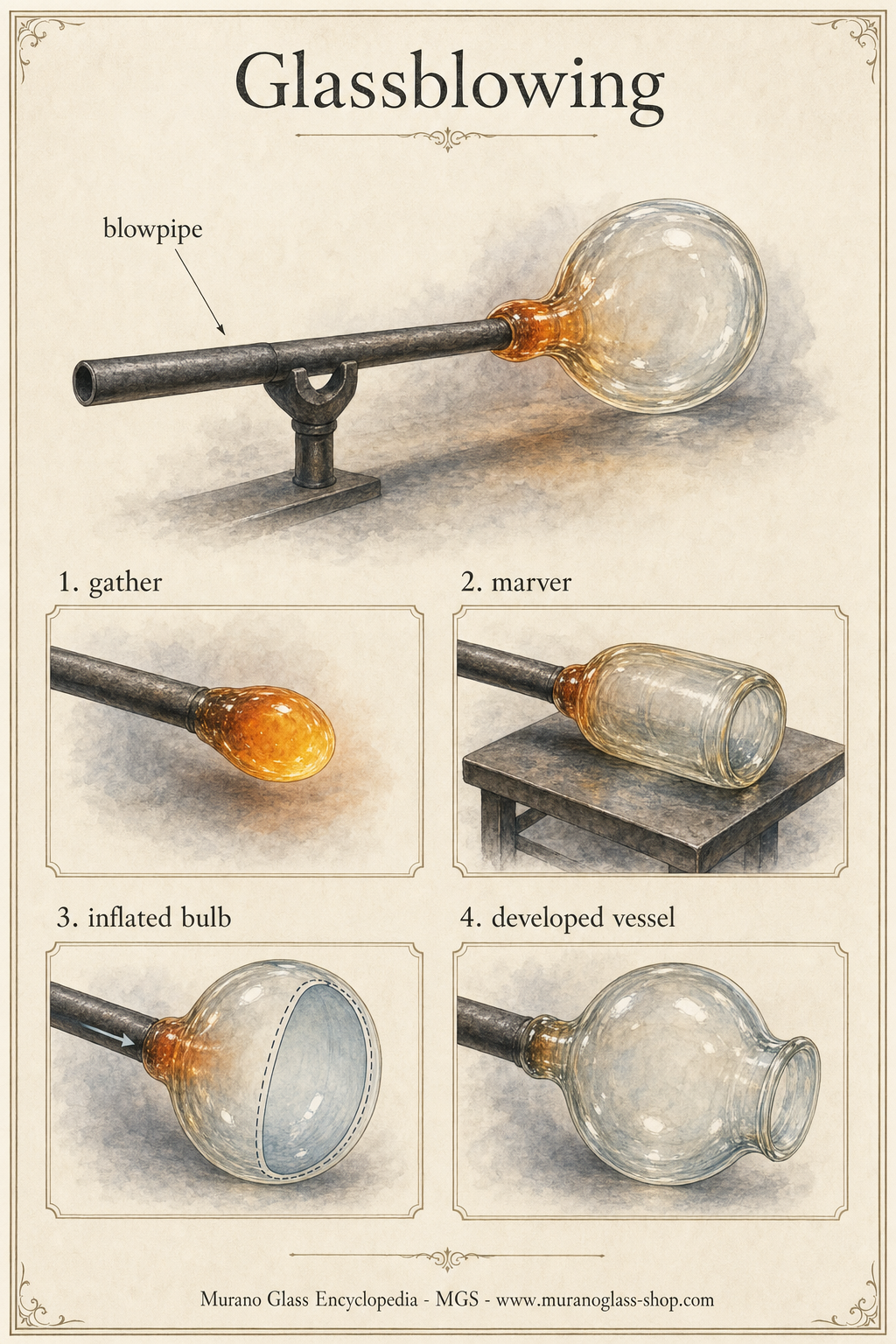
Glassblowing forms a vessel or hollow object from molten glass by expanding it with breath or controlled air pressure. A gather of viscous glass is collected from a furnace or crucible on the end of a blowpipe. While the material remains hot and plastic, the maker rotates, reheats, inflates and works it with tools until the desired volume, thickness and outline are reached.
The method depends on the physical behavior of glass at high temperature: it is not a crystalline solid, but an amorphous material that softens gradually. This allows it to be stretched, compressed and inflated within a working range before it stiffens on cooling.
Historical context
The invention of glassblowing is generally associated with the Syro-Palestinian or eastern Mediterranean region in the first century BCE. Earlier glass vessels were commonly made by core-forming, casting, cutting or assembling mosaic sections; these methods could produce refined objects, but they were slower and less suited to thin-walled hollow forms.
Under the Roman Empire, blown glass spread rapidly through trade and workshop networks. The technique made cups, bottles, flasks and storage vessels easier to produce in large numbers, widening the social use of glass. Mold-blown vessels, some with inscriptions or decorative reliefs, also became common in the early imperial period.
Tools and working sequence
The essential tool is the blowpipe, a hollow metal tube used both to carry the gather and to deliver air into it. The hot glass is usually rolled on a smooth metal or stone working surface, often called a marver, to center it, cool the outer skin slightly and create a regular cylindrical or rounded form. Repeated heating restores malleability as the piece is enlarged or reshaped.
- Gathering: molten glass is collected from the furnace on the pipe.
- Marvering: the gather is rolled to even out temperature, axis and surface.
- Inflation: air expands the glass into a bubble.
- Shaping: tools such as jacks, paddles, shears and wet newspaper may be used while the glass is rotated.
- Transfer: many vessels are moved to a pontil rod so the mouth, rim or foot can be finished.
- Annealing: the object is cooled slowly in an annealing oven to reduce internal stress.
Main techniques
Free-blowing
In free-blowing, the maker shapes the object without a mold, relying on rotation, gravity, breath, reheating and hand tools. This method allows great variation in contour and is central to artistic glass.
Mold-blowing
In mold-blowing, the inflated glass is pressed by air against the interior of a mold. It can reproduce relief decoration, repeated profiles or standardized dimensions. Ancient Roman mold-blown glass is an important archaeological category.
Overlay, color and decorative work
Blowing can be combined with colored glass, trails, filigrana canes, murrine, incalmo joins and surface manipulation. These are distinct operations, but they depend on the same control of heat, viscosity and timing.
Relationship with Murano glass
Murano glassmaking made glassblowing one of its central workshop skills. After Venetian glass furnaces were concentrated on Murano in the late thirteenth century, the island developed an exceptional specialization in furnace work. Blown forms became essential to tableware, lamps, mirrors, beads and later artistic objects. Renaissance innovations such as very clear cristallo, associated with Venetian practice in the fifteenth century, relied on refined furnace control and expert blowing.
Murano masters are historically known for combining blowing with hot-applied ornament, thin walls, cane work and complex color effects. The technique remains fundamental to contemporary Murano production, even when combined with design, sculpture or limited-edition art glass.
Technical considerations
Common historic soda-lime glass is based on silica as the main network former, with alkali fluxes such as soda lowering the melting temperature and calcium compounds helping stabilize the glass. The exact recipes changed by place and period. For the glassblower, the workable interval, viscosity, reheating behavior and compatibility of colors are as important as the nominal recipe.
Influence and legacy
Glassblowing changed the history of material culture. It enabled transparent containers, scientific apparatus, lighting components, tableware and artistic vessels on a scale that earlier methods could not easily support. Modern studio glass, industrial lampworking and many laboratory techniques still depend on principles established by ancient furnace workers: controlled heat, rotation and the inflation of a hot glass bubble.
FAQ
When was glassblowing invented?
It is generally dated to the first century BCE in the eastern Mediterranean, often linked to the Syro-Palestinian region.
What is a blowpipe?
A blowpipe is a hollow metal tube used to gather hot glass and introduce air into it, expanding the material into a bubble.
What is the difference between free-blowing and mold-blowing?
Free-blowing shapes glass without a mold, while mold-blowing expands the glass against a mold to obtain repeated forms or relief decoration.
Why is annealing necessary?
Annealing cools the finished object slowly, reducing internal stresses that could otherwise cause cracking or breakage.