Metal oxides are among the most important materials used to colour glass and to produce enamel decorations fired onto its surface. Their effects depend not only on the metal itself, but also on the glass composition, furnace atmosphere, temperature and purity of the batch.
Definition and scope
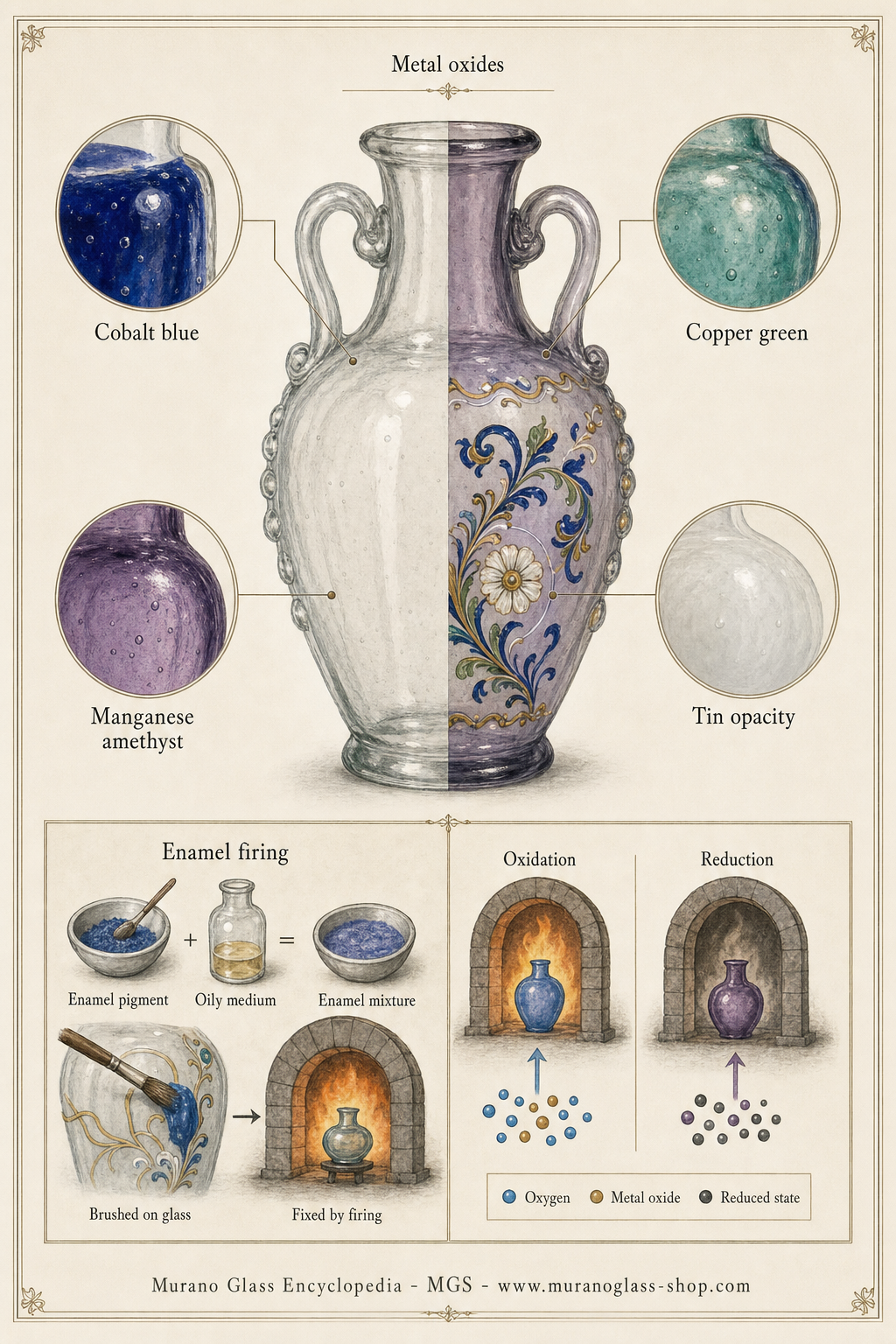
In glassmaking, a metal oxide is introduced into the batch or into a decorative enamel to modify the optical appearance of the finished object. When the oxide is melted with the glass, it colours the whole glass body. When it is incorporated into an enamel, it becomes part of a finely ground, fusible coloured glass that is painted on the surface and fixed by firing.
The same metal can give different colours in different circumstances. This is because colour in glass is controlled by the chemical state of the metal ions, their concentration, the base glass composition and the conditions inside the furnace. A reducing atmosphere, in which oxygen is limited, can change the valence state of metals such as copper, iron or manganese and therefore alter the final hue.
Historical context
Colouring glass with mineral compounds is ancient, but the technical refinement of colour recipes became especially significant in medieval and Renaissance glass centres, including Venice and Murano. Glassmakers protected formulas closely because colour was a commercial and artistic asset. The production of transparent coloured glass, opaque white glass, enamelled vessels and patterned rods required precise control of raw materials and firing.
Murano glassmakers became famous not because they used a single unique oxide, but because they combined high-quality base glasses with sophisticated furnace practice. Techniques such as coloured canes, millefiori, lattimo, enamel painting and aventurine glass all depend, in different ways, on controlled interactions between metals, silica-rich glass and heat.
How metal oxides colour glass
Most glass is based on silica, with fluxes that lower the melting temperature and stabilizers that make the glass durable. Colourants are added in comparatively small amounts. Transition metals are particularly effective because their electrons absorb selected wavelengths of visible light.
- Cobalt is one of the strongest blue colourants; even small quantities can create an intense blue.
- Copper can produce blue-green and green tones in oxidising conditions, while special reducing conditions can contribute to red glass through copper particles or compounds.
- Iron is common as an impurity and as a deliberate colourant; it can give green, blue-green, yellowish or amber-brown effects depending on oxidation state and composition.
- Manganese can produce violet or purple tones and has also been used historically to counteract greenish tints caused by iron.
- Chromium is associated with strong greens, although its effect varies with the glass matrix.
- Nickel may give grey, violet, brown or smoky tones depending on formulation.
- Gold, when correctly dispersed, is famous for ruby and cranberry red glasses.
- Silver can create yellow staining effects, especially when it diffuses into the surface during firing.
- Selenium is used in modern red and orange glasses, often with cadmium compounds in industrial practice; historical use depends on period and availability.
- Uranium was used historically for yellow-green glass and is known for fluorescence under ultraviolet light; modern use is restricted and highly regulated in many contexts.
- Titanium can influence opacity, colour and crystallisation effects in some glass compositions.
Enamel colours on glass
Enamelling differs from through-colouring. The colour is not normally mixed into the entire vessel; it is applied to the surface as a low-melting glassy mixture. The coloured enamel is commonly made from finely powdered glass, fluxes and metal oxides. Before firing, it is suspended in a liquid medium so that it can be brushed, drawn or painted with control.
After decoration, the object is heated to a temperature high enough to fuse the enamel to the surface but low enough to avoid deforming the vessel. The firing step is essential: the visual colour seen after firing may differ from the unfired paint because the oxide becomes incorporated into a glassy layer and undergoes chemical changes.
Opacity and the role of tin oxide
Not all oxide additions are intended primarily to create hue. Tin oxide has long been used as an opacifier: dispersed particles scatter light and make the glass appear white or opaque. In the Venetian and Murano tradition this principle is important for opaque white glass, often known as lattimo, which imitated the appearance of porcelain or milk-white materials.
Other opacifying systems exist, including antimony-bearing compounds in certain historical glasses, but the effect depends on the formation and distribution of small crystals or particles within the glass.
Furnace atmosphere and firing control
The final colour of oxide-bearing glass cannot be predicted from the metal name alone. Furnace atmosphere is decisive. In oxidising conditions, oxygen is abundant; in reducing conditions, oxygen is limited and carbonaceous or fuel-rich conditions may remove oxygen from the melt. These differences change metal ions and may produce distinct optical effects.
Temperature and time also matter. Excessive heat can volatilise some components or dissolve particles that are needed for a specific colour. Insufficient heat can leave an enamel underfired, weakly bonded or dull. Skilled glassworkers therefore judge colour as a process, not merely as a recipe.
Relationship with Murano glass
Murano’s reputation rests partly on its mastery of colour. Renaissance enamelled glass, opaque white glass, coloured cane work and later decorative effects all required knowledge of metallic colourants. Cobalt blues, copper greens and reds, manganese purples, gold ruby tones and tin-opacified whites appear within the broader technical vocabulary associated with Venetian and Murano glass.
Aventurine glass, historically associated with Venice and Murano, illustrates the difficulty of controlling metal-rich effects. Its sparkling appearance is produced by tiny metallic copper crystals suspended in the glass. The process requires careful control of composition, cooling and reducing conditions; a slight change can prevent the characteristic glitter from forming.
Technical and historical cautions
Historical terminology can be imprecise. Older recipes may name minerals, ashes or trade materials rather than modern chemical compounds. A manuscript reference to a colour ingredient does not always identify the exact oxide or oxidation state by modern standards. For this reason, museum conservation, archaeometry and experimental reconstruction are important for interpreting historic glass.
Some colourants once used in glassmaking, including uranium compounds and certain selenium or heavy-metal formulations, raise health, environmental or regulatory issues today. Their historical presence should not be taken as a recommendation for contemporary studio practice.
Legacy
The study of metal oxides links craft knowledge with chemistry, conservation and art history. For historians of Murano glass, these materials help explain why two objects made from similar recipes may differ in colour, brilliance or opacity. For conservators, understanding the oxide system can clarify deterioration, restoration choices and safe display conditions.
FAQ
What are metal oxides used for in glass?
They are used to colour the glass body, produce enamel colours for surface decoration, or alter opacity and optical effects.
Why can the same oxide produce different colours?
The colour depends on the base glass, the oxidation state of the metal, temperature, purity of materials and furnace atmosphere.
How is enamel applied to glass?
A coloured fusible mixture is painted onto the surface, often with the help of a liquid medium, and then fired so that it bonds to the glass.
Why is tin oxide important?
Tin oxide is an important opacifier. It scatters light in the glass and can create white or opaque effects, including those associated with lattimo glass.
Are all historical glass colourants still used today?
No. Some materials, such as uranium compounds or certain heavy-metal systems, are restricted or avoided in many modern contexts for safety and regulatory reasons.