
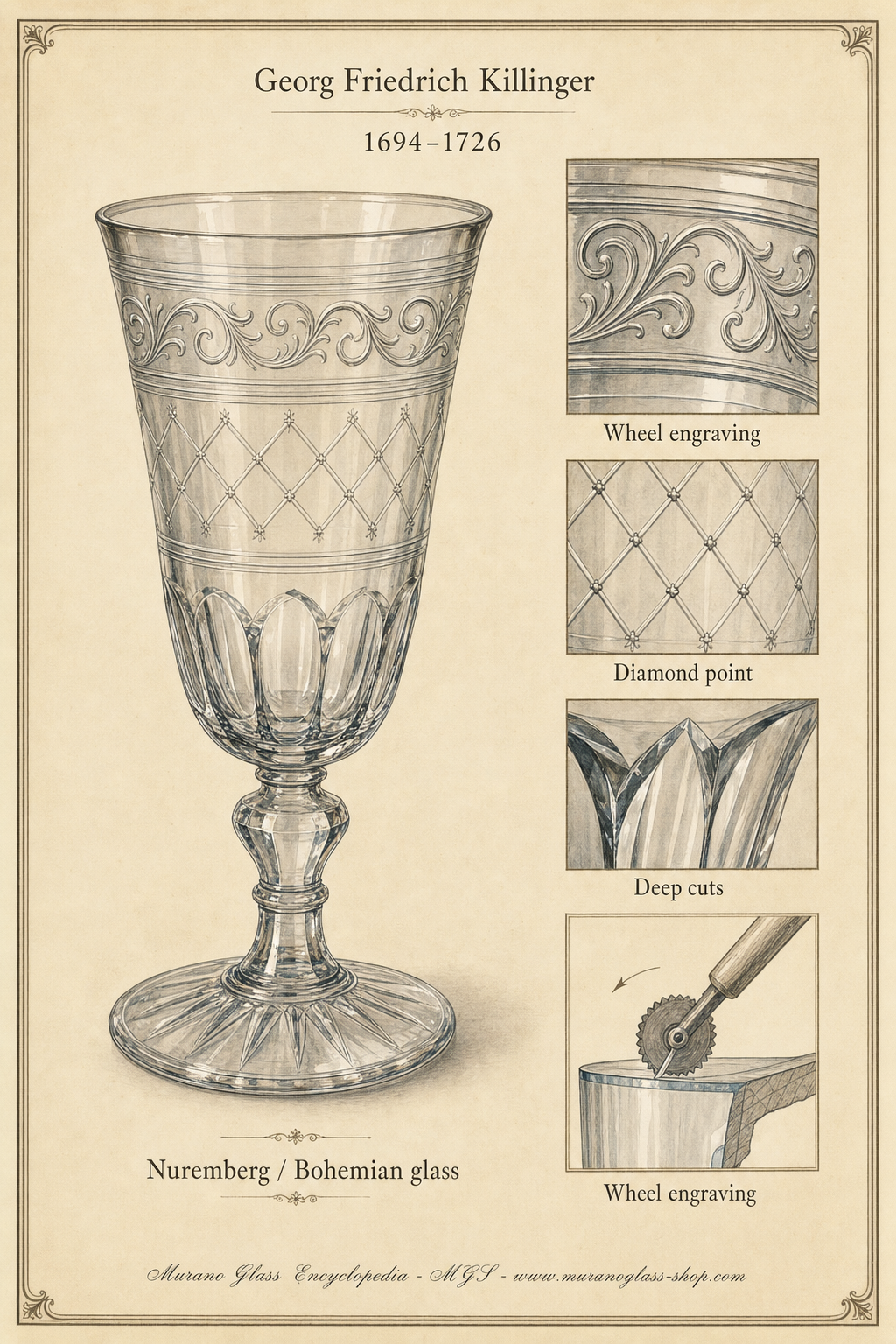
Georg Friedrich Killinger was a glass artist active between 1694 and 1726 in the Nuremberg sphere. He is associated with wheel engraving on Nuremberg and Bohemian drinking glasses, and with the transition from lighter diamond-point work to deeper cutting on harder Bohemian glass.
Historical context
Killinger worked during a period in which Central European glass decoration was becoming increasingly specialized. Nuremberg was an important artistic and commercial centre with a strong tradition of metalwork, engraving and luxury crafts, while Bohemia became renowned for hard, clear potash-lime glass particularly suitable for cutting and wheel engraving.
In the late seventeenth and early eighteenth centuries, engraved glass often imitated the visual language of metal engraving, medals, armorial devices and courtly emblems. The workshop skills required were closer to those of a lapidary or engraver than to those of a furnace glassblower: the form was supplied by the glasshouse, while the decorator transformed the surface through abrasion.
Biography
The documented biographical frame for Georg Friedrich Killinger is limited. He is recorded as active from 1694 to 1726 and is identified with Nuremberg glass engraving. No secure birth or death dates are implied by the activity dates. His name is connected with both local Nuremberg glass and Bohemian blanks, indicating a practice shaped by regional exchange rather than by a single glassmaking centre.
Artistic style
Killinger’s career is commonly understood through a technical progression. His earlier production used Nuremberg glass and combined fine diamond-point incision with wheel work. Later pieces exploited the greater depth and sculptural effect made possible by Bohemian glass, whose hardness and clarity responded well to more pronounced cutting.
This shift reflects a broader Central European preference for relief-like engraving, brilliant facets and deeply abraded ornament. Such work could give drinking vessels a strong play of light and shadow, especially when the surface carried heraldic, ornamental or figural motifs.
Techniques
Diamond point
Diamond-point engraving scratches the glass surface with a hard point. It produces precise, linear marks and is well suited to inscriptions, outlines and delicate ornament. The effect is graphic rather than deeply modeled.
Wheel engraving
Wheel engraving uses rotating abrasive wheels, traditionally of different sizes and profiles, charged with abrasive material. It can create broad cuts, shaded passages, polished hollows and relief-like modeling. On suitable hard glass, the wheel allows the engraver to cut more deeply and to build a richer optical surface.
Bohemian glass and cutting
Bohemian glass of the period is generally associated with potash-lime compositions: silica forms the glass network, potash acts as a flux, and lime contributes stability. Its mechanical properties helped make it a preferred substrate for engraved and cut decoration in Central Europe.
Works and signatures
No universally cited single masterpiece can be assigned here without further documentary specification. The secure facts are that Killinger decorated drinking glasses from Nuremberg and Bohemia and that some surviving pieces bear signatures. Signed examples are especially valuable to historians because many engraved glasses of the period are anonymous or only attributed by style, technique and provenance.
Relationship with Murano glass
Killinger does not belong to the Murano school, and no direct connection with Venetian workshops should be assumed. His importance lies in the Central European tradition of cold working: cutting and engraving finished glass vessels. Murano, by contrast, was historically celebrated for furnace virtuosity, thin blown cristallo, colored glass, filigrana and other hot-glass techniques. The comparison is useful because it shows two different ideals of luxury glass: Venetian lightness and technical brilliance at the furnace, and Bohemian-Nuremberg depth of engraved surface.
Legacy
Killinger represents a moment when engraved glass became a major art form in the German-speaking and Bohemian regions. His documented activity and signed pieces make him a useful reference for the study of early eighteenth-century glass engraving, workshop attribution and the development of deep wheel cutting.
Historical documented curiosities
- His known activity spans the years 1694–1726.
- He worked on both Nuremberg and Bohemian glasses, indicating the circulation of blanks and decorated wares across regional craft networks.
- The presence of signed pieces is notable because many comparable glasses remain anonymous.
FAQ
Who was Georg Friedrich Killinger?
He was a Nuremberg-associated glass engraver active from 1694 to 1726.
What technique is he known for?
He is known for wheel engraving and for work that also involved diamond-point incision in his earlier phase.
Did Killinger work with Murano glass?
No direct link with Murano glass is documented in the provided facts. His work belongs to the Central European engraved-glass tradition.