

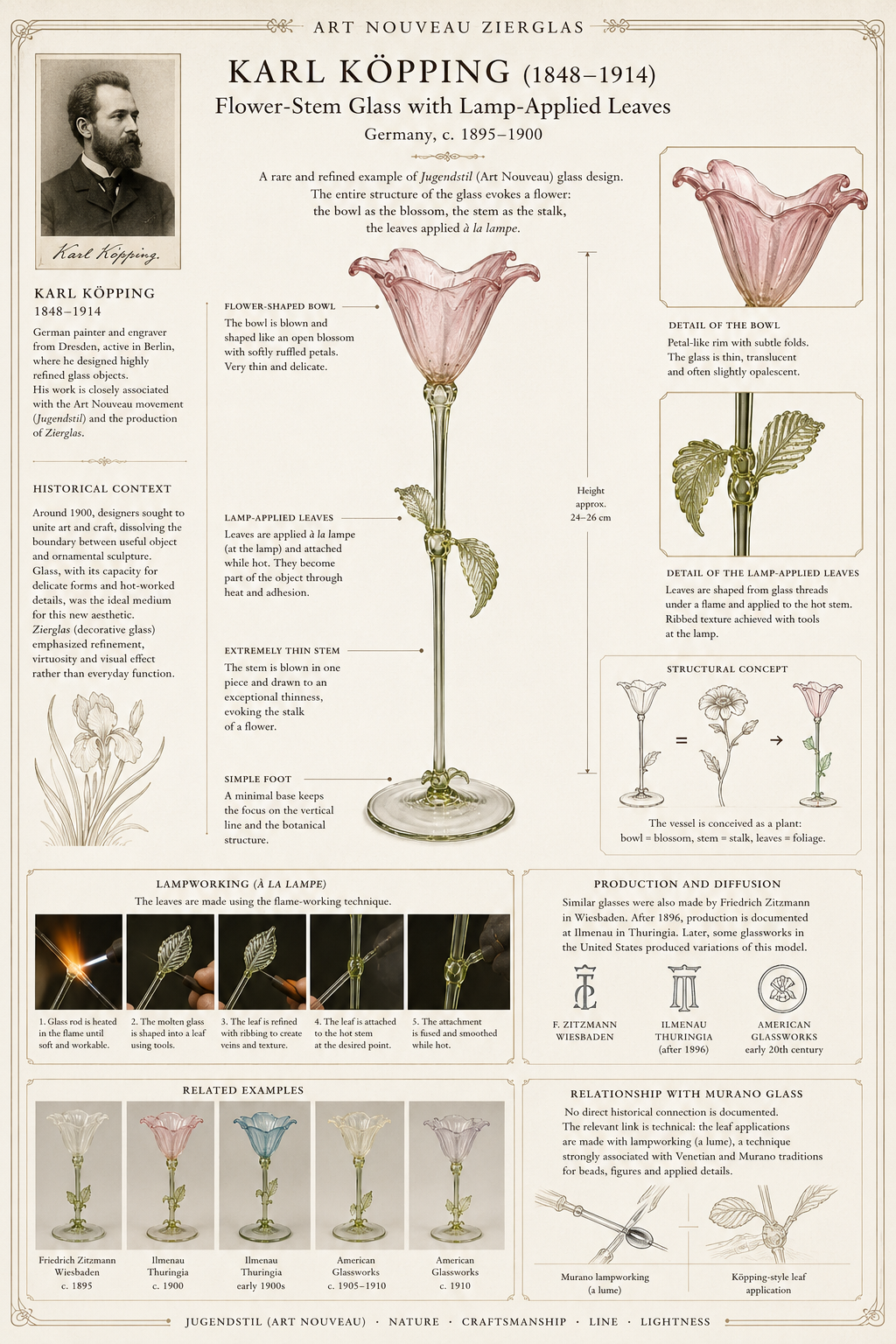
Karl Köpping (1848–1914) was a German painter and engraver from Dresden who became associated with highly refined glass design in Berlin. His name is especially linked with a fragile floral drinking glass, a type of Zierglas, in which the vessel takes on the structure of a flower.
Historical context
Köpping’s glass belongs to the European Art Nouveau moment, known in German-speaking regions as Jugendstil. Around the turn of the twentieth century, designers sought to dissolve the boundary between useful object and ornamental sculpture. Glass was an ideal material for this ambition because it could be blown into thin shells, drawn into long stems, and enriched with small additions applied while hot.
The German term Zierglas indicates decorative or ornamental glass. Such works were not necessarily intended for ordinary table service; they often emphasized virtuosity, refinement and visual effect. Their value lay in the delicacy of the silhouette, the precision of the hot-worked details and the dialogue between craftsmanship and design.
Biography
Karl Köpping was born in Dresden in 1848 and died in 1914. He is recorded as a painter and engraver, and his activity in Berlin included the design of glass objects. This background is significant: an engraver’s sensitivity to line helps explain the linear, attenuated character associated with his most familiar glass designs.
Artistic style
Köpping’s glass designs are associated with an emphatic Art Nouveau language. Instead of relying on heavy mass or dense decoration, they heighten the expressive value of the contour. The best-known example is a very slender glass, probably conceived for a small drink such as liqueur, whose bowl resembles a flower. The stem is not merely a support: it functions visually as the flower stalk, rising in an exceptionally thin and elongated line.
The design is typical of Jugendstil’s fascination with botanical growth, but it is also more radical than a simple floral ornament. The whole structure of the vessel becomes plant-like. The cup, stem and applied leaves form a single image, turning the drinking glass into a miniature floral construction.
Techniques
The documented feature of Köpping’s famous glass is the use of leaf applications made à la lampe, or at the lamp. Lampworking, also called flameworking, uses a flame to soften glass rods, threads or small components so that they can be shaped and attached. In the context of a delicate stemmed glass, this technique allowed small leaves and botanical details to be added without overwhelming the fragile profile.
This should be distinguished from ordinary moulding or cold engraving. Lamp-applied details are hot-worked additions: they become part of the object through heat and adhesion while the glass is workable. The technical challenge is considerable, because long thin stems and small attachments are prone to distortion, thermal stress and breakage.
Major work: the flower-stem glass
Köpping’s most noted creation is a light, narrow, elevated glass classified as Zierglas. Its distinctive features are a blossom-shaped bowl, an extremely thin high stem conceived as the flower stalk, and applied leaves made at the lamp. The object has sometimes been described as possibly intended for liqueur, though the precise function is less certain than its decorative identity.
The importance of the design lies in the fusion of function, line and natural imagery. It is not simply a glass decorated with flowers; it is a glass reimagined as a flower. This makes it a strong example of Art Nouveau’s preference for organic form and continuous line.
Related makers and production
The same type of floral glass was also made by Friedrich Zitzmann in Wiesbaden. After 1896, production is documented at Ilmenau in Thuringia, a region known for technical glass activity. Later examples were made by some glassworks in the United States. These later productions show that the model circulated beyond a single workshop or city.
The spread of the type also illustrates how a design could move between artistic conception and specialized manufacture. In such delicate glass, the final object depended not only on the designer’s idea but also on the skill of glassworkers capable of managing thin blown forms and flame-applied details.
Relationship with Murano glass
No direct historical connection between Köpping and Murano is established by the available information. The relevant link is technical and comparative rather than biographical. The Italian expression a lume corresponds to lampworking, a practice strongly associated with Venetian and Murano traditions, especially for beads, small figures and applied details. Köpping’s floral glasses, however, should be understood within the German Jugendstil and Zierglas context unless a specific Murano attribution is documented.
Influence and legacy
Köpping’s reputation in glass rests on the capacity to translate Art Nouveau linearity into a demanding glass form. His floral Zierglas belongs to a broader international search for objects that were at once decorative, technically sophisticated and inspired by natural growth. The later making of similar glasses in Wiesbaden, Ilmenau and the United States indicates that the type was admired and reproducible, though always dependent on highly controlled workmanship.
Historical documented curiosities
- The famous glass has been described as perhaps a liqueur glass, but its ornamental character is the most secure classification.
- The plant metaphor is structural: the stem of the vessel is also the stem of the imagined flower.
- The use of lamp-applied leaves made the object a hybrid of blown glass and small-scale flame work.
FAQ
Who was Karl Köpping?
Karl Köpping (1848–1914) was a German painter and engraver from Dresden who worked in Berlin and designed Art Nouveau glass objects.
What is Köpping’s best-known glass design?
He is best known for an extremely slender floral Zierglas, probably a small drinking glass, with a flower-shaped bowl, a very thin stem and lamp-applied leaves.
Was Köpping connected with Murano glass?
No direct documented connection is established. The relevant comparison is technical: the leaf applications were made with lampworking, a technique also important in Venetian and Murano glass traditions.
Who else made this type of glass?
Friedrich Zitzmann made similar glasses in Wiesbaden; after 1896 the type was also produced at Ilmenau in Thuringia and later by some American glassworks.