Venetian cristallo, also called cristallino in Italian sources, is a highly clear, colourless soda glass associated with Murano glassmaking and the technical innovations of the fifteenth century. It should not be confused with later lead crystal or Bohemian potash glass.
Definition
Venetian cristallo is a transparent, colourless soda-lime glass developed for refined blown forms rather than for heavy cutting. Its name evokes rock crystal, but it is a glassy material produced by melting silica with alkaline fluxes and stabilising components, not a natural mineral. In historical usage, the term refers especially to the exceptionally clear glass made by Venetian and Murano glassmakers from the mid-fifteenth century onward.
Historical context
The development of cristallo belongs to the period in which Venice was one of Europe’s leading centres for luxury glass. Glass furnaces had been concentrated on Murano since the late thirteenth century, a measure that also helped protect specialised knowledge. By the fifteenth century, Murano masters were supplying courts, churches and urban elites with drinking vessels, reliquaries, lamps and decorative objects distinguished by lightness and technical virtuosity.
The invention or perfection of cristallo is generally attributed to Angelo Barovier, a celebrated Murano glassmaker active in the mid-fifteenth century. The exact workshop sequence behind the discovery cannot be reconstructed in every detail, but art-historical tradition links Barovier with the creation of a remarkably clear Venetian glass that transformed European taste. Its success depended not on a single ingredient alone, but on the careful control of raw materials and furnace practice.
Materials and composition
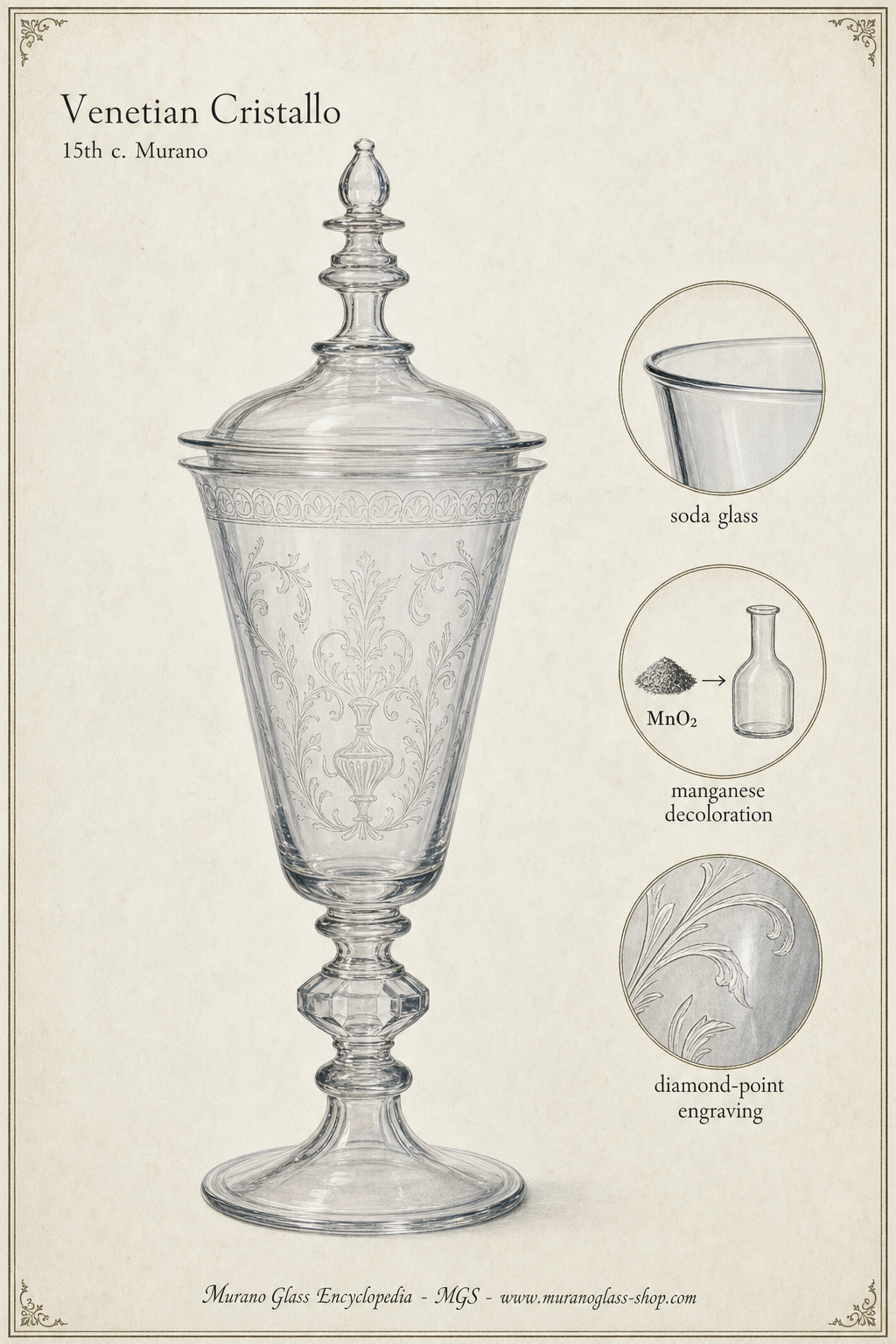
Cristallo was a soda glass. In simplified terms, silica formed the glass network, soda-rich ash acted as a flux by lowering the melting temperature, and lime and related oxides helped stabilise the material against water attack. The Venetian achievement lay in reducing impurities that would otherwise tint the melt green, brown or grey.
Historical recipes and technical practice point to two key operations: purification of the alkaline ash used as a flux and decolourising with manganese compounds. Manganese could counteract the greenish hue caused by iron impurities when used in suitable proportions. Too much, however, could introduce purple or amethyst tones, so the operation required experience and close observation of the melt.
Techniques
Cristallo was well suited to demanding hot-working. Its clarity and workability encouraged thin walls, balanced proportions, applied stems, handles, trails, wings, finials and other elaborate details made at the furnace. The material also lent itself to diamond-point engraving, a delicate cold technique in which a hard point scratches fine linear decoration into the surface.
By contrast, Venetian cristallo was not ideal for deep cutting, wheel engraving or heavy grinding. Its prestige was based on transparency, lightness and blown complexity rather than on the brilliance produced by faceted surfaces. This distinction is essential: later lead crystal can be cut deeply because its composition and optical behaviour differ markedly from Venetian soda glass.
Comparison with later crystal traditions
English lead crystal, associated with developments of the late seventeenth century, contains lead oxide, which increases density, refractive index and suitability for cutting. Bohemian potash-lime glass, which became important later in central Europe, used a different alkaline base and was also valued for cutting and engraving. Venetian cristallo predates these traditions and represents a different aesthetic: thin, lucid, precisely blown and often enhanced by hot-applied ornament or fine surface incision.
Relationship with Murano glass
Cristallo is one of the defining achievements of Murano glass. It demonstrated that Venetian glassmakers could rival the purity associated with rock crystal while exploiting the plastic possibilities of molten glass. The innovation strengthened Murano’s reputation and influenced glasshouses across Europe, many of which tried to imitate Venetian techniques and forms.
Influence and legacy
The success of cristallo helped establish a European fashion for vessels that appeared almost weightless. Venetian-style glass, sometimes called façon de Venise outside Italy, spread through skilled migration, imitation and trade. Although the term crystal later became widely associated with lead glass, Venetian cristallo remains historically distinct: it is the product of soda glass technology, furnace refinement and Murano design intelligence.
Historical documented curiosities
- The term cristallo was chosen because the best examples aspired to the visual purity of rock crystal.
- Its colourlessness depended on purification and decolourising practice, not on the absence of all impurities.
- The same thinness that made cristallo elegant limited its suitability for deep cutting.
- Diamond-point engraving was compatible with cristallo because it required shallow surface lines rather than the removal of large amounts of glass.
FAQ
Is Venetian cristallo the same as lead crystal?
No. Venetian cristallo is a clear soda glass, while lead crystal contains lead oxide and became important much later in England.
Who is associated with the invention of cristallo?
The invention or perfection of cristallo is generally attributed to the Murano master Angelo Barovier in the mid-fifteenth century.
Why was manganese used?
Manganese compounds were used to neutralise unwanted greenish tones caused mainly by iron impurities in the raw materials.
Why is cristallo not usually deeply cut?
Venetian cristallo was typically thin and valued for blown elegance, making it less suitable for deep cutting and heavy grinding than later lead crystal.