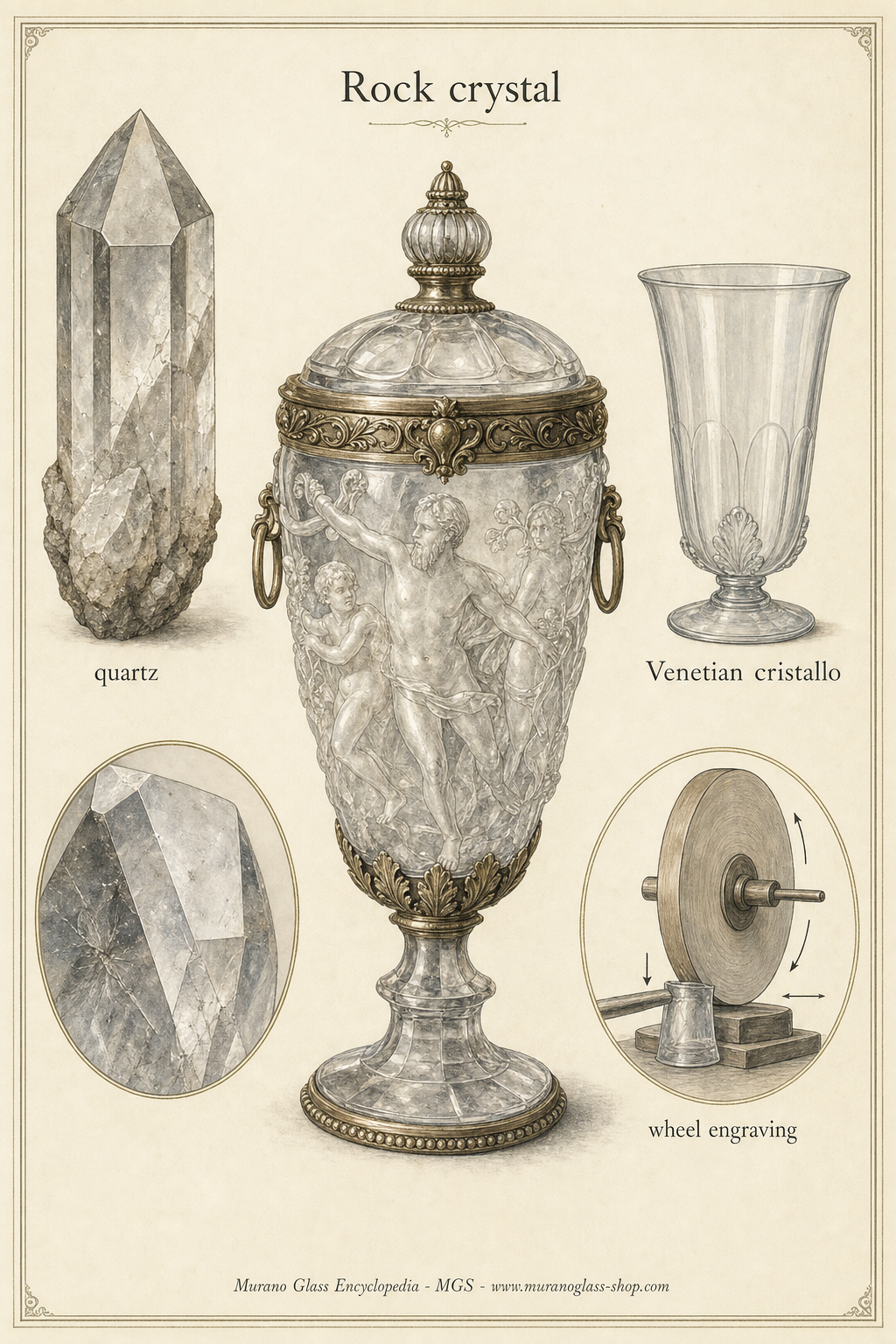
Rock crystal is the colourless to translucent variety of natural quartz, valued for its clarity, hardness and association with luxury objects. Long before modern crystal glass, carved quartz vessels and ornaments provided a technical and visual model for glassmakers in Venice, Bohemia and England.
Material identity
Rock crystal is natural quartz, a crystalline form of silicon dioxide. When it is relatively free from inclusions and colour, it appears transparent or faintly translucent. Its hardness, lustre and ability to take a sharp polish made it suitable for carving, engraving and mounting in precious settings.
The term should not be confused with modern commercial uses of the word crystal. In mineralogy, rock crystal is quartz. In glass history, crystal may refer to several transparent glasses, including Venetian cristallo, Bohemian potash glass and English lead crystal, each with a different composition and working behaviour.
Historical context
Cut and carved rock crystal was known in ancient and medieval luxury production. Objects associated with Egypt, Iraq and Persia helped establish a vocabulary of faceted, polished and hollowed forms that later glassmakers attempted to emulate. Egyptian finds are comparatively scarce, a circumstance often linked to the limited esteem in which the material appears to have been held there when compared with other stones and glassy materials.
During the Renaissance, rock crystal acquired renewed prestige in European courts and princely collections. The material suited the period’s taste for virtuoso carving, precious mounts and objects that combined natural rarity with goldsmiths’ work.
Techniques
Working rock crystal differs fundamentally from shaping molten glass. Quartz cannot be blown or fused in the way glass is worked in a furnace; it is sawn, ground, drilled, carved and polished by abrasion. Its hardness demands durable tools and abrasives, while its brittleness makes fracture a constant risk.
Glassmakers imitated rock crystal by pursuing transparency, colourlessness and brilliance. Cutting and grinding on glass, especially facets and wheel-engraved decoration, developed in dialogue with hardstone practices but required glass compositions capable of withstanding abrasion.
Renaissance precious mounts
Benvenuto Cellini, active in the sixteenth century, is among the artists associated with rock-crystal objects mounted in precious metals. Such works belonged to the sphere of courtly display: the transparent body of the quartz and the richness of gold, enamel or other metals formed a deliberate contrast between mineral purity and human craftsmanship.
Bohemia and wheel engraving
In Central Europe, especially in Bohemia, the technical bridge between hardstone carving and glass engraving became particularly important. Caspar Lehmann, active around the turn of the seventeenth century, is credited with introducing or decisively advancing wheel engraving first on hard stones and then on glass. This development favoured potash-based glass, whose working qualities could be more suitable for cutting and engraving than the delicate soda glass associated with Venice.
Relationship with Murano glass
The Venetian word cristallo was adopted for a highly refined, colourless glass whose appearance recalled rock crystal. Murano glassmakers used manganese compounds to counteract unwanted tints caused by iron impurities, producing a clear glass admired for its lightness and purity. This Venetian cristallo was a milestone in European glassmaking, but it was not the same substance as quartz and did not behave like it under tools.
Venetian cristallo was primarily celebrated for thin blown forms, elegance and clarity. Its relative fragility limited the extent to which it could be engraved or cut like rock crystal. Later northern European traditions, especially Bohemian and English developments, placed greater emphasis on heavy bodies suitable for faceting, cutting and wheel engraving.
England and Ravenscroft
In 1674, George Ravenscroft obtained a patent in England for the production of a crystalline glass intended to resemble rock crystal. His work is central to the history of English lead glass, a material prized for brilliance, weight and suitability for cutting. Lead oxide changes the optical and working properties of glass, increasing refractive qualities and helping create the appearance associated with later crystal tableware.
Influence and legacy
Rock crystal shaped European taste in two ways: as a luxury mineral carved into rare objects, and as an ideal of clarity that glassmakers sought to reproduce. The history of transparent glass cannot be separated from this mineral model. Venetian cristallo, Bohemian engraved glass and English lead crystal each translated the prestige of quartz into different materials and techniques.
Names in European languages
- English: rock crystal
- French: cristal de roche
- German: Bergkristall, historically also written in variant forms
- Italian: cristallo di rocca
FAQ
Is rock crystal the same as glass crystal?
No. Rock crystal is natural quartz, while glass crystal is a manufactured glass. The historical link lies in appearance: clear glass was often made to resemble colourless quartz.
Why is rock crystal important for Murano glass?
Murano cristallo took its name from its resemblance to rock crystal. Venetian glassmakers pursued transparency and colourlessness, although their soda glass was not worked like hard quartz.
What did Ravenscroft contribute?
George Ravenscroft received an English patent in 1674 for a crystalline glass resembling rock crystal, an important step in the development of English lead glass.