Reverse glass painting is a decorative technique in which images or ornaments are applied to glass and protected by the transparent support itself. It includes both kiln-fixed colours and unfired paints placed on the back of a sheet or inside an object.
Definition and terminology
Reverse glass painting is the practice of decorating glass with pigments, enamels or other colouring materials so that the finished image is viewed through the glass. In English the expression reverse painting is commonly used when the design is executed on the back of a plate or panel. German art history uses Hinterglasmalerei, literally painting behind glass. In French, two expressions occur: verre peint au revers, which is technically precise, and verre églomisé, which is often used more broadly than its strict meaning allows.
The essential feature is the reversal of the normal pictorial order. Details that would be added last on canvas or paper must often be painted first, because they lie closest to the viewer once the glass is turned over. This makes the technique demanding: inscriptions, highlights, facial details and outlines may need to be applied in mirror sequence.
Techniques
Fired colours and enamels
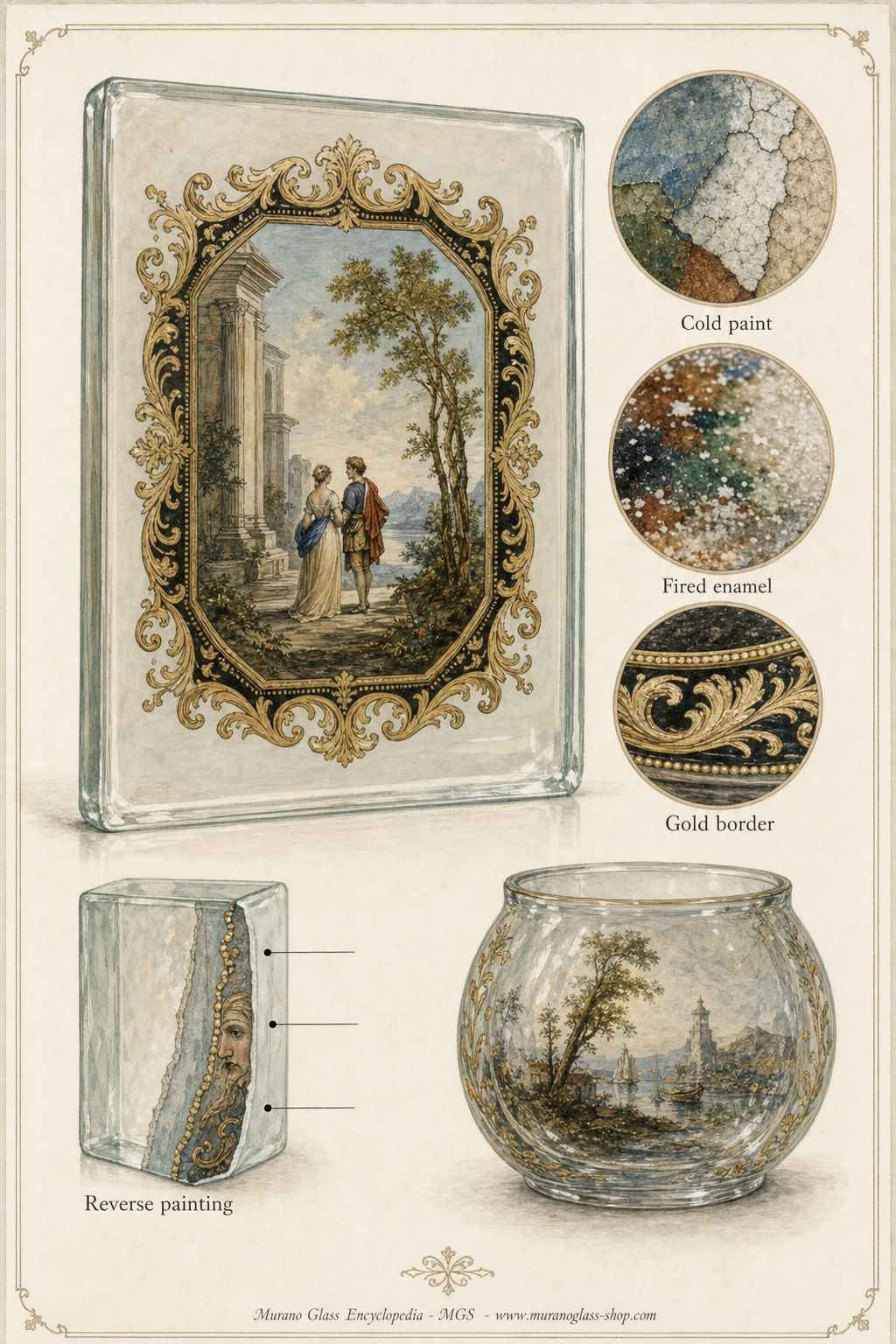
Some painted glass is decorated with vitreous colours or enamels that are made stable by heating. These materials contain finely ground glass or fluxes mixed with colourants and a binder. During firing, the paint fuses sufficiently to adhere to the glass surface. The temperature must be controlled so that the decoration bonds without deforming the object or panel.
Cold painting
Cold-painted decoration is not fixed by kiln firing. It may use paints, varnishes, metallic powders, leaf metal or other binders applied after the glass has been formed. Because these layers are more vulnerable to abrasion and moisture than fired enamel, they are commonly placed on the reverse side of a flat sheet or on the interior surface of a hollow object, where the glass acts as a protective shield.
Order of execution
In reverse painting the artist usually works from foreground to background. Fine lines, small highlights and gilded details are laid down before broader areas of colour. The final background may be added last, although it will appear visually behind the scene when the object is viewed from the front.
Verre églomisé and a frequent confusion
Verre églomisé should not be treated as a simple synonym for every painted image on the reverse of glass. In its narrower historical sense it refers to a decorative glass treatment associated with gilding and black ornament, often used as a protective or ornamental framing element. The term is linked to the Parisian frame maker and dealer Jean-Baptiste Glomy, active in the eighteenth century, although the broader practice of gilding and painting behind glass is older.
By the late nineteenth century, the French expression was sometimes applied imprecisely to reverse-painted glass in general. For clarity, verre peint au revers is preferable when describing a painted scene or ornament executed on the back of a glass sheet, while églomisé is best reserved for gilded, black-and-gold or frame-like reverse decoration.
Historical context
Painting on glass has appeared in many contexts: devotional images, domestic pictures, shop signs, clock faces, mirror borders, furniture panels and small luxury objects. Reverse glass painting became especially attractive where bright colour, a glossy surface and inexpensive repetition were valued. The transparent support gives the image luminosity and protects the surface, but it also makes restoration difficult when paint layers detach.
The technique should be distinguished from stained glass painting for windows. Stained glass normally relies on coloured panes, fired tracing, shading and leading for architectural glazing. Reverse glass painting, by contrast, often concerns an independent sheet or object and is intended to be viewed from one principal side through the glass.
Relationship with Murano glass
The technique is relevant to the study of Murano glass because Venetian and Murano workshops supplied high-quality glass objects, mirrors and decorative supports that could receive painted, gilded or enamelled ornament. However, reverse glass painting is not exclusively a Murano invention and should not be attributed to Murano unless a specific object, workshop or document supports that connection.
Murano glassmaking is technically important in this context because the clarity, smoothness and chemical stability of the glass influence the visual effect of painting, gilding and enamelling. On a polished or well-blown surface, even a thin painted layer can appear bright and sharply defined when seen through the glass.
Conservation issues
Fired enamel is generally more resistant than cold paint, but it can still be damaged by impact, excessive cleaning or incompatible previous restoration. Cold-painted reverse decoration is particularly sensitive at edges, cracks and unsealed backs. Flaking, darkened varnish, moisture stains and losses in metallic leaf are common conservation concerns.
Because the apparent image is viewed through the glass, damage may be hidden until the reverse is inspected. Conservation normally avoids aggressive cleaning and favours stable environmental conditions, careful handling and minimal intervention.
Related techniques and movements
- Stained glass painting: architectural glass coloured and shaded with fired paints.
- Glass enamelling: decoration fused to the surface by heat, widely used on vessels and panels.
- Gilding behind glass: application of gold or metal leaf to the reverse, sometimes combined with black paint.
- Mirror decoration: painted, gilded or engraved borders and panels associated with interiors and frames.
FAQ
What is reverse glass painting?
It is a technique in which decoration is applied to glass and viewed through the glass, often from the opposite side of the painted surface.
Why is the image painted in reverse?
Because the viewer sees the design through the glass. Details closest to the viewer must often be painted first, in the opposite order from ordinary painting.
Is verre églomisé the same as reverse glass painting?
Not exactly. The term is often used loosely, but in a stricter sense it refers to gilded or black-and-gold reverse decoration, often connected with framing.
Can reverse glass painting be kiln-fired?
Yes. Some decorations use enamels or vitreous colours fixed by firing; others use cold paints that are not fired.
Is the technique specific to Murano?
No. It is an international glass-decorating technique, although it can appear on Venetian or Murano glass supports and is relevant to their study.