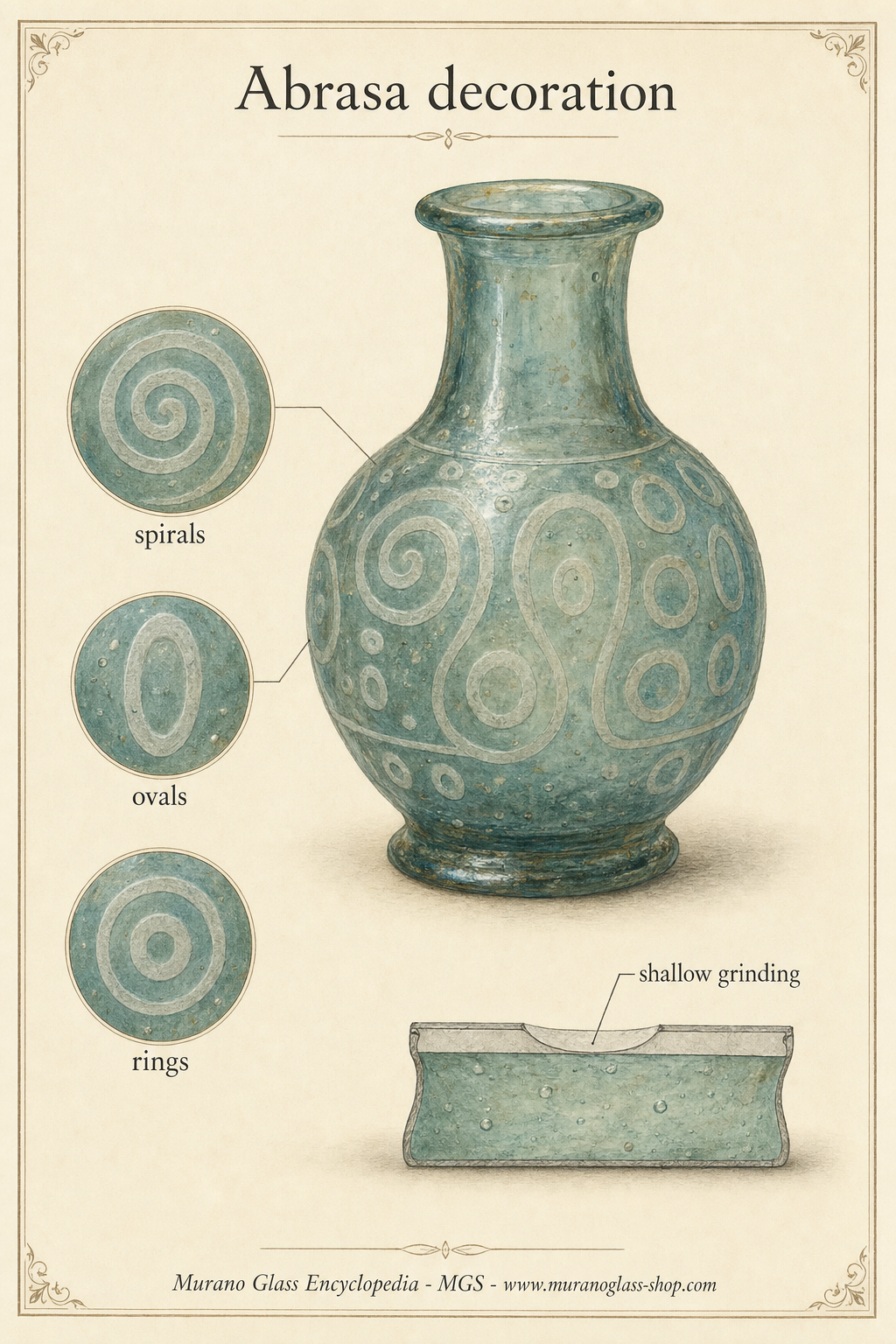
Abrasa decoration is a cold-working glass technique based on shallow surface grinding. It produces curved ornamental marks such as spirals, rings and ovals, and is historically associated with ancient Egyptian and Syrian glass of the 5th–4th centuries BCE and with a later revival in Bohemia during the 18th century.
Definition
Abrasa decoration is a form of surface ornament made by mechanically abrading the exterior of a glass object. Unlike deep cutting or sharply planned faceting, it relies on a relatively quick and shallow grinding action. The resulting design is usually linear or curvilinear rather than architectural: spirals, circular bands, oval reserves and other rounded patterns are typical.
The term is especially useful when describing decoration that is visibly ground into the surface but does not have the crisp geometry, depth or optical precision expected from faceted glass. It belongs to the broader family of cold glassworking techniques, meaning that the glass is shaped or decorated after the object has been formed and cooled.
Historical context
The technique is documented in relation to Egyptian and Syrian glass of the 5th and 4th centuries BCE. In the ancient eastern Mediterranean, glass vessels were valued luxury objects, and surface treatment was one way to enrich small containers, beads and other objects without completely altering their form. Abrasion allowed artisans to create ornamental contrast on the surface by removing a thin layer of glass.
A later historical phase is associated with Bohemia in the 18th century. Bohemian glass workshops became especially important in early modern Europe for cut, engraved and wheel-worked glass. The revival of abrasa decoration fits within this broader interest in mechanically worked surfaces, although abrasa remained distinct from the more elaborate traditions of deep cutting and copper-wheel engraving.
Technique
Abrasa decoration is produced after the glass has been annealed. The artisan brings the object into contact with an abrasive tool, stone or wheel, often with the aid of abrasive powders and water. The abrasive action removes a small amount of material from the surface. The mark may be left satin-like or subsequently softened by polishing, depending on the desired effect.
The key technical features are:
- Surface depth: the grinding is shallow and does not normally create strong relief.
- Speed of execution: it is faster than careful faceting because it does not require the same exact geometric alignment.
- Curved vocabulary: the method is well suited to round and flowing marks such as spirals, circles and ovals.
- Optical effect: the decoration can appear lighter, matte or softly reflective against the surrounding glossy glass.
Comparison with related techniques
Faceting
Faceting cuts flat planes into the glass with controlled angles, creating strong reflections and a jewel-like effect. Abrasa decoration is less exacting: it is shallower, more rapid and usually less geometric.
Engraving
Glass engraving may use small wheels, points or abrasive tools to draw detailed figures, inscriptions or foliage. Abrasa decoration is generally broader and simpler, favoring ornamental curves rather than fine pictorial detail.
Polishing and surface finishing
Polishing can follow grinding, but it is not the same operation. Abrasion removes material to make a design; polishing smooths the abraded zone and changes the way it reflects light.
Artistic character
The visual appeal of abrasa decoration lies in its balance between restraint and movement. Curved motifs can animate a vessel without covering it completely. Because the decoration is made by removing the surface rather than adding pigment, the ornament belongs materially to the glass itself. The contrast is subtle: it depends on light, transparency, thickness and the finish of the abraded area.
Relationship with Murano glass
Abrasa decoration is not a defining technique of Murano glass in the way that filigrana, millefiori, lattimo, aventurine glass or elaborate hot-working traditions are. Its historical milestones are more strongly linked to ancient Egyptian and Syrian glass and to 18th-century Bohemian glass. Nevertheless, it can be discussed within the wider history of glass decoration because Murano, Bohemia and other European centers all developed different answers to the same artistic problem: how to enrich transparent or colored glass after, during or before forming.
In Murano practice, cold working has existed alongside furnace techniques, but the island’s most famous contributions are generally associated with hot manipulation, canes, color effects and refined vessel forms. Abrasa decoration therefore provides a useful point of comparison rather than a central Murano category.
Influence and legacy
The historical importance of abrasa decoration is not based on monumental complexity but on its efficiency and adaptability. It demonstrates how a modest intervention on the surface can change the visual reading of a glass object. Its revival in 18th-century Bohemia also shows the continuing appeal of ancient-looking and mechanically worked surfaces at a time when European glassmakers were expanding the expressive possibilities of cutting and engraving.
Historical documented curiosities
- The same broad family of abrasive techniques could serve both practical finishing and decoration; the difference lies in intention and placement.
- Curvilinear motifs were particularly suitable because a rotating wheel or rounded abrasive could naturally produce arcs and circles.
- The technique helps historians distinguish between shallow ornamental grinding and more labor-intensive faceted cutting.
FAQ
What is abrasa decoration?
It is a shallow glass surface-grinding technique used to create ornamental marks, especially curved motifs such as spirals, circles and ovals.
How is it different from faceting?
Faceting creates precise flat planes and strong optical effects. Abrasa decoration is quicker, shallower and less geometrically exact.
Where was abrasa decoration used historically?
It is associated with Egyptian and Syrian glass of the 5th–4th centuries BCE and was later revived in Bohemia in the 18th century.
Is abrasa a Murano technique?
It is not one of the characteristic Murano techniques. It is better understood as a broader cold-working method, with stronger historical links to ancient eastern Mediterranean glass and Bohemian glass.