
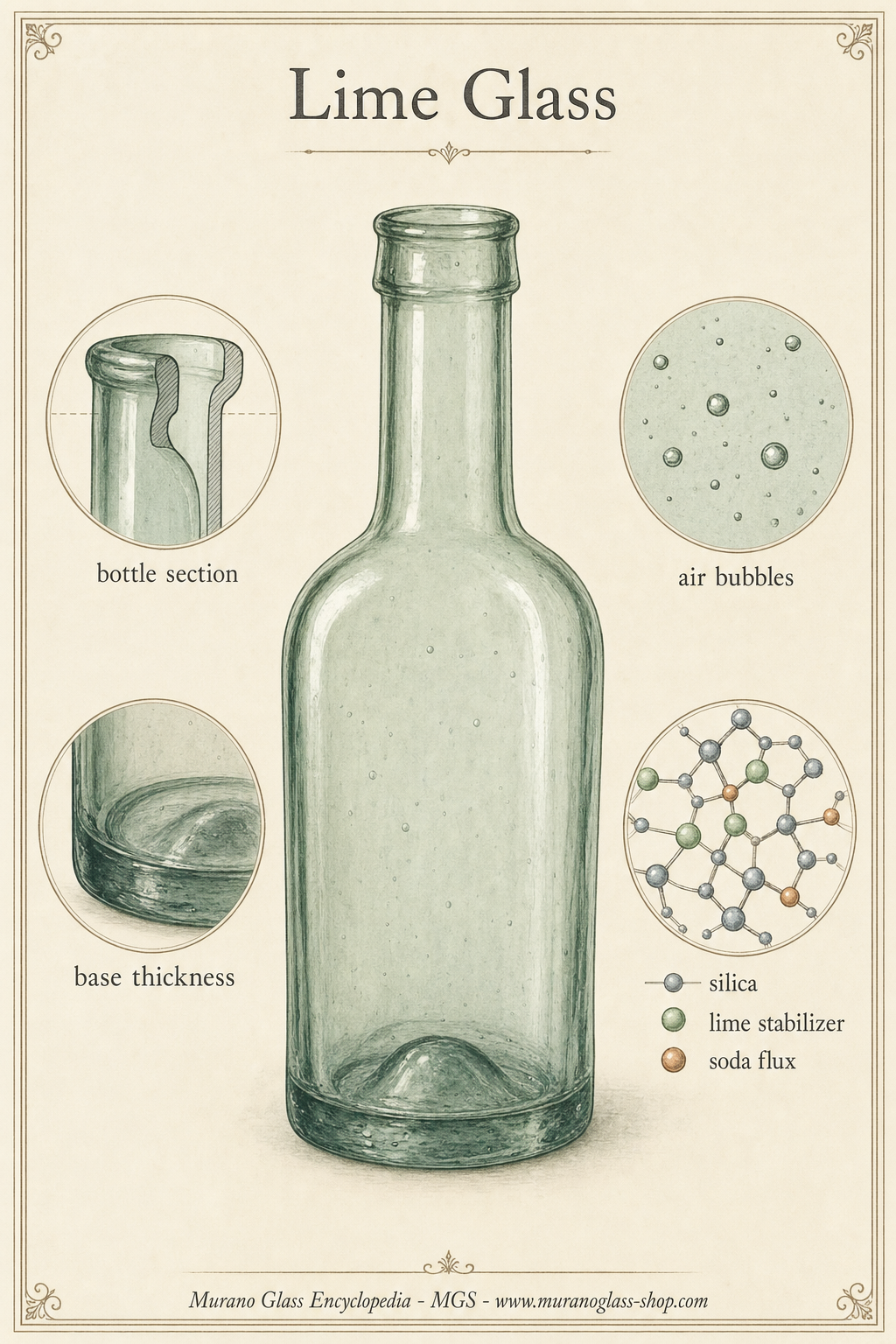
Lime glass is a historical and technical name for glass in which lime acts as a stabilizing component in a silica-based composition. In common modern terminology it often corresponds to soda-lime glass, the family used for many bottles, window panes and everyday vessels.
Definition and terminology
The expression lime glass may be translated as vetro calcico in Italian, but the term requires care. Lime is not normally the main ingredient of this glass. The structural basis is silica, usually supplied by sand; alkali fluxes such as soda or potash lower the melting temperature; lime, chemically calcium oxide derived from limestone or similar sources, helps stabilize the glass network and improves resistance to water compared with a simple alkali silicate glass.
In present-day technical language, the broad industrial family is usually called soda-lime glass. Historical usage is less uniform: older sources may emphasize the presence of lime because it distinguished the material from lead glass, in which lead oxide contributes density, brilliance and acoustic resonance.
Historical context
A documented historical attribution links a type of lime glass to William Leighton, who produced it in 1864 at a glassworks in Wheeling. Some older references describe the location as Virginia; in modern geography Wheeling is in West Virginia, a state created in 1863, so the wording depends on the historical source being cited.
The reported aim was practical rather than decorative: Leighton sought a less expensive alternative to lead glass for bottle manufacture. The result was described as cheaper, lighter, faster to cool in production, and less resonant than lead-containing glass. These characteristics made it better aligned with utilitarian container production than with luxury table glass or cut crystal.
Technical composition
Lime glass belongs to the family of silicate glasses. Its typical components can be understood by function:
- Silica: the network former that gives the glass its basic structure.
- Alkali flux: soda or potash reduces the temperature needed for melting and working.
- Lime: a stabilizer that improves chemical durability and reduces the solubility that would affect a glass made only from silica and alkali.
- Minor oxides and impurities: iron and other trace elements can influence colour, especially in bottle glass.
Unlike lead glass, lime glass does not rely on lead oxide for optical weight or brilliance. This difference explains its lower density and the more subdued sound produced when struck.
Manufacture and working properties
In nineteenth-century bottle production, glass was commonly gathered from the furnace and shaped by blowing, often with mould assistance. Lime glass could be used in such workflows because it was suited to repeated production of practical forms. Faster cooling, as noted in historical descriptions, should not be confused with the elimination of annealing: glass still needs controlled cooling to reduce internal stress.
Comparison with lead glass
Lead glass, often associated with crystal tableware, is valued for high refractive index, weight and ringing resonance. Lime glass offers a different balance: lower material cost, lower density and adequate strength for containers. For bottles, these traits could be more important than optical brilliance.
Relationship with Murano glass
The 1864 Wheeling attribution belongs to American industrial glass history, not to Murano. Nevertheless, the chemistry has a useful connection with Venetian glassmaking. Many historic Venetian glasses, including the celebrated cristallo, were alkali-lime silicate glasses rather than lead crystals. Murano’s importance lies in refined furnace practice, purification of raw materials, colouring, filigrana, enamel and lampworking traditions; lime glass as an industrial bottle material should not be treated as a Murano invention.
Legacy
Soda-lime glass became the dominant family for common glass goods because it combines workable melting temperatures, acceptable durability and economical raw materials. The nineteenth-century search for alternatives to lead glass illustrates a broader industrial shift: glass was increasingly optimized for mass production, transport, storage and architectural use, not only for luxury display.
FAQ
Is lime glass the same as soda-lime glass?
In many modern contexts the terms overlap, although historical usage can vary. Soda-lime glass indicates a silicate glass made with alkali fluxes and stabilized with lime.
Why was lime glass used for bottles?
It offered lower cost and lower weight than lead glass while remaining suitable for utilitarian container production.
Is lime the main ingredient?
No. The principal network-forming ingredient is silica. Lime acts mainly as a stabilizer, while soda or another alkali helps the batch melt at a workable temperature.