Lead glass, often called lead crystal, is a silica glass in which lead oxide is used to modify the melt and the finished material. Its historical importance lies not only in its brilliance, but also in the way it encouraged the development of cut crystal in Britain and continental Europe.
Definition and material character
Lead glass is a family of glasses containing a significant proportion of lead oxide, usually introduced in the form of litharge or another lead compound. In historical and commercial usage it is frequently called lead crystal, although it is not crystalline in the mineralogical sense: it remains an amorphous glass.
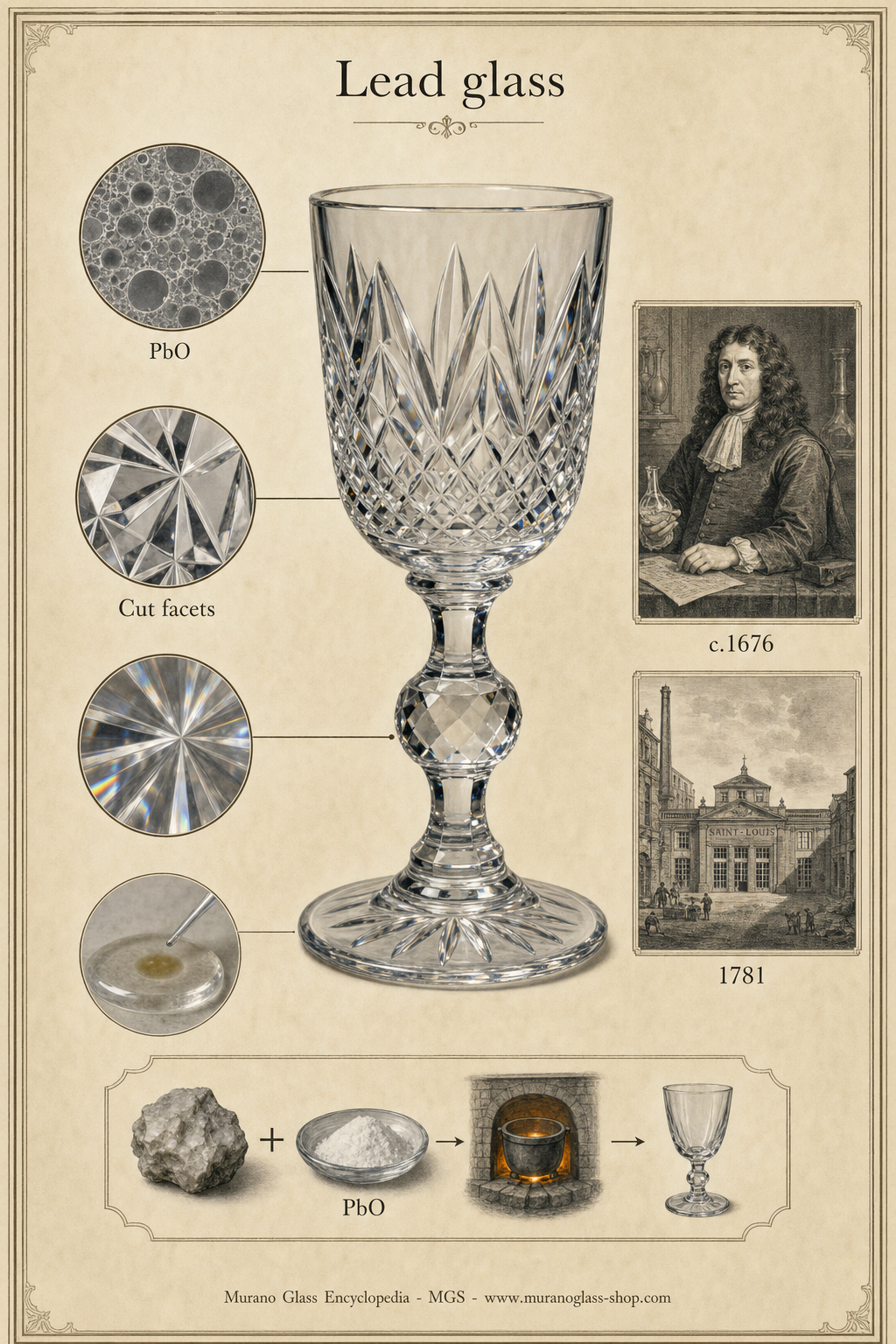
The addition of lead oxide changes several physical properties. It raises the refractive index, gives the material a distinctive weight and sonority, and makes the glass comparatively soft under the wheel. These qualities made lead glass especially suitable for cutting, engraving and polishing. The sharp brilliance associated with eighteenth-century cut crystal depends on both chemistry and workmanship: the composition supplies optical density, while faceting multiplies reflections.
Historical context
Small additions of lead oxide were known long before the early modern period. Before the eleventh century, lead compounds were already used in Mesopotamia and other regions to intensify the appearance of glass, particularly in artificial gems and decorative materials. The decisive change came in seventeenth-century England, when George Ravenscroft developed a lead-rich glass around the 1670s. The source tradition associates this innovation with the attempt to overcome devitrification or instability in glass made in imitation of Venetian cristallo.
Ravenscroft's work helped establish English lead glass as a distinct material. During the eighteenth century, cutting and faceting became central to its visual language. Continental manufacture also adopted comparable formulations; the French glasshouse of Saint-Louis is recorded as having arrived independently at the process in 1781.
Techniques and manufacture
As with other silicate glasses, the structural network is based on silica. Fluxes lower the melting temperature, while stabilizers improve durability. In lead glass, lead oxide acts as a powerful modifier of the glass network and contributes to the high optical density. The exact recipes varied by period, workshop and intended use.
Once blown or cast, lead glass could be wheel-cut. Eighteenth-century cutting used abrasive wheels to create flutes, diamonds, stars and geometric facets, followed by polishing. Because lead glass is less resistant to the wheel than many soda-lime glasses, it permits deep and crisp ornament. The technique shaped the history of table glass, chandeliers, decanters and luxury lighting.
Relationship with Murano glass
Lead glass should be distinguished from the Venetian cristallo associated with Murano. Murano cristallo was a refined soda-lime glass prized for clarity, thinness and virtuoso blowing; its composition did not depend on a high lead oxide content. English lead crystal, by contrast, became famous for mass, brilliance and cut ornament. The two traditions therefore represent different technical ideals: Murano emphasized furnace work, blown elegance and techniques such as filigree, while lead glass encouraged cutting, faceting and optical weight.
Identification and testing
Historically, one chemical test for the presence of lead used a small application of hydrofluoric acid combined with ammonium sulfate. On lead glass, the treated area may darken because lead sulfate forms. Soda glass and barium glass do not produce the same reaction. This test is destructive and hazardous because hydrofluoric acid is extremely dangerous; it belongs in the context of trained laboratory or conservation practice, not casual collecting.
Non-destructive methods used in modern conservation and authentication may include X-ray fluorescence analysis, ultraviolet observation in some contexts and comparison of density, sound and optical behavior. Such methods must be interpreted with caution, because glass recipes can overlap and visual appearance alone is not proof of composition.
Influence and legacy
Lead glass transformed European luxury glass after the late seventeenth century. It supported the rise of cut crystal as a major decorative art, particularly in Britain and France, and influenced the design of drinking vessels, lighting components and optical-looking decorative objects. In modern regulations and trade usage, the term “crystal” may be defined by composition thresholds that vary by jurisdiction; many standards reserve “lead crystal” for glass with a substantial lead oxide content.
Historical documented curiosities
- The English terms lead glass and the rarer glass of lead both refer to this material tradition.
- Lead oxide had decorative uses centuries before Ravenscroft, but the seventeenth-century English development made it central to a durable commercial glass type.
- The brilliance of cut lead crystal is not caused by composition alone; without precise cutting and polishing, the optical effect is greatly reduced.
FAQ
Is lead glass the same as natural crystal?
No. Lead crystal is a glass, not a natural crystal. The word “crystal” is historical and commercial, referring to clarity and brilliance rather than mineral structure.
Why is lead oxide added to glass?
Lead oxide increases optical density, improves brilliance, gives the glass a characteristic weight and makes it well suited to cutting and polishing.
How does lead glass differ from Murano cristallo?
Murano cristallo is a refined soda-lime glass linked to Venetian furnace technique and thin blown forms. Lead glass is richer in lead oxide and became especially associated with cut crystal.
Can collectors test lead glass with acid?
Historical acid tests exist, but they are destructive and dangerous. Hydrofluoric acid should only be handled by qualified professionals under controlled conditions.