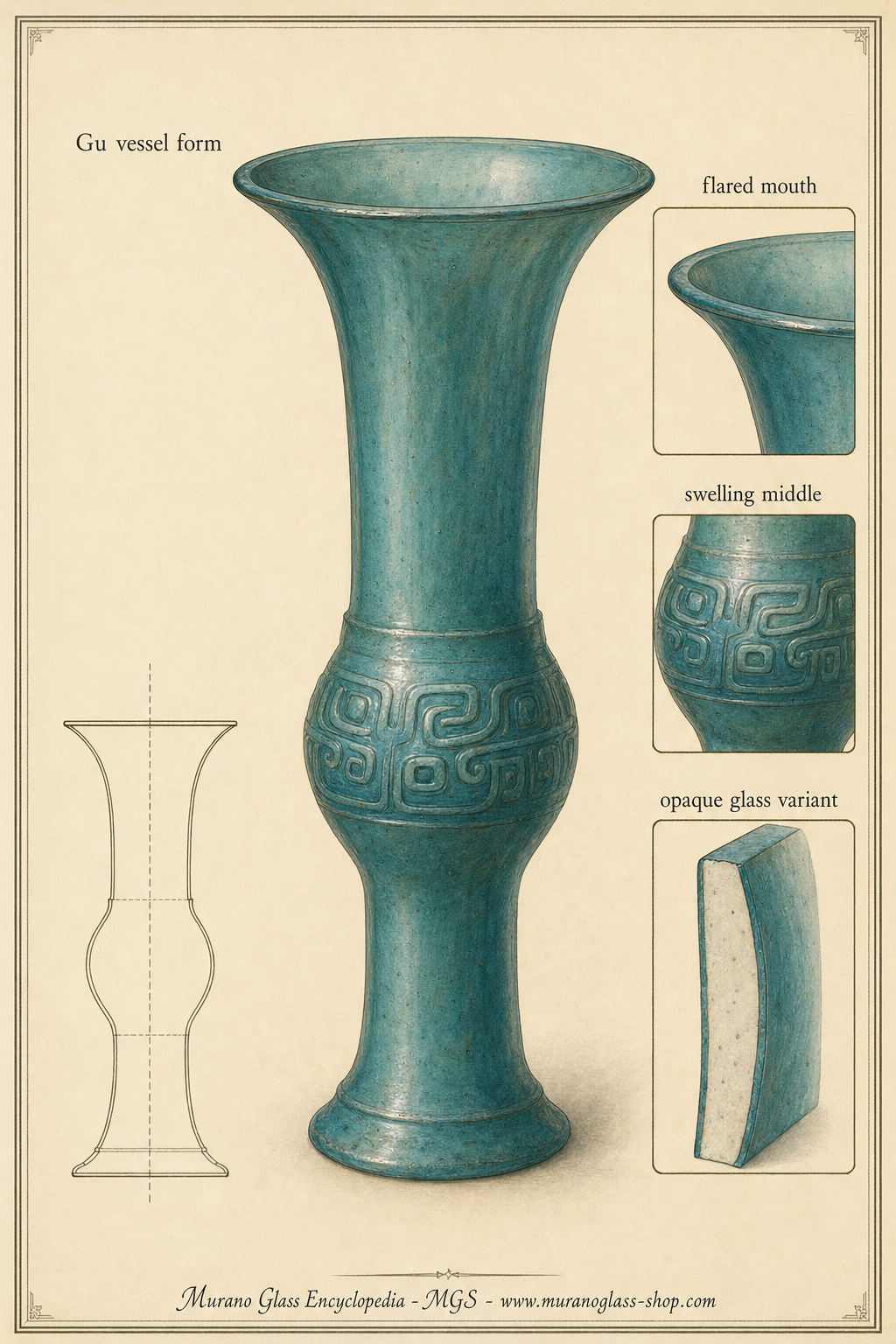
The ku, more commonly rendered in modern pinyin as gu, is a Chinese vessel form descended from ancient bronze ritual models. Its tall beaker-like silhouette, swelling middle section and dramatically flared mouth made it one of the most recognizable archaistic forms later adapted in porcelain and, more rarely, opaque colored glass.
Definition and form
The ku, or gu, is a Chinese vase type based on an early ritual vessel. Its profile is usually vertical and beaker-like: a narrow cylindrical body rises from a foot, expands at the central register, and opens into a broad trumpet-shaped mouth. The strong contrast between the constricted shaft, the fuller middle and the flaring rim gives the object an architectural clarity that remained legible even when the form was translated from bronze into ceramic or glass.
Historical context
The prototype of the form is the ancient Chinese bronze gu, a wine vessel associated above all with the ritual bronzes of the Shang and Zhou periods. Bronze examples were not merely utilitarian containers: they belonged to a ceremonial culture in which vessels served ancestral rites, expressed rank and preserved patterns of ornament and inscription. Later Chinese art repeatedly returned to these early bronzes, especially during periods in which antiquarian learning and court collecting encouraged archaistic design.
When the form reappeared in later media, it no longer necessarily functioned as a wine vessel. In porcelain and glass it became a vase, a display object and, in some contexts, a sign of cultivated reference to antiquity.
Materials and techniques
Bronze origins
The earliest models were cast in bronze, typically using the sophisticated piece-mold casting methods characteristic of ancient China. Their decoration could include raised registers, masks, blades and linear motifs integrated with the vessel's segmented structure.
Porcelain adaptations
Porcelain versions translated the bronze silhouette into a fired ceramic body. Potters could emphasize the archaic outline through monochrome glazes, painted decoration or relief ornament. Because porcelain is formed and fired rather than cast, the crispness of bronze profiles was often reinterpreted through thrown or molded sections joined into a tall, balanced shape.
Opaque colored glass
Some ku-shaped vases were also made in opaque colored glass. Yellow and turquoise are among the colors most often associated with such examples. In Chinese glass, opacity can be produced by chemical opacifiers dispersed within the glass body; the resulting material differs visually from transparent blown glass because it reflects light from the surface and internal particles rather than allowing a clear view through the vessel. The dense color made opaque glass suitable for objects intended to evoke jade, enamel, porcelain glazes or other valued materials.
Artistic style
The aesthetic power of the ku depends on balance: a swelling center stabilizes the high flared mouth, while the narrow lower section makes the form appear taller. In archaistic versions, the surface may reinforce this structure through horizontal bands or panels that recall bronze registers. Even undecorated examples retain a strong historical character because the outline itself carries the memory of ritual bronze design.
Relationship with Murano glass
The ku is a Chinese form and should not be treated as a Murano type. A connection with Murano exists only at the level of comparative glass history. Murano workshops also mastered opaque and colored glasses, including white lattimo and enamel-like colors, but their vessel shapes and decorative traditions developed within a Venetian context. Chinese opaque glass ku vases belong instead to the history of Chinese antiquarian design and Asian glassmaking. Any attribution of a ku-shaped opaque glass vase to Murano would require independent documentation.
Influence and legacy
The lasting importance of the ku lies in its ability to move across materials while preserving a recognizable silhouette. From bronze ritual vessel to porcelain vase and opaque glass object, the form demonstrates how Chinese art reused ancient models without simply copying them. Each material changed the visual effect: bronze gave weight and relief, porcelain offered glaze and painted surfaces, and opaque glass introduced saturated color and a smooth, luminous density.
Historical documented curiosities
- The spelling ku reflects older systems of transcription; gu is the usual modern pinyin form.
- The trumpet mouth is not just decorative: in the bronze prototype it is one of the key identifying features of the vessel class.
- Yellow and turquoise opaque glass examples show how a bronze-derived shape could be reimagined through color rather than metal surface.
FAQ
Is ku the same as gu?
Yes. Ku is an older transcription; gu is the standard modern pinyin spelling for the Chinese vessel form.
What was the original function of the form?
The ancient bronze gu was a ritual wine vessel connected with ancestral ceremonies, especially in the Shang and Zhou bronze tradition.
Was the ku made only in porcelain?
No. Later versions are known in porcelain, and some were made in opaque colored glass, especially in yellow or turquoise tones.
Is a ku vase a Murano glass object?
No. The form is Chinese. Murano provides useful comparisons for opaque colored glass techniques, but a ku vase is not a Murano type unless separately documented.