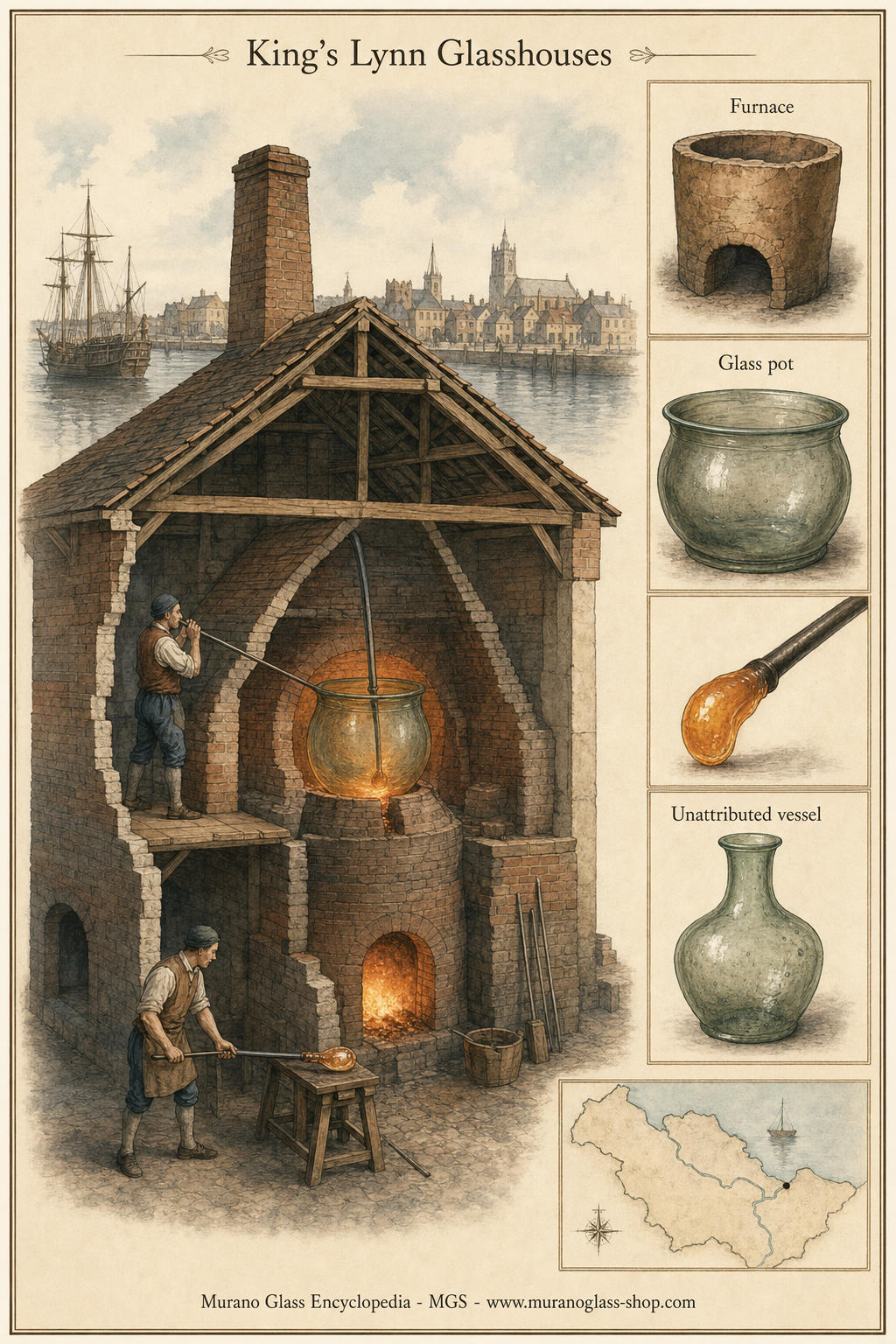
King's Lynn, a port town in Norfolk, has a documented but fragmentary place in the history of English glassmaking. Records connect the town with several glasshouses between the first half of the seventeenth century and the mid-eighteenth century, yet no surviving group of objects can be securely assigned to these furnaces.
Historical context
King's Lynn was one of the English provincial locations associated with glass production during a period of major technical and commercial change. In the seventeenth century English glassmaking was shaped by patents, monopolies, the availability of fuel, and the movement of skilled workers and capital between London and regional centres. Port towns such as King's Lynn were practical sites for industry because they could receive raw materials and fuel by water and send finished goods to wider markets.
The early modern glass industry in England was not a single craft tradition but a set of related activities: window glass, vessel glass, bottles and other utilitarian wares were often produced in different kinds of furnaces and under different commercial arrangements. For King's Lynn, the documentary record confirms the presence of glasshouses, but it does not allow a precise catalogue of their output.
Documented glasshouses and proprietors
Sir Robert Mansell and the seventeenth-century industry
A glasshouse existed at King's Lynn in the first half of the seventeenth century and was owned by Sir Robert Mansell. Mansell is a significant figure in English glass history because he held a major royal patent for glassmaking in the early seventeenth century and was closely linked with the reorganisation of the trade after the move away from wood-fired production. His interests were not limited to one site; they formed part of a broader network of English glass manufacturing.
The reference to Mansell establishes King's Lynn as one of the places connected with this wider commercial structure. It should not, however, be taken as evidence for a specific style of glass or for surviving objects unless supported by independent documentation.
Francis Jackson and John Straw
Another glasshouse at King's Lynn is recorded in 1693 as belonging to Francis Jackson and John Straw. In the same year, the two men were also owners of the Falcon Glassworks in London. They left the Falcon enterprise in 1695. This overlap is important because it shows that King's Lynn was not isolated from the metropolitan glass trade; investors and proprietors could operate across both provincial and London sites.
The documents identify ownership, not the exact nature of production. Without account books, marked wares or archaeological evidence directly tied to the furnace, the kinds of glass made there remain uncertain.
Eighteenth-century references
A notice published in 1747 concerning the liquidation of goods probably refers to the King's Lynn factory. The wording of the surviving reference makes the attribution probable rather than absolute. A further glass furnace at King's Lynn is documented in 1753 as belonging to Jonas Philips. These references show that glassmaking activity, or at least industrial property connected with glassmaking, continued to be recorded in the town into the eighteenth century.
Techniques and materials
No technical recipe from the King's Lynn furnaces is identified in the cited documentation. For that reason, it is safer to discuss the general technical framework of English glass production rather than assign a particular composition to the town. Early modern glass was based principally on silica, usually supplied by sand or other siliceous material. Fluxes such as alkali lowered the melting temperature, while stabilising components, notably lime, helped make the glass more durable. The exact proportions varied according to product type, raw materials and workshop practice.
Coal-fired furnaces became increasingly important in England during the seventeenth century. This had consequences for furnace design and for the organisation of production, but it does not by itself identify the appearance or quality of glass made at any single site. King's Lynn's documented glasshouses should therefore be understood as part of a wider technical environment rather than as the source of a defined decorative school.
Relationship with Murano glass
No direct connection between the King's Lynn glasshouses and Murano is documented in the available facts. The broader European glass trade was deeply influenced by Venetian and Murano techniques, especially in fine cristallo-style vessel glass, but the records for King's Lynn do not show that Venetian workers, Murano recipes or Venetian-style luxury production were present there. Any such link would require separate evidence.
The problem of “Lynn glass”
The expression “Lynn glass” has appeared in historical discussions, but the King's Lynn factories listed in the documentary record have not been accepted as the creators of the so-called “Lynn glasses”. The source tradition points instead to a separate problem of attribution, associated in references with Wedgwood glassmaking. For an encyclopedic treatment, this distinction is essential: the name of the town does not automatically prove origin.
This is a common issue in glass history. Place names may refer to a manufacturing site, a trading label, a later collecting term, or a misattribution. Without marked pieces, excavation data or contemporary descriptions, a geographical name cannot be treated as secure evidence of manufacture.
Influence and legacy
King's Lynn's importance lies less in a recognisable artistic style than in what it reveals about the geography of English glassmaking. The town illustrates how glass production extended beyond London and how provincial furnaces could be linked to national networks of ownership. The association with Mansell, Jackson, Straw and Philips places King's Lynn within a documented sequence of early modern industrial activity.
Its legacy is therefore primarily historical and archival. The King's Lynn glasshouses are useful to scholars studying ownership, industrial sites, fuel transition, and the uncertain relationship between documentary evidence and surviving objects.
Historical documented curiosities
- King's Lynn is linked in the record to more than one glasshouse, not to a single continuous factory with an uninterrupted history.
- Francis Jackson and John Straw were connected in 1693 with both King's Lynn and the Falcon Glassworks in London.
- The 1747 notice is treated cautiously because it probably, but not certainly, refers to the King's Lynn factory.
- The documented furnaces have not been recognised as the makers of the objects known as “Lynn glasses”.
FAQ
Where were the King's Lynn glasshouses?
They were in King's Lynn, a port town in Norfolk, England.
Who owned the earliest documented King's Lynn glasshouse?
In the first half of the seventeenth century, a glasshouse there was owned by Sir Robert Mansell.
Were the King's Lynn glasshouses connected with London?
Yes. In 1693 Francis Jackson and John Straw owned a King's Lynn glasshouse and were also owners of the Falcon Glassworks in London.
Did King's Lynn produce the so-called “Lynn glasses”?
The documented King's Lynn factories have not been accepted as the creators of the so-called “Lynn glasses”.
Is there a proven Murano connection?
No direct Murano connection is documented for these glasshouses in the available facts.