

Kimble Glass Co. was an American glass concern associated with Evan F. Kimble and with the 1931 acquisition of Vineland Flint Glass Works after the death of Victor Durand Jr. Its historical interest lies in the transition from the art-glass ambitions of the Durand period to a more commercial production that retained selected decorative references to Clutha glass and Tiffany.
Historical context
Kimble Glass Co. belongs to the later chapter of the American art-glass story. By the early 1930s the market that had supported highly individual decorative glass was under pressure from the economic conditions of the Great Depression, changing domestic taste and the growing importance of standardized industrial production. In this setting, many glassworks reduced or discontinued expensive art-glass lines and concentrated on items with broader commercial appeal.
The company is linked to Vineland Flint Glass Works, a New Jersey glasshouse known in art-glass history through its association with Durand Art Glass. Victor Durand Jr. had been a central figure in that enterprise, and his death in 1931 marked a decisive change in ownership and direction.
Company history
According to the documented account used here, Evan F. Kimble owned Kimble Glass Co. and in 1931 took over Vineland Flint Glass Works after the death of Victor Durand Jr. The transfer is significant because it closed, or at least sharply curtailed, the phase in which the Vineland works had been identified with ambitious decorative glass.
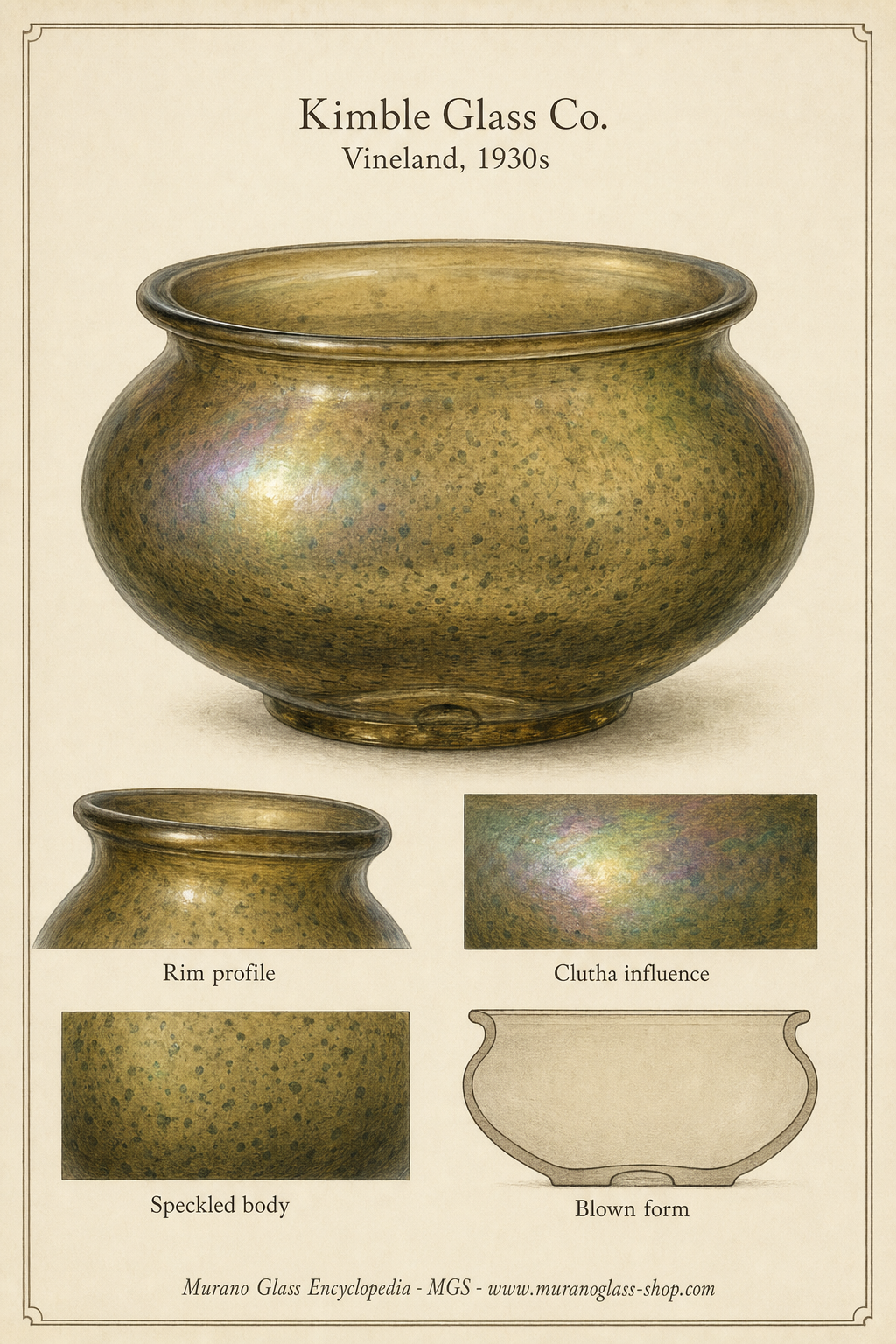
After the takeover, the company largely moved away from art glass, although isolated exceptions are noted. Its production became more commercial in character. This does not mean that decorative effects disappeared completely: some forms and surface ideas continued to echo earlier art-glass models, especially Clutha glass and Tiffany glass.
Artistic style and references
The surviving description points to a selective borrowing of motifs rather than to a full continuation of the Durand art-glass program. Clutha glass, developed in Scotland in the late nineteenth century and associated with James Couper & Sons and the design culture around Christopher Dresser, was admired for cloudy color, trapped bubbles, streaked effects and an intentionally archaic appearance reminiscent of excavated Roman glass. Tiffany glass, especially Favrile glass, was famous for iridescence, opalescent color and organic surface richness.
Kimble Glass Co. is therefore best understood as operating in a commercial register that could still use recognizable decorative cues. The source specifically mentions glass bowls or rounded vessels among the objects that reflected these influences. Without further documentation, individual designs should not be attributed to particular artists or workshops.
Techniques and materials
The term “flint glass” in the name Vineland Flint Glass Works reflects historical glass-industry terminology and should not automatically be read as proof that every object was lead crystal. In nineteenth- and early twentieth-century usage, “flint” could refer broadly to clear, refined glass, depending on local practice and product type.
The decorative affinities noted for Kimble-related production would have been achieved through general hot-glass methods: manipulation of colored gathers, controlled inclusion of air bubbles, internal streaking, and surface treatments capable of recalling iridescent or weathered glass. Tiffany’s celebrated iridescent effects were produced through carefully controlled metallic lusters and furnace conditions; Clutha-like effects depended more on internal veining, bubbles and smoky or mineralized visual textures. No specific proprietary Kimble formula is documented in the supplied source.
Relationship with Murano glass
No direct historical relationship with Murano glass is documented in the available material. The comparison is useful only at the level of broader glass history: Murano makers, like American and British glasshouses, worked with color, bubbles, inclusions, iridescence and vessel form, but Kimble Glass Co. should not be presented as a Murano-related workshop unless independent evidence is available.
Influence and legacy
Kimble Glass Co. is mainly important as a marker of transition. It illustrates how a glassworks associated with American art glass could be redirected toward more commercially viable production after a change in ownership. For collectors and historians, the company also helps explain why objects from the Vineland/Durand orbit may show different levels of artistic ambition depending on whether they belong to the Durand period or the subsequent Kimble-controlled phase.
Historical documented curiosities
- The 1931 change followed the death of Victor Durand Jr., a key event in the history of the Vineland works.
- The later production did not entirely abandon decorative taste, but used art-glass references in a more market-oriented way.
- Clutha and Tiffany are useful reference points, yet the available facts do not support identifying Kimble pieces as direct products of either tradition.
FAQ
Who owned Kimble Glass Co.?
Kimble Glass Co. is documented as a glass company owned by Evan F. Kimble.
What happened in 1931?
In 1931, after the death of Victor Durand Jr., Evan F. Kimble took over Vineland Flint Glass Works.
Did Kimble Glass Co. continue making art glass?
Only to a limited extent. The company largely shifted away from art glass and toward a more commercial output.
What styles influenced its later production?
The documented influences include motifs associated with Clutha glass and Tiffany glass, especially in decorative glass vessels.
Was Kimble Glass Co. connected to Murano?
No direct connection with Murano glass is documented in the available information.