Kew Blas is a late nineteenth-century American iridescent art glass associated with the Union Glass Co. and with William S. Blake, whose name is hidden in the mark. It belongs to the broader taste for decorative art glass that developed in the United States during the 1890s.
Definition and historical context
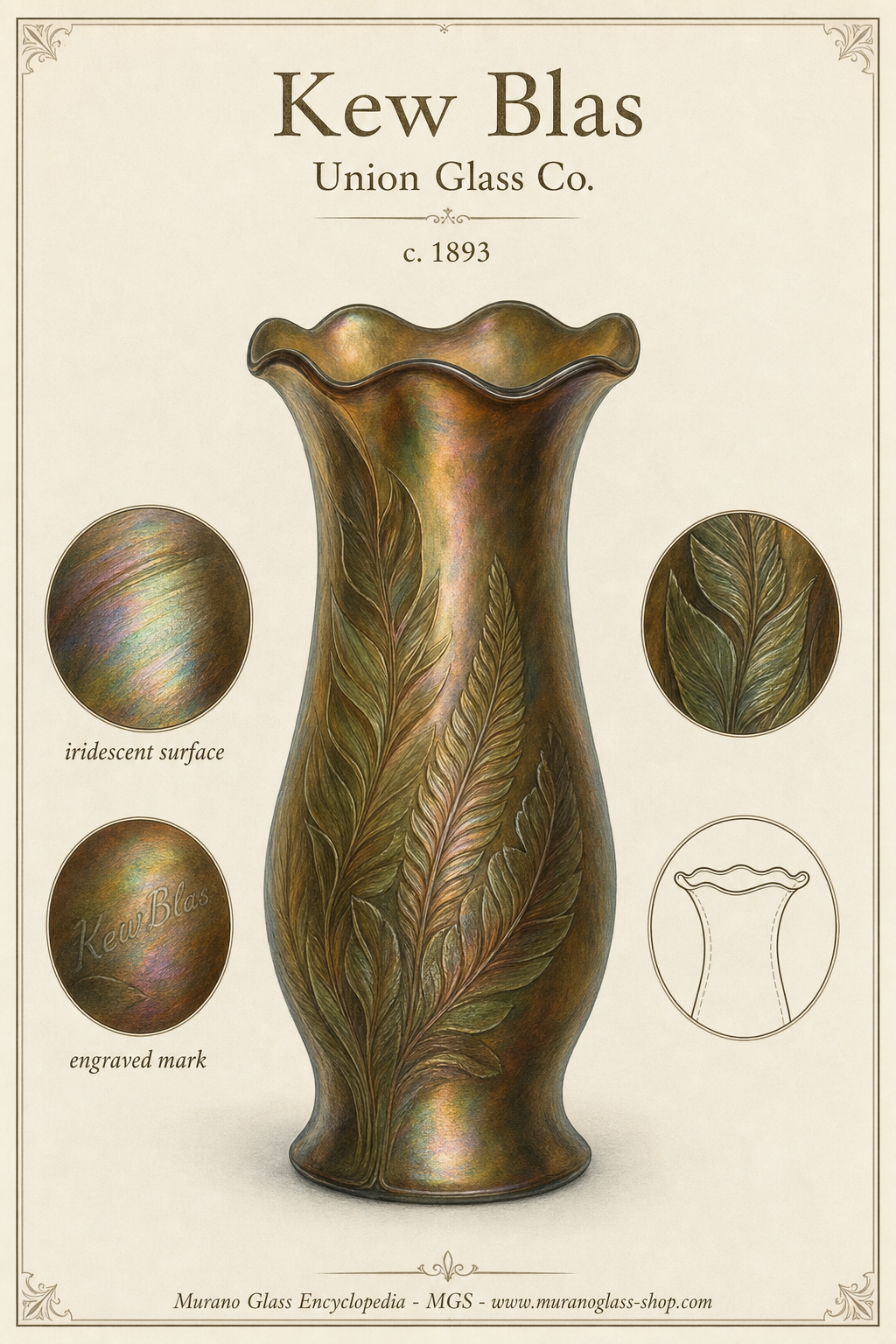
Kew Blas refers to iridescent glass objects produced by the American Union Glass Co. from about 1893. The name is not a place name: it is an anagram of W. S. Blake, identified in the supplied historical note as William S. Blake, director of the factory. Surviving pieces are marked «Kew Blas», a detail that is important for attribution and for distinguishing originals from later imitations.
The appearance of Kew Blas should be understood within the late Victorian market for art glass. In the United States, the last decades of the nineteenth century saw a strong demand for decorative vessels, table objects and display pieces whose value lay not only in function but in surface, color and novelty. Iridescence, already admired in ancient weathered glass and in archaeological collections, became a deliberate aesthetic effect in modern studio and factory production.
Artistic style
Kew Blas pieces are described as iridescent glass decorated with leaf and feather motifs. The palette most closely associated with them consists of browns and greens, often in tonal variations that emphasize an organic, naturalistic effect. These motifs placed Kew Blas within a broader decorative language shared by Aesthetic Movement and early Art Nouveau taste, where plant forms, plumage and atmospheric surfaces were valued as alternatives to strictly geometric ornament.
The name and the appearance also indicate that Kew Blas was conceived in dialogue with other American art glass. The source specifically notes that it was made in imitation of many other American art-glass productions. This does not make it insignificant: rather, it shows how quickly iridescent surfaces became commercially desirable and how factories responded to a competitive market for artistic domestic objects.
Techniques and materials
The defining visual feature is iridescence, a surface phenomenon in which reflected light produces shifting metallic or rainbow-like colors. In nineteenth-century art glass, such effects could be obtained through controlled surface treatments, metallic compounds, reheating or reducing atmospheres; exact recipes varied by factory and are not documented in the supplied source for Kew Blas. For this reason, the safest description is technical but not speculative: Kew Blas is identified by its iridescent finish, its brown-green decorative range and its characteristic motifs, not by a fully documented formula.
The distinction between an engraved and an acid-etched mark is especially important. Engraving removes glass mechanically with a tool or wheel, leaving a cut or incised line. Acid etching, by contrast, chemically attacks the surface, usually producing a softer, frosted or more uniform mark. According to the historical note, genuine Kew Blas pieces carry an engraved mark, whereas many fakes show the mark made by acid etching.
Marks, attribution and collecting
The mark «Kew Blas» is central to the identification of these objects. Because the term is an anagram of William S. Blake's name, it also connects the product to the management of the Union Glass Co. In the collecting field, a marked object is not automatically authentic, since forged marks exist; the method of marking must be examined. The supplied documentation states that numerous fakes are known and that the key difference is the acid-etched rather than engraved signature.
When evaluating a possible example, specialists normally consider the relationship among surface, decoration, palette and mark. A correct-looking name alone is insufficient if the mark is technically inconsistent with documented originals. Condition is also significant, because iridescent surfaces can be vulnerable to abrasion, overcleaning and surface alteration.
Relationship with Murano glass
Kew Blas is not a Murano product and should not be catalogued as Venetian glass. Its relevance to Murano studies is comparative. Both American and Venetian glassmakers engaged with color, surface effects and the revival of historical techniques in the nineteenth and early twentieth centuries, but Kew Blas belongs to the American art-glass market and to the Union Glass Co. tradition. Any connection with Murano should therefore be framed as a comparison of decorative ambitions, not as a direct historical lineage unless supported by specific evidence.
Legacy
Kew Blas occupies a small but useful place in the history of American art glass. It illustrates how iridescence moved from exceptional artistic experiment into a wider commercial field. Its anagrammatic name, its nature-based decoration and the problem of forged marks make it a noteworthy subject for collectors, historians of glass technology and scholars of late nineteenth-century decorative arts.
FAQ
What is Kew Blas glass?
It is an American iridescent art glass made by Union Glass Co. from about 1893 and decorated with leaf and feather motifs.
Why is it called Kew Blas?
The name is an anagram of W. S. Blake, identified as William S. Blake, director of the factory.
How can fakes be recognized?
The historical note states that originals bear an engraved mark, while many fakes have an acid-etched mark.
Is Kew Blas Murano glass?
No. It is associated with an American manufacturer, not with Murano. Comparisons with Murano are useful only at the level of broader glassmaking history.