

Johann Christoff Kiessling, who died in 1744, was a glass engraver active at the court of Dresden in Saxony. His documented service from 1717 to 1744 places him within the refined Central European tradition of wheel-engraved glass, especially courtly goblets bearing hunting subjects.
Historical context
Kiessling worked in Dresden, the Saxon capital, during a period in which princely courts used luxury objects to express rank, taste and ceremonial identity. Glass, like porcelain, metalwork and hardstone carving, belonged to the culture of refined court display. Engraved drinking vessels were not merely functional objects: they were suitable for banquets, gifts, collections and dynastic representation.
In the German-speaking lands, wheel engraving on glass had reached a high level of technical sophistication by the late seventeenth and early eighteenth centuries. It differed from many Venetian decorative traditions by relying less on hot-worked ornament and more on cold cutting, polishing and pictorial incision after the vessel had been formed.
Biography
The verifiable information on Johann Christoff Kiessling is concise but significant. He was active as an engraver at the Dresden court in Saxony from 1717 until 1744, the year of his death. No secure birth date is provided by the available source material. His position at court indicates that his work belonged to an elite environment in which glass decoration was expected to meet the tastes of aristocratic patrons.
Artistic style
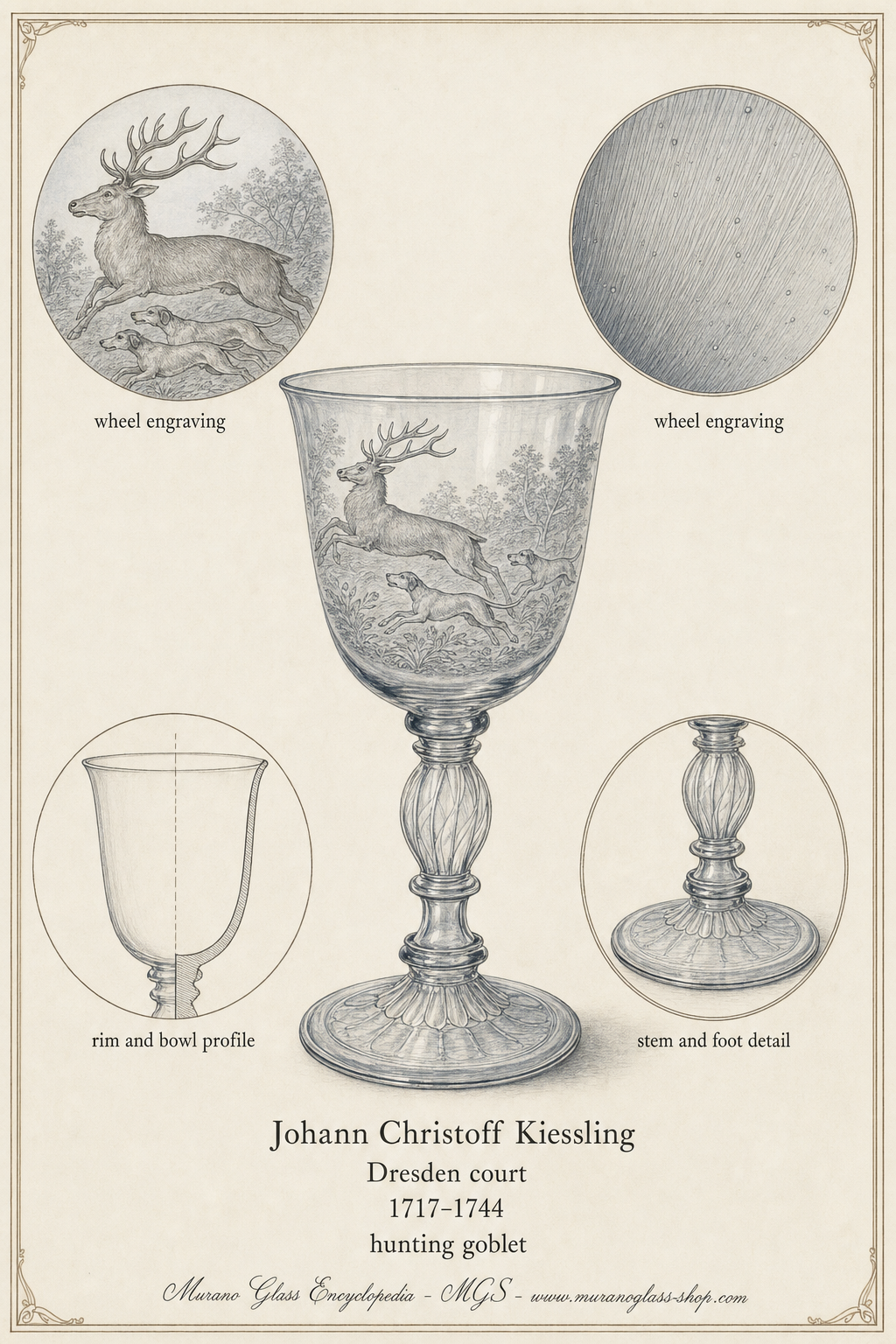
Kiessling is associated above all with decorated goblets. His preferred subject matter was hunting, a theme deeply embedded in European aristocratic culture. Hunting scenes on glass could evoke status, land ownership, courtly leisure, discipline, heraldic identity and princely authority. On a goblet, such imagery transformed a drinking vessel into a miniature narrative field.
Because the documented description emphasizes goblets and hunting scenes, attributions beyond this range should be treated cautiously unless supported by independent evidence. His known profile is therefore best understood through the Dresden court context and the wider Central European taste for engraved glass with figurative scenes.
Techniques
Kiessling’s craft belonged to the cold-working side of glassmaking. In wheel engraving, the vessel is shaped first and then decorated with rotating wheels, commonly of copper, stone or other hard materials, used with abrasives. The engraver creates lines, shaded passages and tonal contrasts by varying pressure, wheel size and depth of cut. Polished and matte areas can be combined to build figures, foliage, animals and landscape details.
Goblets were especially suited to this kind of decoration. Their bowls offered a curved but continuous surface, while the stem and foot gave the object ceremonial presence. The challenge for the engraver was to adapt a legible scene to a transparent, reflective and rounded support.
Relationship with Murano glass
No direct historical link between Kiessling and Murano is established by the available information. The comparison is nonetheless useful for understanding his place in European glass history. Murano was renowned for furnace-working traditions such as cristallo, filigrana and elaborate blown forms, while Saxon and Central European engraved glass often emphasized post-firing wheel work, pictorial subjects and cut ornament.
Kiessling’s Dresden production should therefore not be described as Murano glass. It represents a different technical and cultural tradition: courtly engraved glass from Saxony, shaped by Central European preferences for narrative and emblematic decoration.
Influence and legacy
Kiessling’s documented career illustrates the importance of specialized glass engravers within eighteenth-century court workshops. Although only limited biographical data are secure, his association with Dresden and with hunting scenes on goblets places him in a recognizable artistic environment: the courtly world in which glass could carry images of power, leisure and noble identity.
Historical documented curiosities
- His recorded period of court activity spans twenty-seven years, from 1717 to 1744.
- The recurrence of hunting imagery reflects a subject particularly valued in aristocratic visual culture.
- His work belongs to the engraved glass tradition rather than to hot-applied Venetian-style ornament.
FAQ
Who was Johann Christoff Kiessling?
He was a glass engraver active at the Dresden court in Saxony from 1717 to 1744.
What objects is he mainly associated with?
He is chiefly associated with decorated goblets.
What subjects did he engrave?
The available information indicates that hunting scenes were his most characteristic subjects.
Was Kiessling a Murano glassmaker?
No direct connection with Murano is documented. His work belongs to the Saxon and Central European tradition of engraved court glass.