

A glass chandelier is a suspended lighting structure designed to distribute light from candles, gas, oil or electric sources while also functioning as an architectural ornament. Its history connects church metalwork, cut crystal, Venetian soda glass, Murano floral decoration and modern design.
Definition and function
A chandelier is a ceiling-hung lighting apparatus with a central support and multiple arms, sockets or candle-holders. Before electric lighting, its practical value lay in placing several flames high in a room so that light could spread more evenly. Glass became especially important because polished or transparent elements refract and reflect light, multiplying the sparkle of candles and later lamps.
Historical context
Early and medieval chandeliers were commonly made as crowns, wheels or cross-shaped structures, particularly for churches and ceremonial interiors. In the seventeenth century, European taste increasingly favoured glass components over wood or exposed metal. The column chandelier, with a vertical stem and radiating arms, became suitable not only for religious buildings but also for palaces and domestic rooms.
In England, early examples combined iron frames with crystal ornaments. By the early eighteenth century, central stems sheathed in glass globes and large terminal glass balls were used, with glass arms carrying candle sockets. In the mid-eighteenth century, pendants became more prominent; during the Rococo period, cut crystal drops and spiral elements intensified movement and brilliance. Neoclassical France and England adopted urn-shaped chandeliers with prismatic festoons, while nineteenth-century models often concealed metalwork beneath dense curtains of hanging crystal. Elsewhere, metal frames remained visible and were enriched with strings of glass beads and faceted crystal gems; Austrian examples could include gilded and lacquered wooden stems with crystal festoons.
Relationship with Murano glass
Venice developed a distinctive alternative to the cut-crystal chandelier. The Venetian soda glass made on Murano was admired for lightness, clarity, colour and lampworking possibilities, but it was less suited to deep faceting than the lead or potash-based crystals favoured in other European centres. Murano makers therefore emphasized blown forms, applied decoration and chromatic variety rather than heavy cutting.
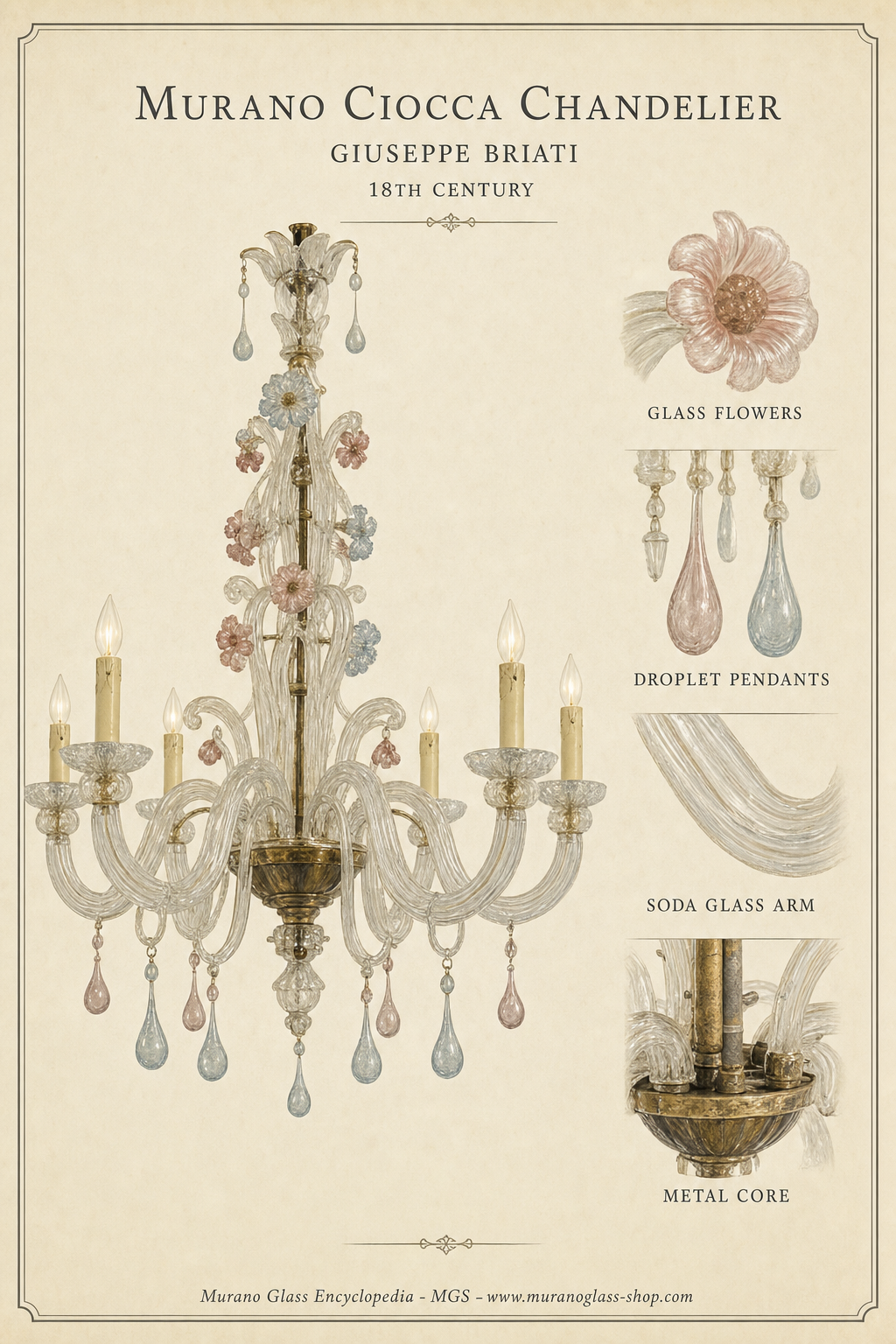
The eighteenth-century glassmaker Giuseppe Briati is closely associated with the Venetian chandelier known as the ciocca. This type used a metal armature covered or visually transformed by transparent and coloured glass, with floral, fruit and leaf ornaments. Its visual effect is not that of a rigid crystal machine but of a luminous vegetal structure: stems, blossoms and pendants surround the light source and make the chandelier part sculpture, part furnishing.
Materials and techniques
- Soda-lime Venetian glass: based on silica, soda as flux and lime as stabilizer; valued for workability in hot shaping and decorative additions.
- Cut crystal: used widely outside Venice for prisms, drops and faceted spirals that scatter light through sharp edges.
- Lattimo: opaque white glass associated with Venetian practice and preferred in some Spanish chandeliers from the eighteenth century.
- Opaline: a translucent or milky glass that became fashionable in the nineteenth century, especially with oil and gas lighting.
- Armatures: metal cores ensured strength; in some traditions they were hidden by glass, in others intentionally displayed and decorated.
From candles to modern lighting
The arrival of oil lamps in the mid-nineteenth century and, later, gas lighting changed the form of chandeliers. Flame management, heat, fuel supply and shades required new solutions. With electric light, the chandelier lost much of its original technical necessity and became primarily a decorative and spatial device. Designers could now conceal the source, diffuse it, or treat the glass body as a luminous screen.
Major work: Gancio by Angelo Mangiarotti
A documented modern example is Gancio, designed by Angelo Mangiarotti and produced by Vetreria Vistosi in 1964. It consists of an ovoid glass cord bent so that the elements can hook together, forming a curtain that screens the light source. The object belongs to the postwar dialogue between Murano glassmaking and industrial design: glass is no longer only a pendant or flower, but a modular structural element.
Terminology and legacy
The French term is lustre; in English the standard word is chandelier. Across Europe, the chandelier records changes in materials, lighting technology and taste: ecclesiastical crowns, Rococo crystal, neoclassical urns, Murano floral ciocche, opaline gas-era forms and twentieth-century design all belong to the same broad family of suspended light architecture.
FAQ
Why did glass become important in chandeliers?
Glass reflects and refracts light, increasing the visual brightness of candles and lamps while offering rich decorative possibilities.
What is a Murano ciocca chandelier?
It is an eighteenth-century Venetian type associated with Giuseppe Briati, using a metal structure covered with transparent or coloured glass and decorated with flowers, fruit and leaves.
How does Venetian glass differ from cut crystal chandeliers?
Murano soda glass was better suited to hot shaping, colour and applied ornament, while lead or similar crystals used elsewhere were preferred for deep cutting and faceting.