

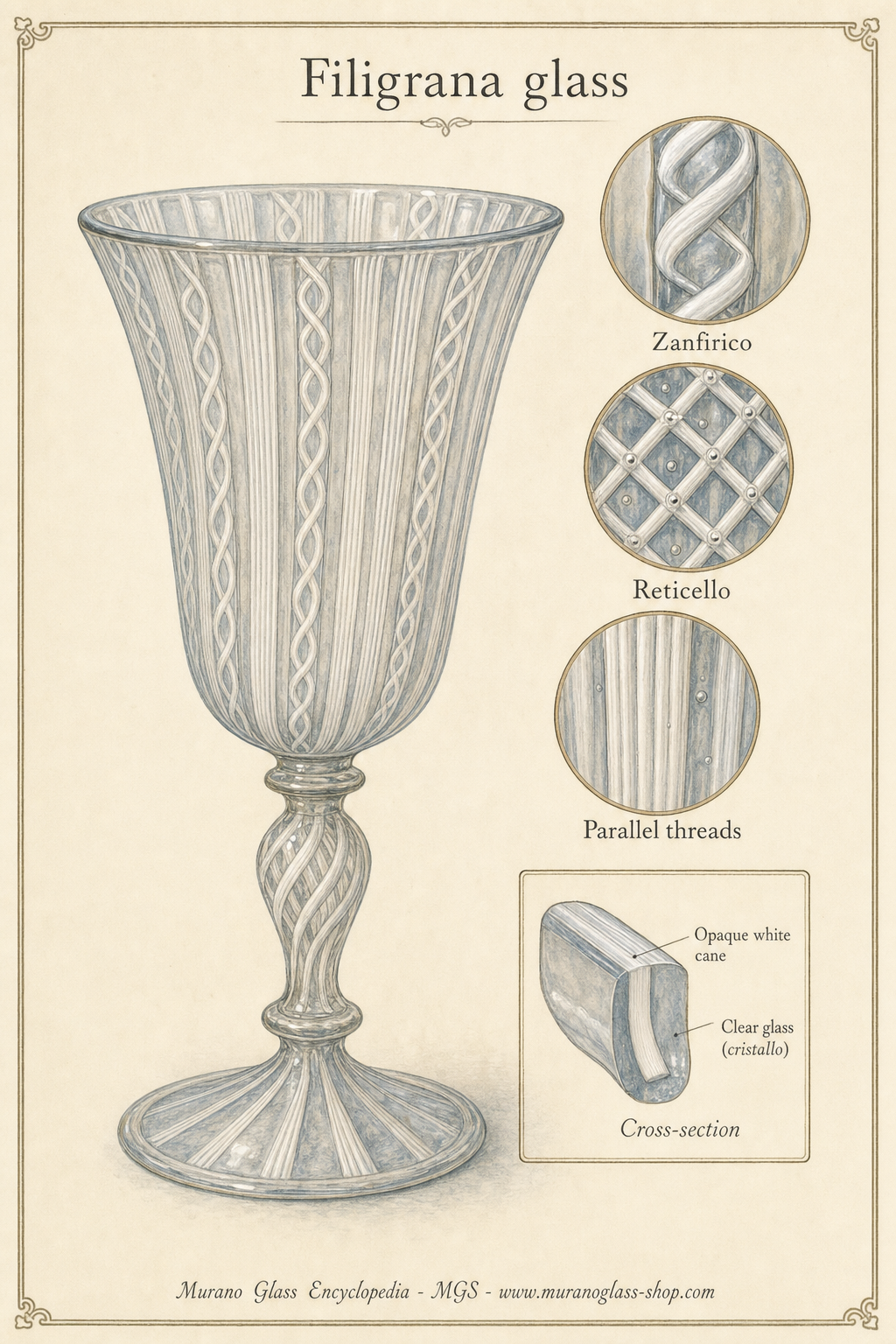
Filigrana is a Venetian glassmaking family of techniques in which long, opaque or colored glass canes are embedded inside a transparent body. Closely associated with Murano, it includes spiralled retorti or zanfirico patterns, reticello networks and modern parallel-thread designs.
Definition and distinguishing features
In glass history, filigrana denotes transparent glass decorated from within by continuous glass threads. The threads are usually made from opaque white glass, especially lattimo, but they may also be colored. The essential point is that the cane is used along its length, not sliced to expose a cross-section. For that reason filigrana should not be confused with murrine or paperweight canes, where the visible pattern is produced by cutting the cane transversely.
The Italian terms vetro a fili and vetro filigranato are often used in connection with the technique. International terminology varies: English writers commonly use filigree glass, while historical and market texts may also say threaded glass, lace glass, muslin glass or cotton glass. In French the term is verre filigrané; in German, Fadenglas.
Historical context
Objects with thread-like glass decoration existed in the Roman world between roughly 100 BCE and 100 CE, although their technical procedure was not the same as the Venetian method later developed on Murano. The Murano tradition became historically decisive in the sixteenth century, when Venetian glassmakers transformed cane work into a refined decorative language for blown vessels.
A key documentary moment is 1527, when Filippo Catani obtained a Venetian privilege for a type of filigrana known as zanfirico or vetro a retorti. In this variety, opaque canes embedded in clear glass are twisted into spiral effects. From Murano the technique circulated widely through the movement of glassworkers and the imitation of Venetian luxury glass in Europe and, later, beyond Europe.
Materials
Filigrana depends on compatibility between the transparent body glass and the inserted canes. The canes must soften and expand in a manner close enough to the surrounding glass to avoid cracking during heating and cooling. White threads were often made with lattimo, the opaque white Venetian glass developed to resemble porcelain or milk-white materials. Colored canes could be combined with white ones when a stronger chromatic rhythm was desired.
Techniques
Setting out and picking up the canes
A typical Murano procedure begins by arranging prepared canes on a heated metal plate or marver, traditionally called a bronzin. A gather of hot transparent glass is rolled over them so that the canes adhere to the surface. The glassworker then reheats, rolls and elongates the mass, incorporating the threads into the vessel wall.
Zanfirico and retorti
In zanfirico, the canes are twisted so that the internal threads form spirals. The effect can be regular, with disciplined helices, or more complex when several twisted canes are combined. The decoration is not painted on the surface; it is part of the glass body itself.
Reticello
Reticello is a celebrated variant in which two systems of filigrana threads cross to form a fine net. At the intersections and within the small diamond-shaped compartments, tiny air bubbles may be trapped, producing a delicate optical rhythm. Reticello requires accurate cane alignment, controlled reheating and precise blowing, because the apparent simplicity of the net depends on strict geometry.
Vetro a fili
The phrase vetro a fili can describe filigrana in a broad sense, but it is also associated with a modern Murano vocabulary of fine, parallel threads. Venini used this visual language in plates, vases and lamps, emphasizing linear clarity rather than the dense crossed structure of reticello.
Relationship with Murano glass
Filigrana is one of the techniques that helped define Murano glass as a union of virtuoso making and visual refinement. It belongs to the same broad culture of cane work as murrine, millefiori and reticello, but it occupies a distinct place because its ornament is longitudinal and internal. The technique also demonstrates the organization of Murano workshops: cane preparation, furnace timing, marver work and blowing must be coordinated with exceptional precision.
Twentieth-century revivals and interpretations
In the twentieth century, Murano companies and masters revisited historical techniques without merely reproducing Renaissance forms. Venini developed objects in which thin parallel filaments became a modern decorative structure suitable for lighting and vessel design. In the 1950s and 1960s, Archimede Seguso produced filigrana works using a particular approach to preparing and grinding small glass canes, showing how a sixteenth-century vocabulary could remain technically and aesthetically active in modern Murano glass.
Terminology and common misunderstandings
Several foreign-language texts have used latticino, latticinio or vetro di trina as if they were exact synonyms of filigrana. This is imprecise. Lattimo identifies an opaque white glass material; filigrana identifies a method of incorporating long threads into glass. Lace glass and similar expressions can be useful descriptions, but they may blur technical distinctions unless the cane structure is specified.
Influence and legacy
Through Murano masters and the international prestige of Venetian glass, filigrana spread to Europe and later to the United States and China. Its appeal lies in a paradox typical of glass: the decoration appears weightless and textile-like, yet it is produced by heat, gravity, rotation and the controlled fusion of rigid mineral materials. Today the term remains essential for cataloguing historical Venetian glass and for describing contemporary works that continue the cane-thread tradition.
FAQ
What is filigrana glass?
It is transparent glass decorated internally with long opaque or colored glass canes, usually arranged as threads, spirals or networks.
Is filigrana the same as reticello?
No. Reticello is a specific filigrana variant in which crossing threads create a net-like pattern, often with tiny trapped air bubbles in the diamond-shaped spaces.
Why is Murano important for filigrana?
Murano glassmakers developed and documented the Venetian technique in the sixteenth century, including the 1527 privilege associated with Filippo Catani and zanfirico.