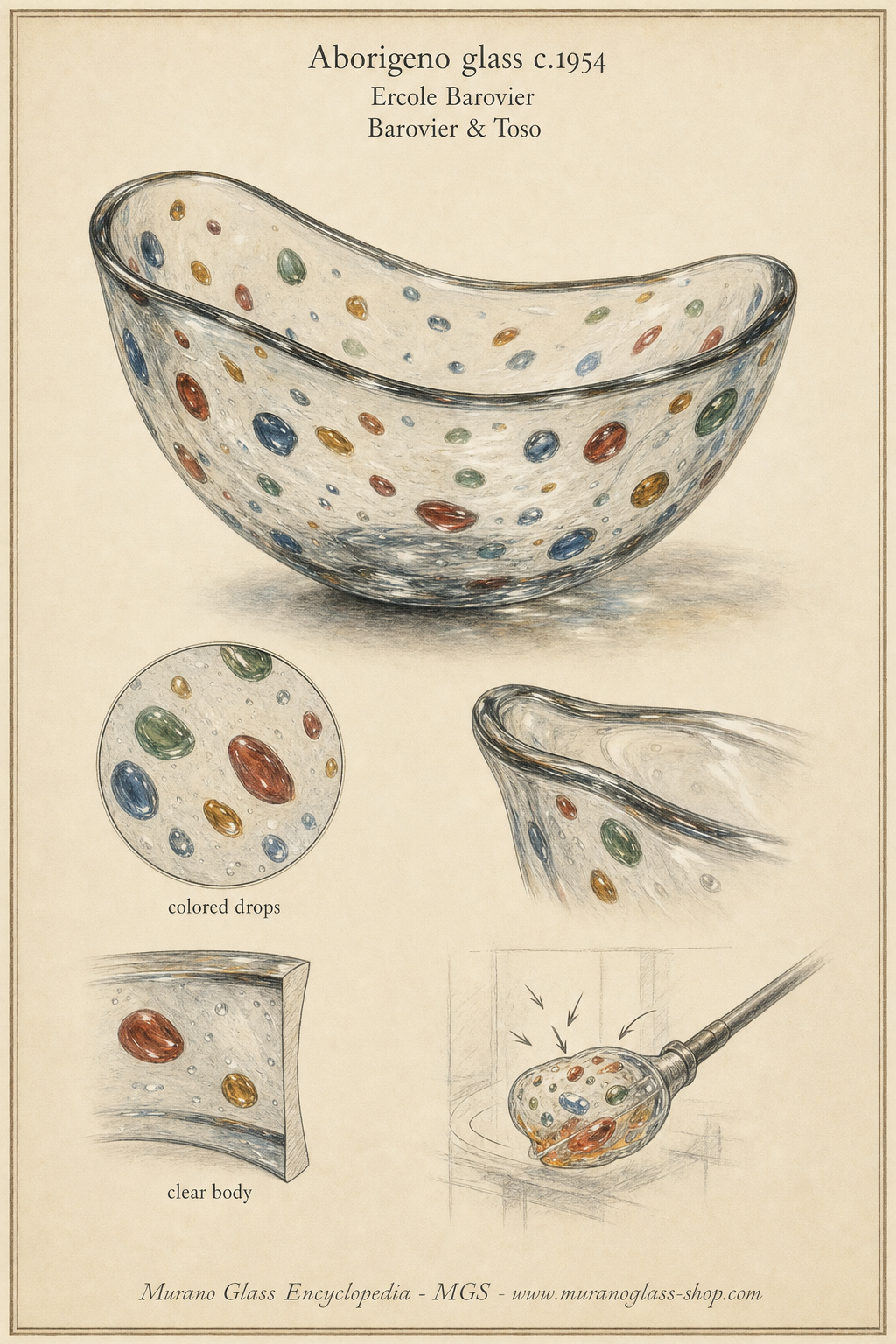
Aborigeno is a decorative Murano glass type associated with Ercole Barovier and Barovier & Toso. Developed around 1954, it is known for small, scattered colored glass drops embedded within a transparent glass body, especially in freehand asymmetrical bowls and vases.
Definition
In Murano glass terminology, Aborigeno identifies an ornamental glass developed around 1954 by Ercole Barovier for Barovier & Toso. Its visual identity depends on a transparent mass of glass animated by small inclusions of colored glass distributed like irregular drops inside the object.
The technique was used for hand-shaped objects such as bowls, cups and vases. The surviving description emphasizes asymmetry: these were not conceived as mechanically regular forms, but as freehand pieces in which the gesture of the glassmaker remained visible.
Historical context
The early 1950s were a particularly inventive period for Murano. After the Second World War, Venetian glasshouses worked to renew their decorative vocabularies for international exhibitions, private interiors and the growing market for collectible design. Color, transparency, surface relief and internal decoration became central fields of experimentation.
Aborigeno belongs to this post-war climate of research. It does not rely on applied painting or engraving; its decoration is built into the glass while the object is hot. The colored elements are therefore not a surface ornament but part of the material structure of the vessel.
Ercole Barovier and Barovier & Toso
Ercole Barovier (1889–1974) was one of the major figures of twentieth-century Murano glass. A member of the Barovier family, long active in Venetian glassmaking, he worked as designer and leading creative force for the firm that became known as Barovier & Toso. His production is associated with technical invention, controlled color effects and a willingness to reinterpret traditional Murano processes for modern decorative forms.
Barovier & Toso is one of the historic names of Murano glass. The modern company name is linked to the 1936 union of the Barovier glassmaking enterprise with the Toso side of the business. In the decades that followed, the firm produced both lighting and art glass, often combining artisanal procedures with designs suited to twentieth-century interiors.
Technique and materials
The essential feature of Aborigeno glass is the inclusion of small colored glass drops in a clear body. In hot glassmaking, such an effect requires compatibility between the transparent glass and the colored glass elements: if the glasses expand or contract too differently during cooling, internal stress may cause cracking. Murano glassmakers therefore worked with carefully prepared glass compositions and controlled annealing.
The clear body functions as an optical matrix. It magnifies, separates and slightly distorts the colored drops, so that the decoration changes with the thickness of the glass and the angle of view. Unlike painted decoration, the pattern cannot be removed from the surface; it is sealed within the transparent material.
How it differs from related Murano effects
- Sommerso: a technique based on layers of differently colored glass submerged under clear or contrasting glass. Aborigeno is instead identified by discrete droplet-like inclusions.
- Murrine: cross-sections of patterned glass canes. Aborigeno is not defined by cane slices, but by small colored drops embedded in the mass.
- Pezzato: associated with mosaic-like patches of color. Aborigeno produces a more scattered, speckled effect inside a clear body.
Forms and artistic character
Aborigeno was used for asymmetrical hand-worked vessels, especially bowls and vases. The irregular distribution of the inclusions suited forms that avoided strict axial symmetry. The result is a dialogue between a lucid transparent volume and seemingly spontaneous colored marks.
The effect is distinctly mid-century: decorative but not historicist, technically refined yet visually informal. Its interest lies in the balance between control and accident. The glassmaker determines the process, but the final rhythm of the drops retains a lively, non-geometric character.
Relationship with Murano glass
Aborigeno is part of the broader Murano tradition in which decoration is fused into glass rather than merely applied to it. Venetian glasshouses had long explored canes, filigrana, aventurine, internal bubbles, overlays and hot-applied color. In the twentieth century, artists and designers used this technical inheritance to create objects aligned with modern taste.
Within that history, Aborigeno is best understood as a specialized decorative vocabulary of Barovier & Toso: a named glass type connected with a specific designer, a specific firm and a documented period around 1954.
Legacy
Although Aborigeno is not as broadly known as some other Murano techniques, it is significant because it records the experimental attitude of Ercole Barovier in the 1950s. For collectors and historians, the term helps identify a precise ornamental effect: colored droplets enclosed in clear glass, often on freely shaped vessels.
Its value is not only aesthetic. It also demonstrates the technical demands of internal decoration in blown glass, where composition, heat, timing, shaping and annealing must work together to preserve both transparency and structural stability.
FAQ
What is Aborigeno glass?
Aborigeno is a Murano ornamental glass type developed around 1954 by Ercole Barovier for Barovier & Toso, with small colored glass drops enclosed in a transparent body.
Who created Aborigeno glass?
It is attributed to Ercole Barovier, one of the leading twentieth-century Murano designers, working for Barovier & Toso.
What objects were made with this glass?
The documented use includes hand-worked asymmetrical bowls, cups and vases.
Is Aborigeno the same as sommerso glass?
No. Sommerso usually refers to layers of glass submerged under other layers, while Aborigeno is identified by small colored droplets included in clear glass.