Early Christian glass refers to late Roman and early Byzantine glass objects bearing Christian symbols, inscriptions or New Testament imagery. Surviving examples are especially associated with the eastern Mediterranean, including Syria, and with Roman workshops active before and during the fourth century.
Historical context
Christian imagery entered the vocabulary of glass decoration during the late Roman world, when domestic vessels, small bottles and commemorative objects could carry religious signs as well as ornamental patterns. The objects commonly discussed under the heading of Early Christian glass belong mainly to the period between the third and fifth centuries CE, although some decorative techniques used for them had earlier Roman precedents.
The eastern Mediterranean was a major region for glassmaking. Syria and neighbouring provinces of the Roman Empire were particularly important because Roman glass technology, trade routes and local devotional practices intersected there. By the fourth and fifth centuries, when Christianity had become publicly established within the empire, crosses, biblical motifs and short inscriptions could appear on vessels intended for use, display or remembrance.
Forms and iconography
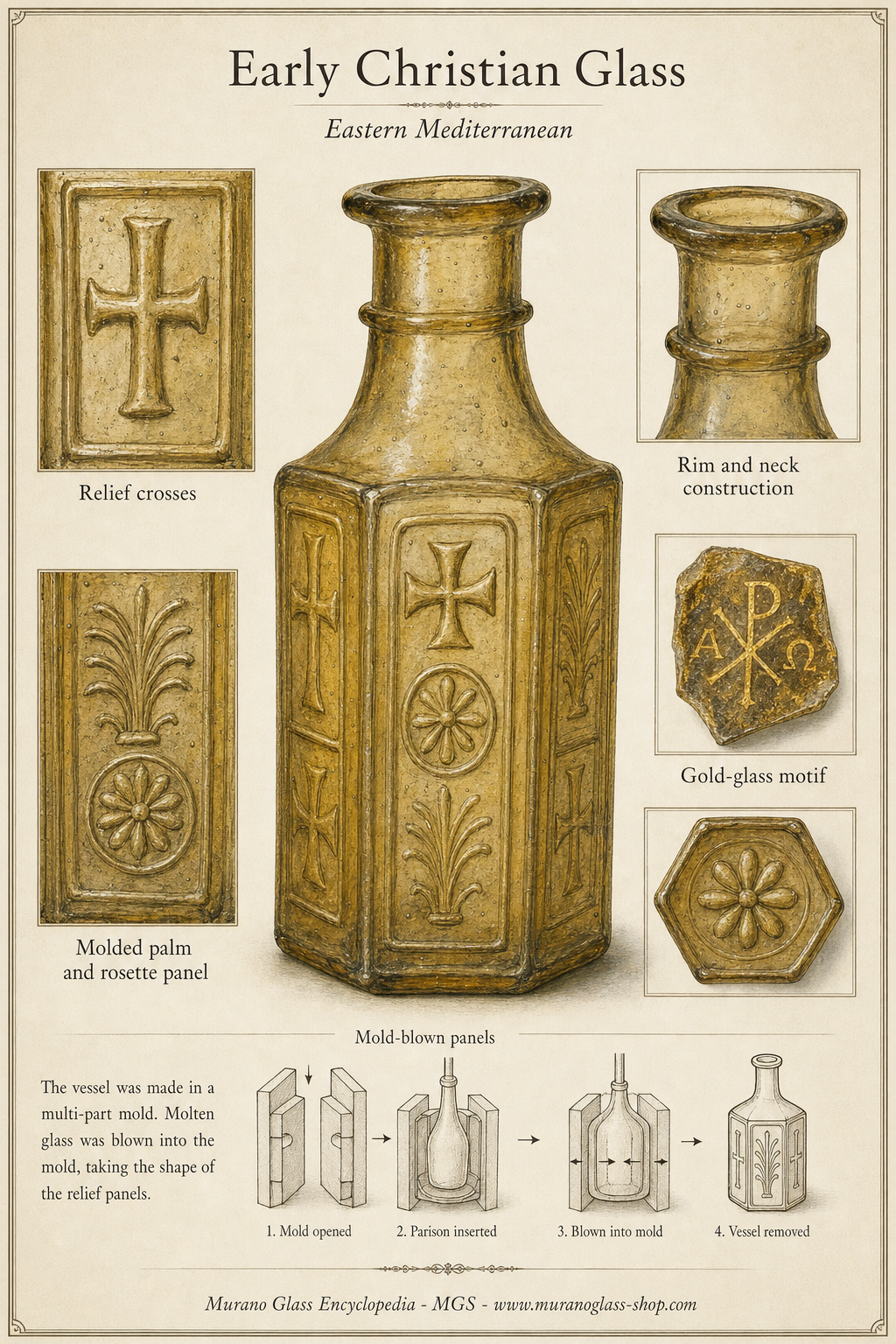
The repertoire includes round, square and polygonal bottles, as well as vessels decorated with relief panels or engraved signs. A type associated with Syrian production is the amber-coloured square or hexagonal bottle whose sides are arranged as alternating panels. These panels may show forms of the cross, stylised sunflowers and palm motifs. The palm, already familiar in classical and Near Eastern ornament, was readily adapted to Christian visual language because of its associations with victory and paradise.
Crosses occur in different forms. The Latin cross is common in later Christian art, while equal-armed or flared crosses can be described according to their shape, sometimes with modern labels such as Maltese cross. Such terminology must be used carefully, since the medieval and modern names of cross types do not necessarily reflect how late Roman makers or users understood them.
Some vessels were engraved rather than moulded. A recorded example is a greenish round bottle decorated with two crosses and an inscription. Inscriptions on ancient glass can be devotional, commemorative or owner-related; their interpretation depends on legibility, archaeological context and comparison with securely dated objects.
Techniques
Blown and mould-blown vessels
Many late Roman glass containers were made by free-blowing or by blowing into a mould. Mould-blown bottles allowed repeated relief decoration: the hot gather of glass was inflated inside a mould whose interior carried the negative of the design. Once opened or removed, the vessel retained raised panels, borders and symbols. This explains the regular arrangement found on some Syrian square or hexagonal bottles.
Engraving and abrasion
Engraved decoration was added after cooling. Craftsmen cut or abraded the surface with rotating wheels, points or abrasive materials, producing linear designs such as crosses, monograms or inscriptions. On pale green or naturally tinted glass, shallow engraving can appear subtle, depending on the thickness of the vessel and the angle of light.
Gold glass
Roman gold glass is a separate but related field. The technique generally involves a design made in gold leaf placed between layers of glass, often in the base of a vessel or medallion. Christian subjects, portraits and inscriptions are well documented in late Roman gold glass, especially in the third and fourth centuries. Earlier Roman luxury glass used gold decoration, but the specifically Christian iconography belongs to the later antique context.
Materials
Roman and eastern Mediterranean glass was usually soda-lime-silica glass. Silica supplied the glass network, soda acted as a flux that lowered the melting temperature, and lime helped stabilise the material. Natural iron impurities often produced greenish tones, while amber hues could result from the chemistry of iron and sulphur under particular furnace conditions. Colour should not be read as a religious code unless supported by context.
Relationship with Murano glass
Early Christian glass was not Murano glass. The celebrated Venetian island became a specialised glassmaking centre many centuries later, especially after the concentration of Venetian furnaces on Murano in the late Middle Ages. The relationship is historical rather than direct: Venetian and Murano glassmaking inherited a broader Mediterranean technical tradition that included Roman and Byzantine knowledge of furnace practice, blowing, colouring and luxury surface effects. Early Christian vessels therefore form part of the distant background against which later Venetian glass culture developed.
Influence and legacy
These objects are important because they show how Christian visual identity moved beyond wall painting, sarcophagi and manuscripts into everyday or portable materials. A bottle with crosses or a gold-glass medallion with biblical imagery demonstrates the adaptation of Roman luxury and household arts to new devotional meanings.
For historians of glass, Early Christian examples also document continuity: older Roman techniques remained in use while their imagery changed. For historians of Christianity, they provide material evidence for the spread of symbols such as the cross and for the use of inscriptions in personal and communal religious expression.
Historical documented curiosities
- The term Maltese cross is modern when applied to late antique glass; it describes a visual shape rather than a proven medieval association.
- Gold-glass medallions are often preserved because vessel bases were cut down and reused or deposited in funerary contexts, especially around Rome.
- Relief panels on mould-blown bottles could combine Christian signs with vegetal motifs, showing that religious and decorative languages were not sharply separated.
FAQ
What is Early Christian glass?
It is glass decorated with Christian symbols, inscriptions or New Testament imagery, mainly from the late Roman and early Byzantine periods.
Where was it produced?
Important examples are associated with the eastern Mediterranean, especially Syria, and with Roman workshops in various imperial provinces.
Was Early Christian glass made in Murano?
No. Murano became a major glass centre centuries later. The connection is only through the wider Mediterranean heritage of glassmaking.
Which techniques were used?
Common methods included mould-blowing, engraving and, for some Roman luxury objects, gold-glass decoration with gold leaf between glass layers.