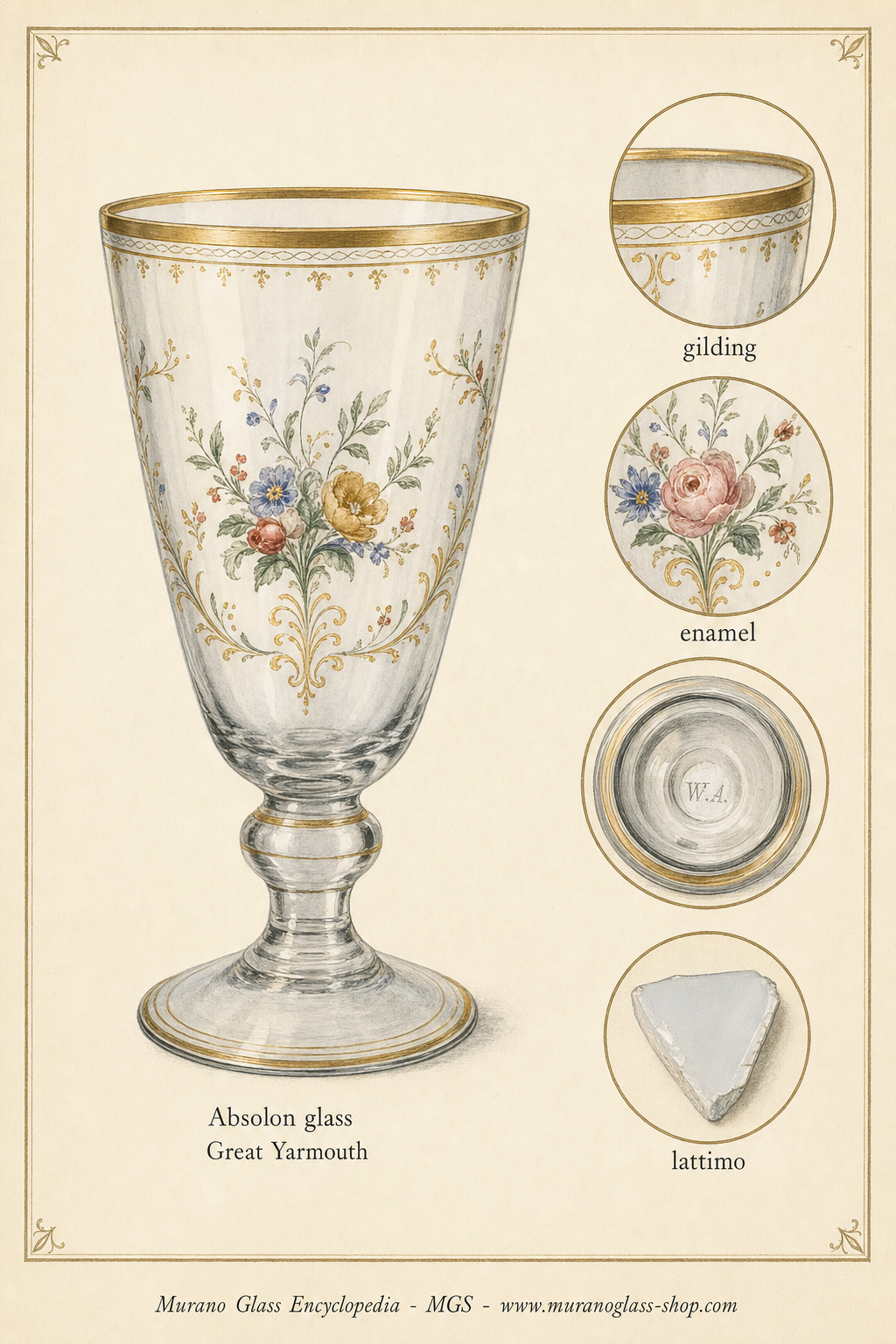
Absolon glass is the name given to late eighteenth- and early nineteenth-century glassware believed to have been enamelled and gilded by William Absolon, an independent decorator working in Great Yarmouth, England.
Definition
The term Absolon glass refers not to a known glasshouse production line but to glass objects associated with the decorative work of William Absolon of Great Yarmouth. The pieces are generally understood as decorated wares: pre-existing glass vessels, often clear, coloured, or opaque white, received enamel and gold ornament after manufacture.
Historical context
The dating usually given to these objects falls between the end of the eighteenth century and the beginning of the nineteenth. This was a period in which decorated drinking and serving glasses circulated widely in Britain, and seaside towns could sustain a market for small commemorative or gift objects. The inscription A Trifle from Yarmouth, found on some examples, places part of the production within the culture of keepsakes and travel souvenirs.
Biography
William Absolon is identified as an English gilder and enameller based in Great Yarmouth. The available information describes him as an independent decorator rather than as the operator of a glass furnace. For this reason, attributions concern the surface decoration more than the making of the glass body itself.
Objects and forms
Recorded forms include cream jugs, cups, mugs, drinking glasses and rummers. A rummer is a large drinking glass, common in Britain during the period, with a capacious bowl suited to punch, wine or mixed drinks. The range of forms suggests domestic and sociable use rather than monumental or architectural glass.
Materials
The decorated substrates include colourless glass, coloured glass and opaque white glass often described by the Italian term lattimo. In glass history, lattimo denotes a white, milk-like opaque glass associated originally with Venetian and Murano practice; similar opaque white glasses were also made or used elsewhere in Europe. In the Absolon context, the term identifies the visual character of the glass, not evidence of Venetian manufacture.
Techniques
The decoration combines enamel colours and gilding. Enamelling on glass uses finely ground vitreous colours mixed with a medium and applied to the surface; the object is then fired at a temperature sufficient to fuse the enamel without deforming the vessel. Gilding applies gold decoration, often fixed by heat or by a binding medium depending on the technique. References to incised or engraved effects indicate that some ornament or inscriptions may have been cut, scratched or otherwise worked into the decorative surface, but individual pieces require direct examination to identify the exact method.
Marks and inscriptions
Some objects carry inscriptions, initials or signatures. Known identifying features include the phrase A Trifle from Yarmouth, the initials W.A., and, on certain pieces, the name Absolon beneath the foot. Such marks are important for attribution, but they do not automatically prove that every similar decorated glass was made by the same hand.
Artistic style
The significance of Absolon glass lies in its combination of everyday forms with personalized surface ornament. The use of gold, enamel and inscriptions transformed ordinary vessels into gifts, souvenirs or commemorative objects. Its appeal is therefore both decorative and documentary: the glass records a local place, a maker’s identity and the taste for small personalised objects in Georgian Britain.
Relationship with Murano glass
No direct historical relationship between William Absolon and Murano production is documented in the available facts. The relevant connection is terminological and technical: lattimo is a word strongly associated with Venetian opaque white glass. Absolon glass may include opaque white vessels described as lattimo, but this should not be read as proof of Murano origin unless supported by separate evidence.
Legacy
Absolon glass is valued by historians and collectors because it links decorative technique, local identity and early souvenir culture. Its attribution depends on close study of form, inscriptions, gilding, enamel handling and, where present, marks under the foot.
FAQ
Who was William Absolon?
William Absolon was an English gilder and enameller associated with Great Yarmouth, active around the late eighteenth and early nineteenth centuries.
What kinds of glass did he decorate?
Objects associated with him include cream jugs, cups, mugs, drinking glasses and rummers in clear, coloured or opaque white glass.
Are Absolon glasses Murano glass?
There is no documented direct link with Murano. The word lattimo may describe opaque white glass, a type historically associated with Venice, but it does not by itself prove Murano manufacture.
How can an Absolon piece be identified?
Some examples bear inscriptions such as A Trifle from Yarmouth, the initials W.A., or the name Absolon under the foot. Attribution still requires expert examination.