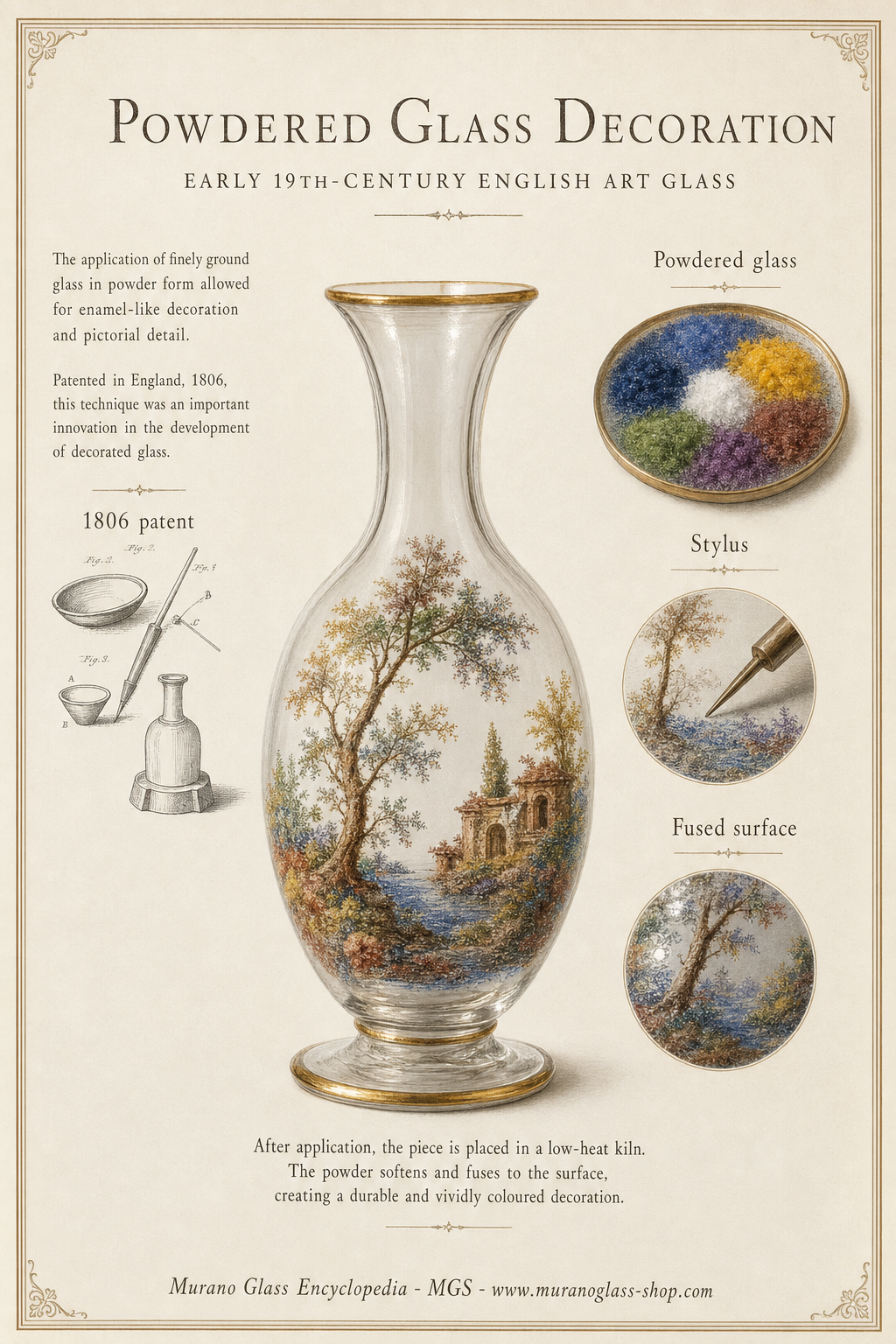
Powdered glass decoration is an early nineteenth-century method of ornamenting art glass by applying coloured vitreous powder to the surface and fixing it by heat. It is chiefly associated with John Davenport’s 1806 patent at Longport, Stoke-on-Trent.
Definition
Powdered glass decoration is a surface technique in which finely ground coloured glass is laid onto a glass object, shaped into a design, and then fused sufficiently to adhere to the surface. The result belongs to the family of fired vitreous decoration, but it is not engraving, wheel cutting, or acid etching: no design is made by removing glass from the body of the vessel.
Historical context
The process is documented in connection with a patent obtained in 1806 by John Davenport of Longport, in the Stoke-on-Trent area of England. Longport lay within the Staffordshire ceramic and glassmaking environment, where experimentation with materials, transfer decoration, enamels and fired surfaces was part of a broader industrial culture.
Objects made by this process are commonly discussed under the name Davenport’s Patent glass. The surviving description of the method compares it with engraving or etching, but that comparison should be understood as an analogy for drawing a design rather than as a precise technical classification.
Technique
The essential stages are clear: a paste containing powdered glass is spread over the surface of the object; a pointed tool is used to articulate or clear the design; the piece is then reheated so that a shallow fusion secures the powdered decoration to the glass.
The heat treatment had to be controlled. If the temperature was too low, the powder would not bind securely; if it was too high, the decoration could lose definition or the object itself could deform. The effect depends on the compatibility between the applied glass powder and the glass substrate, especially in thermal expansion and melting behaviour.
Visual characteristics
The technique allowed coloured motifs to sit on the surface with a fired, vitreous character. Documented subjects include heraldic devices and sporting scenes, both well suited to personalised or commemorative glass. Because the design is built from coloured glass particles rather than cut into the wall of the vessel, the visual effect differs from the crisp incised line of engraving and from the frosted relief produced by acid etching.
Relationship with related techniques
- Engraving: removes material mechanically with a wheel, point or abrasive tool.
- Acid etching: chemically attacks exposed glass areas to create matte or recessed decoration.
- Enamelling: uses vitreous colours fired onto glass; powdered glass decoration is related in its reliance on heat-fixed glassy material, but its documented Davenport process centres on a powder-containing paste worked with a point.
- Murano glass techniques: there is no documented Murano origin for Davenport’s patent process. It may be compared only in broad material terms with Venetian uses of coloured glass, murrine, enamels and aventurine, all of which show how glassmakers exploited coloured vitreous matter in different ways.
Legacy
Powdered glass decoration remains a specialised historical technique rather than a mainstream category of glass production. Its importance lies in the evidence it provides for early nineteenth-century experimentation with fired surface ornament, especially in England. For collectors and historians, the term is most useful when it identifies objects linked to Davenport’s patent and to designs produced by fused coloured powder rather than by cutting or chemical etching.
Historical documented curiosities
The patent’s reference to processes resembling engraving or etching has sometimes caused confusion. Technically, however, the decorated image is added to the surface and fused, while engraving and etching remove or alter the original glass surface. This distinction is essential when cataloguing such objects.
FAQ
Is powdered glass decoration the same as engraving?
No. Engraving cuts or abrades the glass. Powdered glass decoration adds coloured glass powder to the surface and fixes it by firing.
Who patented the process?
The documented patent was obtained in 1806 by John Davenport of Longport, Stoke-on-Trent, England.
What subjects were used?
Recorded subjects include coats of arms and sporting scenes.
Is it a Murano technique?
No Murano origin is documented for the Davenport patent process. It can be compared with Venetian coloured-glass practices only at a general technical level.