Kuan liao is a historical collecting term associated with Chinese glass made for, or in relation to, the imperial court. It is especially relevant to Qing-period court production, where opaque monochromes, carved overlay glass and enamel-decorated opaque white glass were developed for elite use.
Definition and scope
The expression kuan liao, often understood in the context of Chinese court glass, refers to glassware connected with imperial manufacture or commission. The term is encountered in discussions of objects made for the Chinese imperial environment rather than for ordinary commercial circulation.
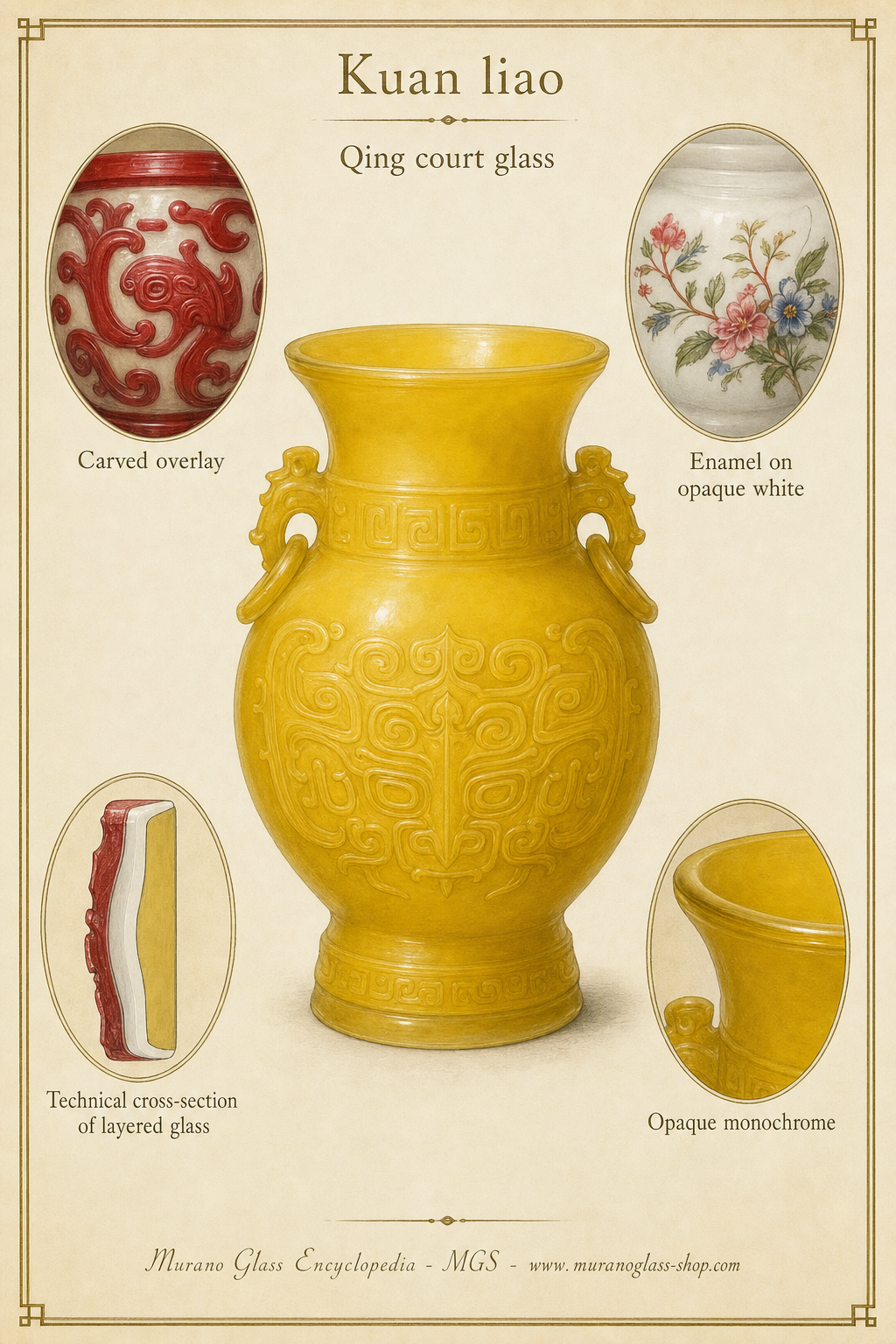
The category is not defined by a single shape or formula. It includes several technical families: opaque monochrome glass, glass made in contrasting layers and then carved, and opaque white glass painted with translucent enamel colours.
Historical context
Chinese glass has a long history, but the best-known imperial court glass belongs to the Qing dynasty, especially from the late seventeenth century onward. In 1696, during the reign of the Kangxi emperor, an imperial glass workshop was established in Beijing within the wider system of court workshops. European Jesuit expertise, including that of Kilian Stumpf, is frequently associated with the early technical development of this workshop.
Court glass served an elite visual culture that also valued porcelain, lacquer, hardstone carving, enamel and metalwork. Its colours and surfaces were selected for ceremonial, decorative and connoisseurial purposes. Yellow opaque glass, for example, had a particular resonance because yellow was closely associated with imperial authority in Qing court culture.
Techniques
Opaque monochrome glass
Imperial Chinese glassmakers produced vessels and small objects in dense, even colours. Opaque yellow is among the most emblematic examples, but other colours were also used. The visual effect depends on controlled colouring agents and opacifiers dispersed through a silicate glass body.
Overlay and carved glass
Overlay glass was made by placing one layer of coloured glass over another. The upper layer could then be carved or cut away to reveal the contrasting ground below. This technique allowed motifs to appear in relief, comparable in visual logic to cameo carving, while remaining a glassmaking practice with its own material constraints.
Opaque white glass and enamel decoration
Opaque white glass, often compared with European lattimo, provided a light ground for painted decoration. Translucent enamels could be applied and fired to create coloured designs on the surface. This method linked glass to the broader Qing interest in enamelled objects, including painted enamel on metal and enamelled porcelain.
Artistic characteristics
Kuan liao glass is often valued for disciplined colour, polished surfaces and controlled contrast rather than for transparency alone. Monochrome pieces emphasize purity of tone and silhouette. Overlay examples favour crisp carving, auspicious imagery and the interplay between raised design and ground colour. Enamelled opaque glass permits a more pictorial surface, suitable for flowers, symbolic motifs and courtly ornament.
Relationship with Murano glass
The connection with Murano should be treated with precision. Venetian glassmakers had produced lattimo, an opaque white glass developed in the Renaissance to evoke the whiteness of porcelain. Chinese imperial glass could also use opaque white grounds, and European technical knowledge reached the Qing court through diplomatic, missionary and commercial channels. However, this does not mean that every Chinese opaque white object was made by Venetian craftsmen or copied directly from Murano models. The Qing court adapted foreign techniques within its own artistic system.
Influence and legacy
Imperial Chinese glass influenced later collecting categories, especially in the field of snuff bottles, small vessels and scholar’s objects. Qing overlay glass became a reference point for later Chinese glass carving, while monochrome opaque glass remains important for understanding how the court translated colour symbolism into glass.
Historical documented curiosities
- The Kangxi-era court glasshouse is one of the key institutions in the history of Chinese imperial glass.
- Jesuit participation at the Qing court helped introduce and refine certain European glass technologies in Beijing.
- Yellow glass is often discussed in relation to imperial colour symbolism, although individual objects still require careful dating and provenance study.
FAQ
What does kuan liao mean in glass history?
It is used for Chinese glass associated with imperial court production or commission, especially in discussions of Qing-period glass.
Which techniques are typical of kuan liao glass?
Typical examples include opaque monochrome glass, overlay glass carved through layers, and opaque white glass decorated with fired translucent enamels.
Is kuan liao the same as Murano glass?
No. Some technical comparisons are possible, especially with opaque white lattimo, but Chinese imperial glass developed within the Qing court workshop system and its own artistic conventions.
Why is yellow glass important?
Yellow had strong imperial associations in Qing court culture, making opaque yellow glass particularly meaningful in the context of court production.