

The Krautstrunk is a late medieval and early Renaissance type of German prunted beaker, closely related to the Nuppenbecher and historically important as a forerunner of the Römer wine glass.
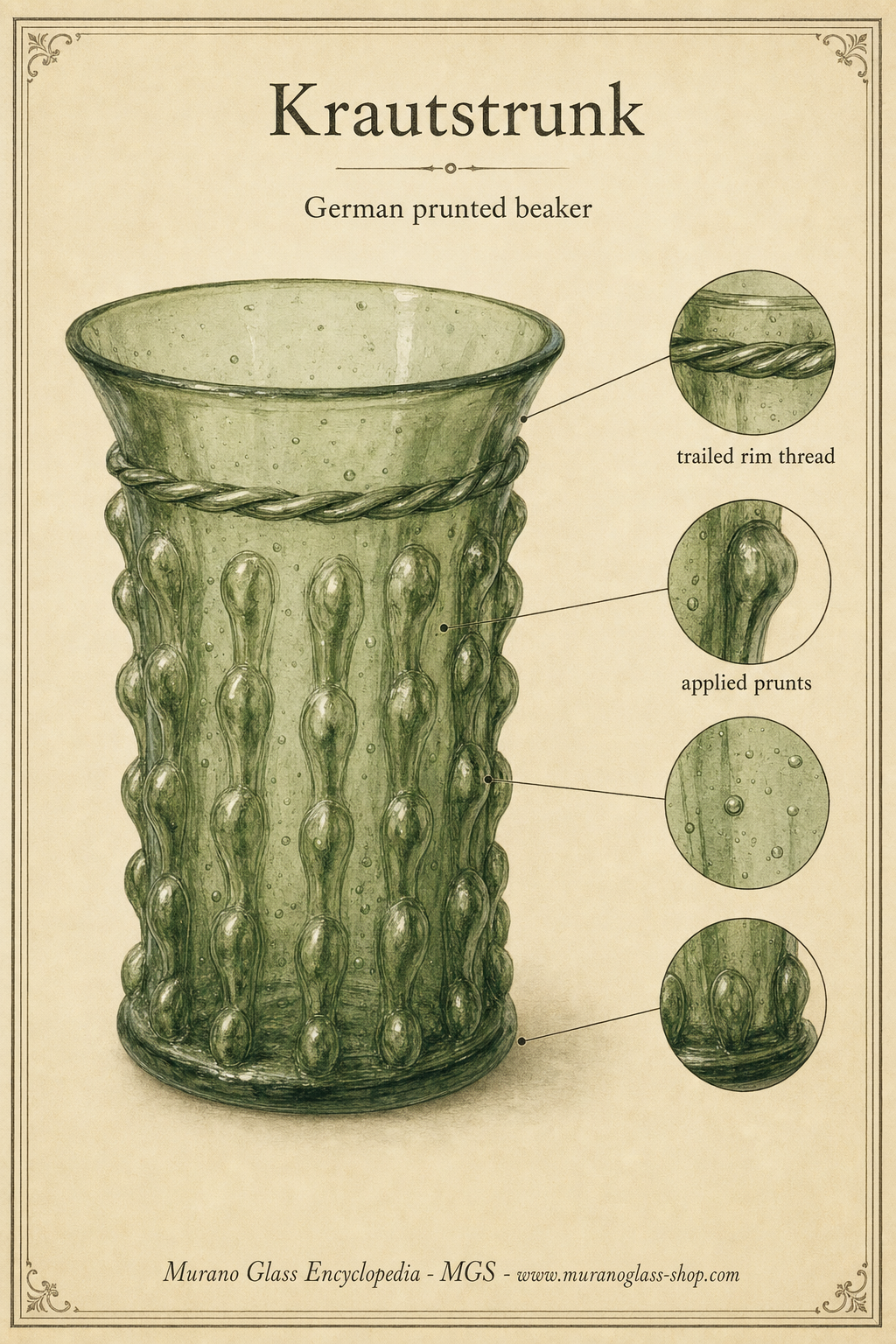
Definition
A Krautstrunk is a form of Nuppenbecher, or prunted beaker, whose surface is covered with applied glass knobs and whose upper section opens outward in a cup-like mouth. The name is German and literally means cabbage stalk, a reference to the thick, irregular, organic appearance produced by the prunts on the body.
The form is distinguished by a flaring rim set above an encircling applied glass thread. This horizontal trail visually separates the mouth from the lower body and is one of the identifying features of the type.
Historical context
The Krautstrunk belongs to the glass culture of German-speaking and Central European regions in the late Middle Ages and early Renaissance, especially the period in which forest glass, or Waldglas, was widely used for drinking vessels. These beakers were made for wine and other table use and are now studied as part of the development of European stemware and decorated utilitarian glass.
It stands between earlier medieval beakers and the later Römer. The Römer, famous in northern European wine service, retained the taste for applied prunts but developed a more articulated stem and bowl. For this reason the Krautstrunk is commonly described as one of the direct predecessors of the Römer family.
Materials and glassmaking
Most comparable Central European prunted beakers were made from potash-lime-silica glass. In this type of glass, silica is the network-forming material, potash-rich plant ash acts as a flux that lowers the melting temperature, and lime contributes chemical stability. The resulting glass often has a greenish, yellow-green or olive tone because of iron impurities in the raw materials.
The vessel would be shaped hot at the furnace. The prunts were applied separately as small gathers of molten glass, pressed or pinched onto the wall. Their tactile function was not merely ornamental: on a smooth drinking vessel, raised knobs could improve grip, especially when hands were greasy or the vessel was wet. The encircling thread below the flared mouth was also applied while hot and could help define the profile of the rim zone.
Artistic style
The visual character of the Krautstrunk is robust rather than refined in the Venetian sense. Its appeal lies in weight, texture and sparkle: the uneven prunts catch light and break up the surface, while the flared opening gives the upper silhouette a strong profile. The name cabbage stalk reflects a medieval and early modern habit of describing glass forms through everyday objects rather than through abstract design terminology.
Relationship with Murano glass
The Krautstrunk should not be identified as a Murano type. It is historically associated with German and Central European glass traditions, especially forest glass, whereas Murano became renowned for soda-lime cristallo, thin blown forms, enamelled decoration and later complex decorative techniques. The comparison is useful because it shows two different European ideals: the tactile, prunted northern beaker and the increasingly transparent, light and refined Venetian vessel.
Influence and legacy
The most important legacy of the Krautstrunk is its place in the evolution of the Römer. The later Römer preserved the use of prunts, often on the stem, while the drinking bowl became more clearly differentiated from the base. In museum catalogues and glass studies, the Krautstrunk therefore helps trace how medieval beaker shapes gradually led to early modern wine glasses.
Related forms
- Nuppenbecher: the broader category of beakers decorated with applied prunts.
- Doppelter Krautstrunk: a related named variant cited in glass terminology.
- Römer: the later northern European wine glass that inherited prunted decoration.
- Waldglas: forest glass, the material tradition with which many such vessels are associated.
Historical documented curiosities
The term Krautstrunk is descriptive rather than mythological: it comes from the appearance of the object. This makes it valuable to historians because it preserves a period perception of form and texture. The glass was not named after an inventor, workshop or patron, but after a familiar vegetable stem.
FAQ
What does Krautstrunk mean?
It is a German word meaning cabbage stalk, used for a prunted glass beaker whose surface suggested that form.
Is a Krautstrunk the same as a Römer?
No. The Krautstrunk is earlier and is regarded as a predecessor of the Römer, which developed a more defined stem-and-bowl structure.
What is a Nuppenbecher?
A Nuppenbecher is a beaker decorated with applied glass prunts, or raised knobs, attached to the vessel while hot.
Was the Krautstrunk made in Murano?
It is not a Murano glass type. It belongs to German and Central European glass traditions, although it can be compared with Murano glass to understand different European approaches to vessel design.