

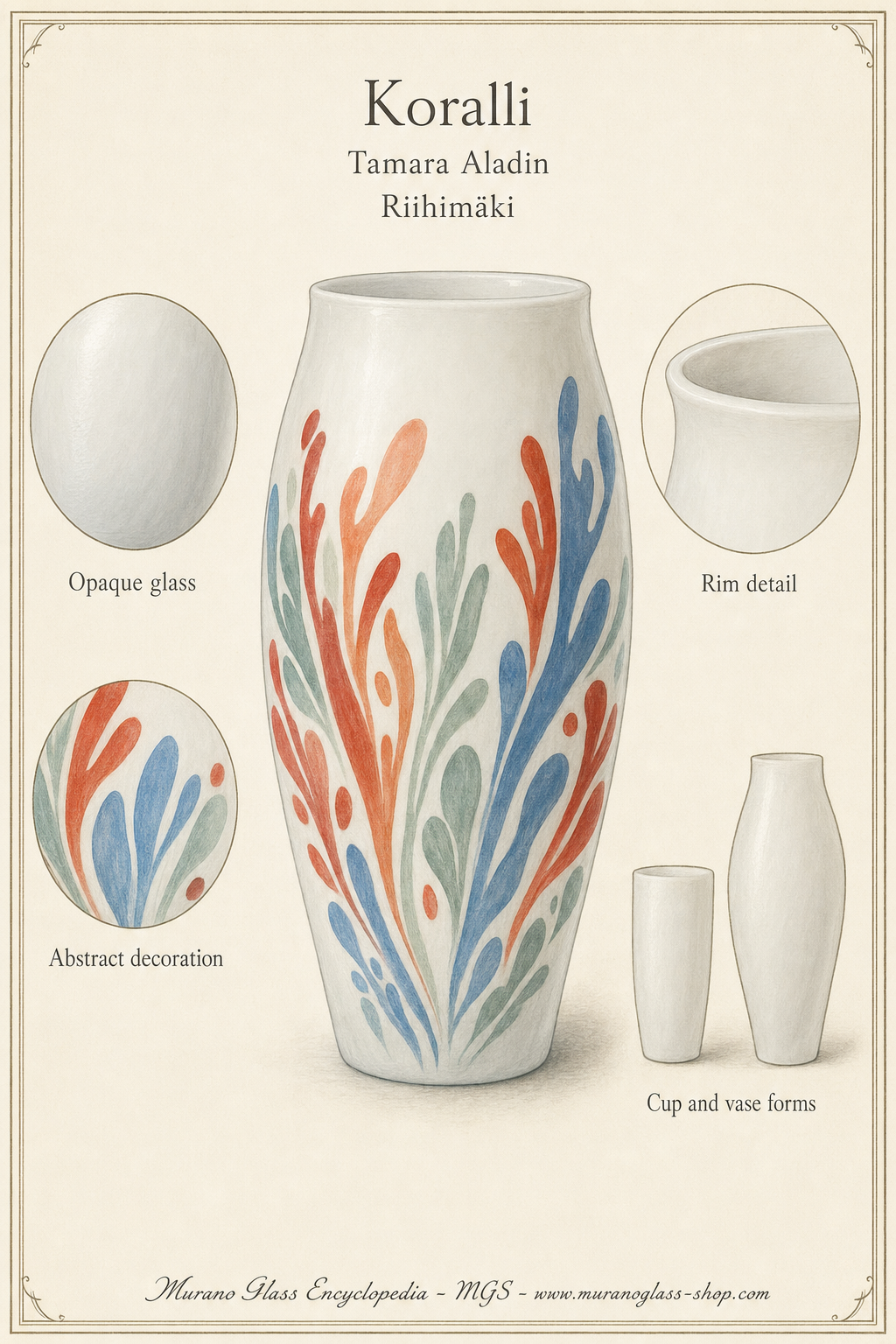
Koralli is a series of opaque glass cups and vases produced by the Finnish glassworks Riihimäki from designs by Tamara Aladin. The group is identified by its non-transparent body and lively abstract colour decoration, placing it within the broader field of post-war Nordic decorative glass.
Definition and attribution
Koralli is documented as a series of cups and vases made by the Finnish glassworks commonly known as Riihimäki or Riihimäen Lasi. The designs are attributed to the Finnish designer Tamara Aladin. The objects are described as being made in opaque glass and decorated with coloured abstract motifs.
The name, meaning “coral” in several Nordic-language contexts and close to the Italian word corallo, is consistent with the visual idea of organic, marine or mineral colour, although the name alone should not be treated as proof of a specific iconographic programme unless supported by catalogues or factory documentation.
Historical context
Riihimäki was one of Finland’s important glassmaking centres in the twentieth century. Finnish glass design became internationally visible after the Second World War through a combination of industrial production, design education, trade fairs and the export reputation of Scandinavian modernism. In that environment, glass was not only a tableware material but also a medium for sculptural forms, colour experiments and serial decorative objects for modern interiors.
Koralli belongs to this climate of design-led production. Rather than being an isolated studio object, it is best understood as a factory-made decorative series in which shape, surface, opacity and colour were coordinated by a named designer for repeat manufacture.
Biography: Tamara Aladin
Tamara Aladin was a Finnish designer associated in particular with glass design for Riihimäki. Her work is usually discussed in relation to the period when Finnish manufacturers developed strong catalogues of modern domestic and decorative glass. Aladin’s designs often attract attention from collectors because they combine accessible serial production with distinctive silhouettes and colour effects.
In the case of Koralli, her role is specifically connected with the design of a series rather than a single unique work. This distinction is important: the historical value of such objects lies partly in the dialogue between artistic authorship and industrial glassmaking.
Artistic style
The most immediately recognisable feature of Koralli is the contrast between an opaque glass ground and coloured abstract decoration. This separates it from fully transparent Scandinavian glass and brings it closer to a decorative language based on surface, pattern and colour rhythm.
The abstract decoration should not be read as figurative unless a specific example clearly shows a representational subject. Its importance lies in the way colour breaks the continuity of the opaque body, giving the vessel an expressive quality even when the form remains functional or vessel-like.
Materials and techniques
The source description identifies Koralli as opaque glass. In glass technology, opacity can be obtained by introducing components or conditions that scatter light within the glass matrix. Historical opaque glasses may involve opacifying agents, controlled crystallisation, or dispersed phases within a soda-lime or related glass composition. Without factory batch records for a specific Koralli object, the exact formulation should not be stated as fact.
The coloured abstract motifs are a defining feature, but the available information does not establish the exact decorating method for every example. Possible historical methods for coloured decoration on glass include enamel painting, applied colour, surface printing, or other factory finishing processes. For Koralli, it is safest to describe the visible result—coloured abstract decoration on opaque glass—unless a specific piece is accompanied by reliable technical documentation.
Forms in the series
The series is recorded as including cups and vases. These categories suggest a range positioned between use and display: cups retain an association with table or interior use, while vases belong more directly to decorative furnishing and floral presentation. In both cases, the opaque body reduces the emphasis on optical transparency and shifts attention to silhouette and ornament.
Relationship with Murano glass
Koralli is a Finnish product, not a Murano work. No direct historical relationship with Murano glass should be inferred from the available information. Nevertheless, the series can be compared cautiously with wider twentieth-century European interests in opaque glass, strong colour and decorative abstraction. Murano furnaces also explored opaque, coloured and patterned glass, but comparison does not imply influence, collaboration or shared manufacture.
Related artists and movements
Koralli is best placed within the broad framework of Nordic modern design rather than within a single avant-garde movement. Its emphasis on serial production, designer attribution and decorative clarity aligns it with the post-war Scandinavian approach to integrating art, industry and domestic life.
Collectors often consider works by Tamara Aladin alongside other Finnish glass designers active for major manufacturers, while maintaining distinctions between individual design languages, factory techniques and production periods.
Collecting and identification
When identifying Koralli, the safest criteria are the combination of form type, opaque glass, coloured abstract decoration, documented association with Riihimäki, and attribution to Tamara Aladin. Because decorative glass series can be confused with later imitations or unrelated opaque glass, reliable identification should rely on catalogues, labels, provenance, or specialist literature where available.
Condition is significant for collecting: surface decoration may be more vulnerable than the glass body, depending on the method of application. Wear, losses to colour, scratches and cleaning damage can affect both visual quality and historical integrity.
Legacy
Koralli illustrates a characteristic strength of twentieth-century Finnish glass: the capacity to combine industrial production with a recognisable designer identity. Its interest lies not in monumental scale but in the way a domestic object can carry colour, abstraction and material experimentation into everyday interiors.
FAQ
What is Koralli?
Koralli is a series of opaque glass cups and vases produced by Riihimäki from designs by Tamara Aladin.
Who designed Koralli?
The series is attributed to the Finnish designer Tamara Aladin.
Is Koralli Murano glass?
No. Koralli is associated with the Finnish glassworks Riihimäki. Any comparison with Murano should be limited to general twentieth-century interests in colour and opaque glass.
What makes Koralli distinctive?
Its defining features are an opaque glass body and coloured abstract decoration.
Can the exact decoration technique be identified?
Not from the available information alone. The visible result can be described, but the precise factory process requires specific documentation.