

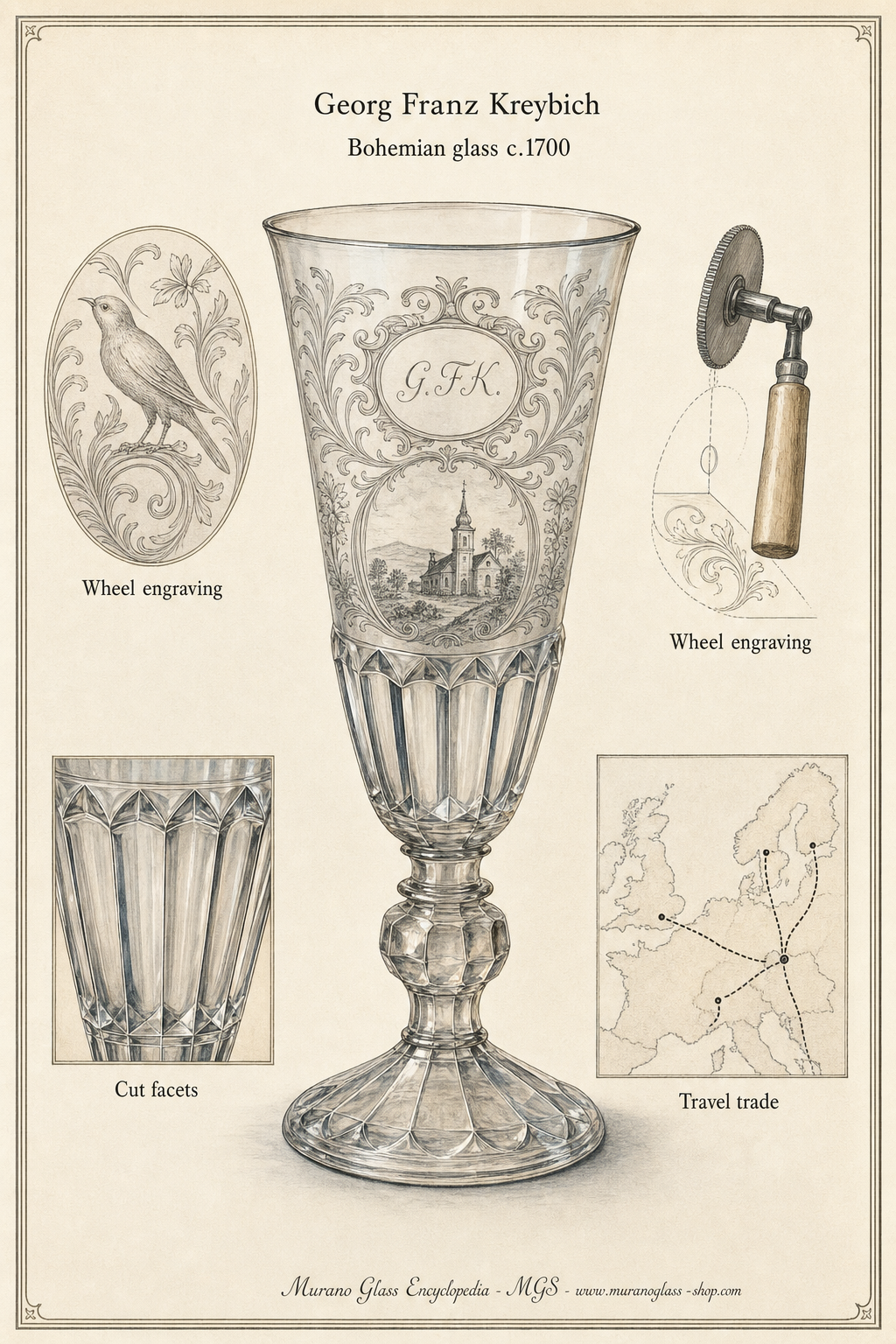
Georg Franz Kreybich was a North Bohemian glass seller from Kamenický Šenov, historically known in German as Steinschönau. Born in 1662, he is documented as an itinerant merchant who travelled widely between 1685 and 1712 to sell Bohemian glass. His importance lies not only in commerce: he also worked as a cutter and engraver, adapting glass objects with decorations and inscriptions requested by customers.
Historical context
Kreybich belonged to the glass world of northern Bohemia, a region that became one of Europe’s most significant centres for glass refining, cutting, engraving and export. Kamenický Šenov, or Steinschönau, was closely associated with the production and finishing of Bohemian glass, especially in a period when Central European workshops were strengthening their commercial networks beyond local markets.
In the late seventeenth and early eighteenth centuries, Bohemian glass was increasingly valued for its suitability for wheel cutting and engraving. Compared with the very thin soda glass associated with Venice and Murano, many Bohemian vessels were made in a harder potash-lime glass tradition. In general terms, such glass used silica as the main network-forming material, alkaline fluxes derived from plant ash or potash to lower the melting temperature, and lime as a stabilising component. The resulting material could support deep, crisp decoration with grinding wheels and engraved designs.
Biography
Georg Franz Kreybich was born in 1662 in Kamenický Šenov in northern Bohemia. He is known as a seller of glass articles who travelled through Europe over a long period. Between 1685 and 1712 he undertook twenty-one journeys connected with the sale of Bohemian glass. The documented progression of his means of travel is telling: he began on foot, later used a chaise or small carriage, and eventually travelled with a larger wagon. This detail reflects the growth of an itinerant commercial activity from modest beginnings toward a more organised trade.
Kreybich also left an autobiographical account of his experiences. For historians of glass, such testimony is valuable because it illuminates the movement of objects, skills and buyers rather than only the activities of workshops. It shows the practical side of early modern glass commerce: travel, direct negotiation, customer requests and the adaptation of goods for different markets.
Techniques and artistic practice
Kreybich was not merely a distributor. He is described as both a glass cutter and an engraver. Cutting normally involved the use of rotating abrasive wheels to shape facets, grooves, borders or ornamental patterns on the surface of a vessel. Engraving, often executed with smaller wheels, allowed finer linear designs, inscriptions, coats of arms, dates or personal dedications.
The ability to add inscriptions and special ornament on request made his work commercially flexible. A glass could be turned into a commemorative object, a gift, a mark of status or a personalised household item. This combination of travelling salesmanship and finishing skill helps explain how Bohemian glass circulated with a degree of customisation unusual for purely anonymous trade goods.
Relationship with Murano glass
No direct connection between Kreybich and Murano is documented in the available information. His career should instead be understood within the Bohemian glass network. Nevertheless, comparison with Murano is historically useful. Murano had long been renowned for refined blown glass and for the prestige of Venetian techniques, while Bohemia became especially prominent for cut and engraved glass. Kreybich’s activity represents the Central European model of mobile trade and personalised surface decoration, rather than the Venetian island workshop tradition.
Influence and legacy
Kreybich’s legacy is mainly documentary and historical. His travels provide evidence of the scale and ambition of Bohemian glass commerce around 1700. The fact that he combined selling with cutting and engraving illustrates the close relationship between craft skill and distribution. He stands as a representative figure of the artisans and merchants who helped make Bohemian glass known across Europe before the rise of later industrial and export structures.
Historical documented curiosities
- He made twenty-one European journeys between 1685 and 1712.
- His business travel evolved from walking to travelling by carriage and then by wagon.
- He recorded his experiences in an autobiographical text.
- He could personalise glass with added inscriptions and decoration for clients.
FAQ
Who was Georg Franz Kreybich?
He was a Bohemian glass seller from Kamenický Šenov, born in 1662, also known as a cutter and engraver.
Why is he important in glass history?
He documents the mobile trade of Bohemian glass in Europe and shows how sales, cutting, engraving and personalisation could be combined.
Did Kreybich work with Murano glass?
No direct link with Murano is documented. His known activity belongs to the North Bohemian glass tradition.
What techniques did he use?
He worked as a cutter and engraver, adding decorative details and inscriptions to glass objects.