Crystal glass is not rock crystal, but a family of high-quality transparent glasses valued for clarity, brilliance and decoration by cutting or engraving. The name has been used for different technical traditions, from Venetian cristallo to English lead glass and Bohemian potash-lime crystal.
Definition and terminology
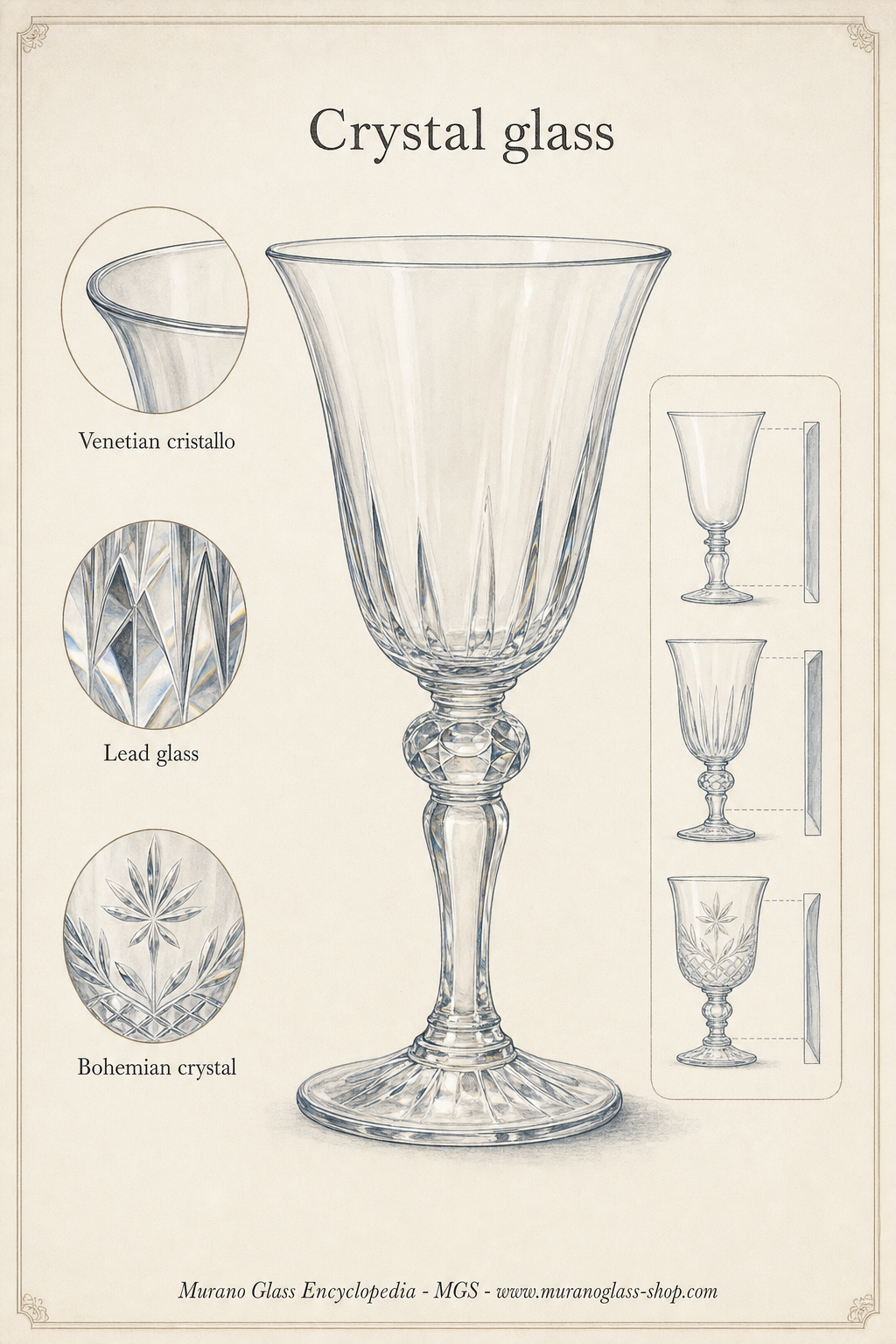
In glassmaking, crystal generally denotes a colourless, transparent glass of high optical quality. Historically the word referred to glass that visually evoked rock crystal, the natural transparent quartz prized in antiquity and the Renaissance. It does not identify a single formula: Venetian cristallo, English lead glass and Bohemian crystal are technically distinct materials.
In modern European commercial usage, the word is regulated. Under European rules on crystal glass labelling, categories depend on composition and measurable properties such as lead oxide content, density and refractive index. Lead crystal must contain at least 24% lead oxide by weight, while higher-grade lead crystal categories may require at least 30% lead oxide together with specified physical values.
Historical context
The prestige of transparent glass grew in Renaissance Europe, when glassmakers sought a material as limpid as rock crystal but easier to form into vessels. Venice, and especially Murano, became a crucial centre for this ambition. The term cristallo was already in use in Venice by the sixteenth century and referred to an exceptionally clear glass, today often described as crystalline glass rather than lead crystal.
In England, a decisive development occurred in the later seventeenth century. George Ravenscroft developed a lead-rich glass known as flint glass in the 1670s; the date 1675 is commonly associated with his successful production of a highly clear glass. Lead oxide gave the material a high refractive index, a notable weight and a sonorous quality, all of which helped shape the later idea of cut crystal.
Bohemia developed another important tradition. Bohemian crystal was typically a hard potash-lime glass, made from silica, potash derived from wood ash and lime as a stabilising component. Its hardness and clarity made it particularly suitable for wheel cutting, engraving and faceted decoration.
Relationship with Murano glass
Murano cristallo should not be confused with lead crystal. Venetian glassmakers produced a refined soda-lime glass, using carefully selected silica and purified alkali sources, with decolourising techniques that reduced greenish or brownish tints caused by iron impurities. The achievement lay in purity, thinness and elegance of blown form rather than in the heavy brilliance associated with later lead glass.
The Murano tradition influenced European luxury glass by establishing transparent glass as an artistic and social ideal. Its cristallo vessels, stemware and delicate blown forms were admired and imitated across Europe, even where local recipes and decorative methods differed substantially.
Materials and technical properties
All common glass is based primarily on silica, which forms the glass network. Fluxes such as soda or potash lower the melting temperature, while stabilisers such as lime improve chemical durability. Crystal traditions differ in the choice and proportion of these components.
- Venetian cristallo: a highly refined soda-lime glass, prized for transparency and lightness.
- English lead glass: a glass in which lead oxide increases density, brilliance and refractive index, and makes cutting visually effective.
- Bohemian crystal: commonly a potash-lime glass, harder than lead glass and well suited to engraved and faceted surfaces.
Lead oxide does not simply make glass more luxurious; it changes its optical and working properties. It increases sparkle by bending light more strongly, raises density, softens the glass relative to hard potash-lime compositions and allows deep cutting to create bright highlights.
Decoration and uses
Crystal glass has long been associated with tableware, goblets, decanters, bowls, candlesticks and chandeliers. Cut decoration uses abrasive wheels or grinding tools to remove glass and create facets, stars, mitres and geometric patterns. Engraving can be shallower and more pictorial, producing coats of arms, floral motifs, inscriptions or figural scenes.
Chandeliers exploit the optical qualities of crystal elements. Pendants, drops and prisms split and reflect light, turning a functional lighting object into an architectural ornament. This use became especially important in courtly and aristocratic interiors from the early modern period onward.
Regulation and labelling
Because the word crystal can imply a particular quality, European legislation restricts its use in commercial descriptions. Products that do not meet the relevant criteria cannot be marketed under protected crystal glass names. Labelling categories help distinguish full lead crystal, lead crystal and other crystal glass types, preventing ordinary transparent glass from being sold under misleading terminology.
Historical documented curiosities
- The name crystal derives its prestige from comparison with rock crystal, although the two materials are chemically different: rock crystal is crystalline quartz, while glass is amorphous.
- Venetian cristallo was admired for its near absence of colour at a time when many glasses retained visible green or smoky tones from impurities.
- Bohemian crystal and English lead crystal achieved brilliance through different routes: one by hardness and cutting precision, the other by optical density and lead content.
FAQ
Is crystal glass the same as rock crystal?
No. Rock crystal is natural quartz, while crystal glass is an artificial amorphous glass made from silica and other ingredients.
Does all crystal contain lead?
No. Venetian cristallo and Bohemian potash-lime crystal are not necessarily lead glass. In modern EU labelling, lead crystal categories require defined lead oxide percentages.
Why is lead crystal so brilliant?
Lead oxide increases refractive index and density, allowing cut facets to reflect and refract light strongly.
How is Murano cristallo different?
Murano cristallo is historically a refined, clear soda-lime glass, celebrated for purity and blown elegance rather than for lead content.