
Crizzling is a form of chemical deterioration affecting certain unstable glasses, notably some Venetian and German crystal wares of the sixteenth and seventeenth centuries. It is linked to glass composition rather than to age alone, and is especially relevant to the history and conservation of cristallo and other refined glass types.
Definition and terminology
In the conservation of glass, the condition often called crizzling is a progressive chemical decay of an unstable glass body. In Italian historical and collecting vocabulary it may be described as cristallizzazione, although the phenomenon is not simply the formation of decorative crystals on the surface. It concerns the glass matrix itself and may ultimately compromise the object structurally.
The term is used most often for clear, highly refined glass whose composition lacks enough stabilizing oxides. It has been observed in some Venetian and German crystal glasses from the sixteenth and seventeenth centuries, and comparable symptoms may also appear in some later Italian and Scandinavian crystal wares made from excessively purified raw materials.
Historical context
Venetian cristallo, developed on Murano from the late medieval and Renaissance glassmaking tradition, was valued for its exceptional transparency, brightness and absence of colour. Achieving this appearance required careful selection and treatment of silica and alkaline fluxes. The same pursuit of clarity, however, could produce a chemically vulnerable glass when the batch was deprived of sufficient stabilizers.
German glass production of the early modern period included potash-rich traditions associated with forest glassmaking as well as more refined clear wares. Some German crystal glasses of the sixteenth and seventeenth centuries show deterioration similar to unstable Venetian examples. The risk was not tied to national origin alone, but to the balance among silica, alkalis and alkaline earth stabilizers.
Materials and chemical causes
Glass is primarily a silicate network. Silica forms the structural framework; alkali materials such as soda or potash act as fluxes, lowering the melting temperature; calcium and magnesium oxides, when present in appropriate amounts, help stabilize the network against moisture and atmospheric attack.
In some Venetian recipes, ash used in the glass batch was purified before being mixed with siliceous material. This refinement helped produce a clearer and more brilliant glass, but it could remove a significant share of calcium and magnesium compounds. If the resulting frit or batch contained too much alkali and too little stabilizer, the finished glass became susceptible to chemical breakdown.
The same principle explains why some modern crystal glasses can show analogous decay. When raw materials are refined to a degree that reduces stabilizing constituents, a visually excellent glass may be less durable over time unless the formulation is corrected by deliberate additions.
Visible symptoms
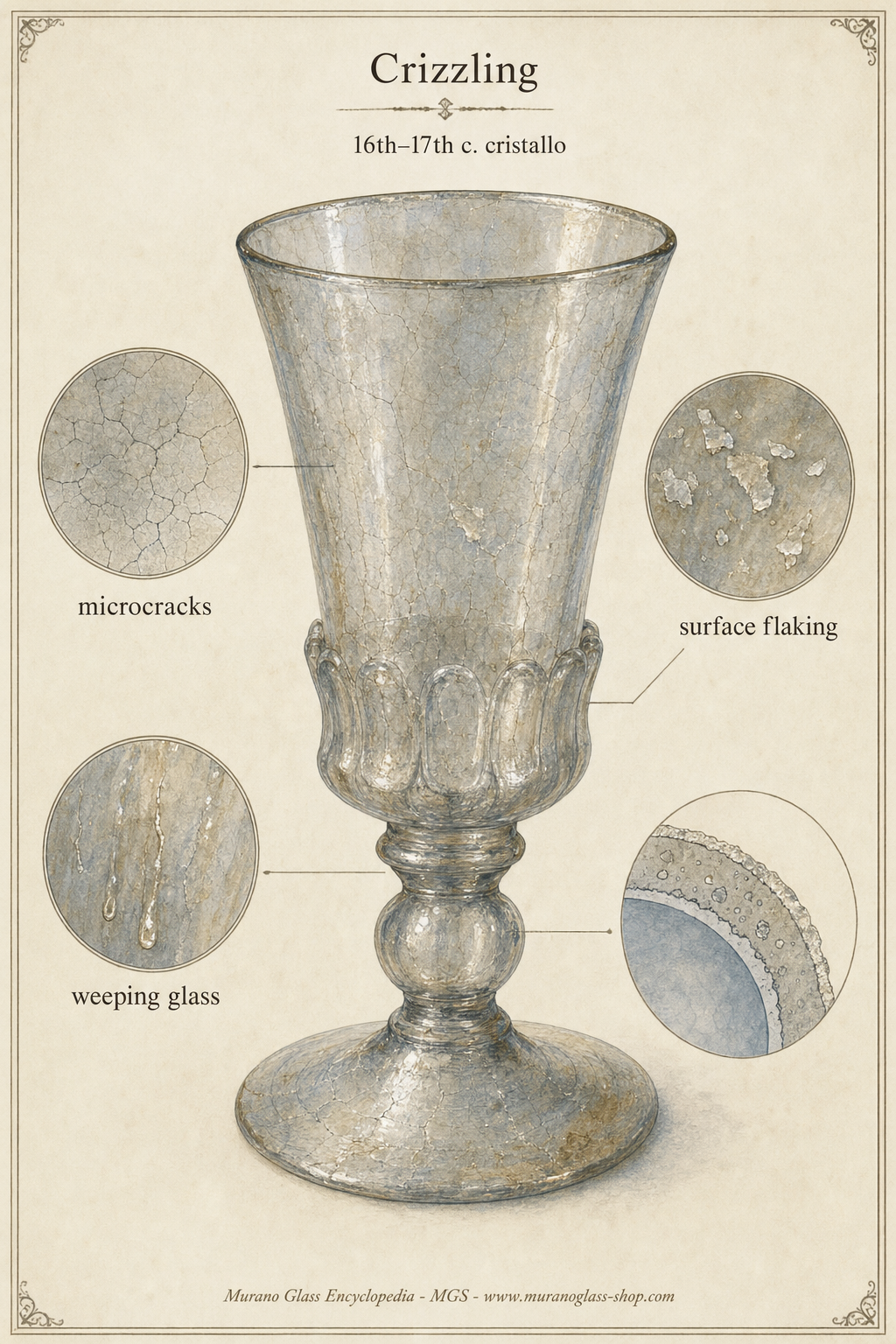
Crizzling often begins subtly. Conservators may first detect a fine network of minute cracks or a slightly hazy surface. As deterioration advances, the surface may flake, shed powdery material, or appear damp because alkali-rich degradation products attract moisture from the air. In advanced cases the glass becomes fragile and may fragment.
- Early stage: fine internal or surface checking, loss of brilliance, faint cloudiness.
- Intermediate stage: surface flaking, powdering and increased sensitivity to handling.
- Advanced stage: weeping, sticky or slippery-feeling deposits, structural weakening and possible crumbling.
Distinction from related phenomena
Crizzling should not be confused with the iridescence often seen on archaeological glass. Burial iridescence is generally a surface alteration caused by layered corrosion products formed in soil conditions, and it can create multicoloured optical effects. Crizzling, by contrast, reflects instability of the glass composition and may extend through the body of the object.
It is also distinct from ordinary mechanical cracking, which results from impact, thermal shock or stress, and from devitrification, a process in which crystalline phases form within or on a glass under particular thermal or compositional conditions. The visual overlap among these conditions makes specialist examination important.
Relationship with Murano glass
The phenomenon has particular importance for Murano studies because Venetian crystal glass was one of the great technical achievements of Renaissance glassmaking. The brilliance of cristallo depended on refined raw materials and skilled furnace practice. Yet the very strategies used to obtain colourless transparency could, in some batches, reduce long-term chemical stability.
This does not mean that all Murano glass is vulnerable. Many Venetian glasses are stable, and deterioration depends on a specific composition, environment and history of storage. The condition is therefore a diagnostic issue for conservators and historians, not a general property of Venetian glass.
Conservation and handling
There is no simple restorative treatment that reverses the chemical instability of crizzled glass. Conservation practice focuses on documentation, environmental control and minimizing stress. Stable relative humidity, avoidance of condensation, careful handling and isolation from unsuitable storage materials are central measures.
Cleaning must be approached with caution. Water can aggravate alkali leaching in unstable glass, and abrasive cleaning may remove weakened surface layers. Museum conservators typically assess each object individually before any intervention.
Historical documented curiosities
The problem illustrates a recurring paradox in glass history: technical refinement aimed at optical perfection may reduce durability if the chemistry is unbalanced. In early modern Venice, purification of ash helped create the admired brilliance of cristallo; in later industrial and studio contexts, similar risks could arise when raw materials were made exceptionally pure without compensating for missing stabilizers.
FAQ
Is crizzling the same as archaeological iridescence?
No. Archaeological iridescence is usually a surface corrosion effect formed during burial, while crizzling is a chemical instability of the glass itself.
Why are some Venetian crystal glasses affected?
Some highly refined Venetian batches contained too little calcium and magnesium relative to alkali content, making the silicate network less resistant to moisture.
Can crizzled glass be cured?
No treatment can reliably restore the original chemistry. Conservation aims to slow deterioration through careful storage, handling and environmental control.
Does crizzling affect all Murano glass?
No. It affects only particular unstable compositions. Many Murano glasses are chemically sound and show no such decay.