

Alvar Aalto (1898–1976) was a Finnish architect and designer whose work in glass helped define the international image of Scandinavian modernism. His best-known glass objects, produced for Iittala, transformed the vase from a symmetrical container into an organic, asymmetrical form.
Historical context
Aalto’s glass design emerged during the 1930s, when Nordic designers were seeking a modern language distinct from both historic ornament and strict machine-age geometry. In Finland, companies such as Iittala played an important role in translating modern design into domestic objects.
The years 1937–1938 are especially significant for Aalto’s association with Iittala. During this period his designs for glass tableware and vessels entered production and became linked with the wider international presentation of Finnish design.
Biography
Hugo Alvar Henrik Aalto was born in 1898 in Kuortane, Finland, and died in 1976 in Helsinki. He is internationally known primarily as an architect, but his practice also included furniture, lighting, interiors and glass. This breadth was central to his idea of design: architecture and objects were not separate disciplines but parts of a coordinated human environment.
Aalto’s architectural work is often associated with modernism tempered by natural materials, human scale and irregular spatial movement. These qualities also appear in his glass objects, where the vessel is conceived less as a static geometric solid than as a fluid outline.
Artistic style
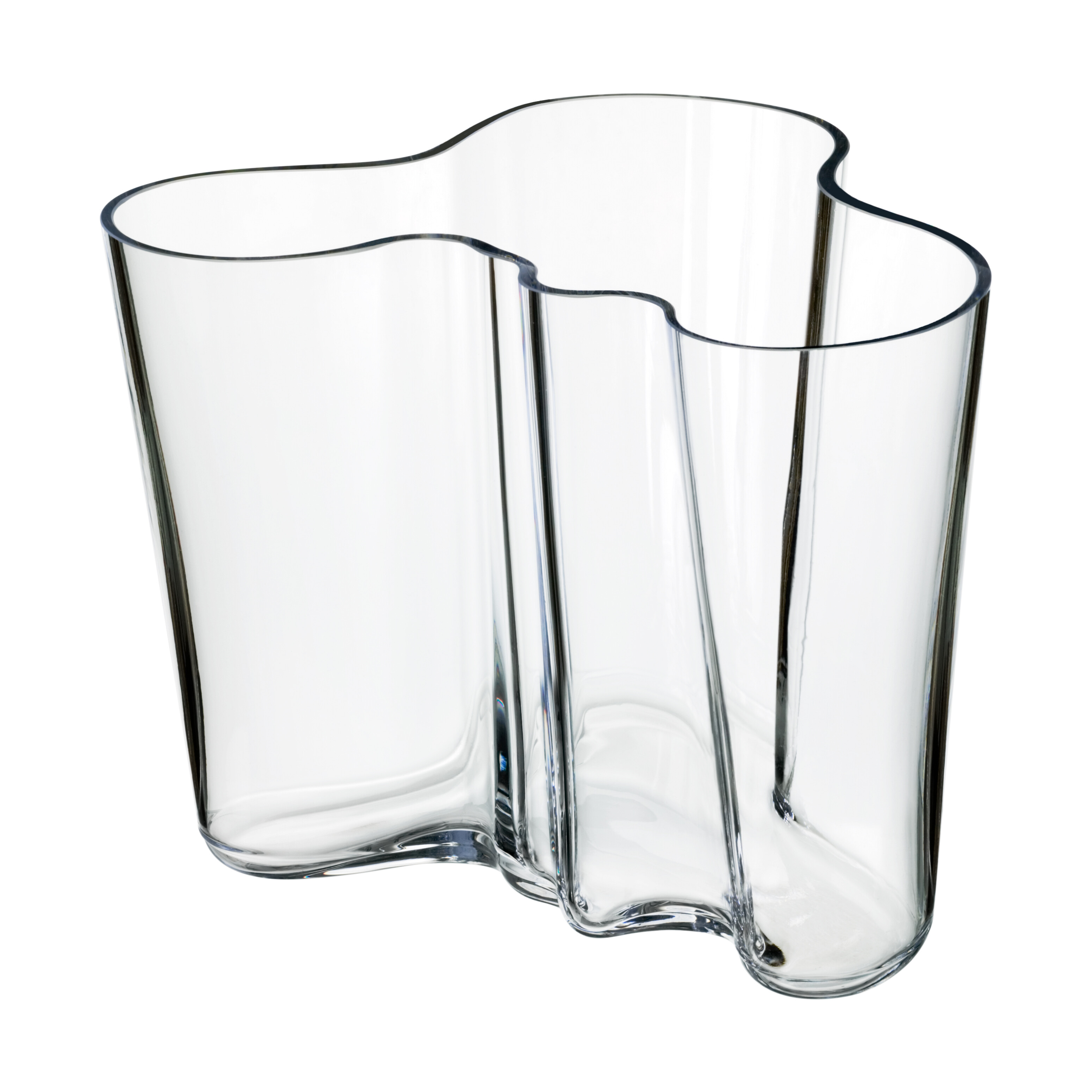
Aalto’s vases are recognized for their undulating contours, asymmetrical footprint and absence of applied decoration. Their visual force comes from the silhouette, the thickness of the glass and the way light is refracted through curved walls. The pale green glass documented among his Iittala works gives the objects a restrained, cool tonality typical of much Nordic design of the period.
The forms have often been read as organic: they suggest shorelines, water, landscape or biological growth without literally representing any of them. This ambiguity was one reason for their success, because the objects could function as practical vessels while also appearing sculptural.
Techniques and materials
Aalto’s glass pieces for Iittala were made in blown glass. Historically, the production of free-form vessels required close control of the hot glass bubble, the mould, the annealing process and the cutting or finishing of the rim. Unlike a simple rotationally symmetrical vase, an asymmetrical object demands that the maker maintain the intended profile while the material is still plastic and responsive to gravity.
The glass itself belongs to the soda-lime family commonly used for tableware and decorative vessels: silica provides the glass network, alkali fluxes lower the melting temperature, and stabilizers such as calcium oxide improve durability. Colour, including pale green, may result from controlled additives or from iron-bearing constituents, depending on the batch and period of manufacture.
Major works
The most famous glass design associated with Aalto is the vase commonly known as the Aalto vase or Savoy vase. It is characterized by a flowing, irregular perimeter and a base that breaks with conventional axial symmetry. Although often treated as a single object, the design belongs to a family of related free-form vessels and dishes produced by Iittala.
Its practical function is flexible: it can serve as a flower vase, a table centrepiece or an autonomous decorative object. This adaptability contributed to its long life in production and to its status as a design classic.
Influence and legacy
Aalto’s glassware helped establish Finnish design as a major presence in twentieth-century decorative arts. The free-form vase became an emblem of organic modernism, a mode of design that retained modernist clarity while avoiding rigid symmetry.
Its influence can be seen in later Scandinavian glass, in post-war discussions of domestic modernity and in museum collections devoted to design history. The object remains important because it demonstrates how an everyday vessel can embody architectural ideas about movement, proportion and the relationship between form and use.
Relationship with Murano glass
There is no documented evidence that Aalto worked within the Murano glass industry or that his Iittala vases were Murano products. The connection is instead comparative. Murano glass, especially in the twentieth century, developed through virtuoso furnace techniques, colour effects and collaborations between designers and glass masters. Aalto’s Finnish glass pursued a different expression: restrained, organic form, minimal decoration and a modern domestic setting.
Both traditions show the importance of collaboration between designer and furnace, but they belong to distinct industrial and cultural contexts: Murano to the Venetian lagoon and its long artisanal lineage; Iittala to Finnish modern design and Nordic glass manufacturing.
Related artists and movements
- Scandinavian modernism: the broader movement that linked functional objects with clarity, material honesty and domestic comfort.
- Organic modernism: a design tendency in which modern forms are softened by natural, flowing or biomorphic outlines.
- Finnish design: the national design culture in which Aalto worked alongside architects and designers concerned with architecture, interiors and everyday objects.
Historically documented curiosities
The Aalto vase is frequently associated with the Savoy restaurant in Helsinki, whose interiors were designed by Alvar Aalto and Aino Aalto. Its later fame has made it one of the best-known glass objects of the twentieth century, often reproduced in design histories as an example of how modernism could be both practical and expressive.
FAQ
Who was Alvar Aalto?
Alvar Aalto was a Finnish architect and designer, born in 1898 and died in 1976, known for architecture, furniture, interiors and glass objects.
What is the Aalto vase?
It is a free-form glass vase produced by Iittala, known for its irregular, undulating outline and asymmetrical base.
Did Aalto design Murano glass?
No documented evidence places Aalto as a designer for Murano furnaces. His famous glass vessels are associated with the Finnish company Iittala.
Why is the vase important?
It changed the visual language of the vase by replacing strict symmetry with an organic modernist outline that is both functional and sculptural.